


As the holidays approach, we at FIRE have been compiling the latest figures from our Students Under Fire database, and what we found isn’t very merry.
The 273 attempts to sanction student speech in 2025 breaks the previous record of 252 set in 2020, and that was a year marked by George Floyd protests, a presidential election, and a global pandemic. Yet 2025 set a new high, culminating in the assassination of conservative activist and Turning Point USA founder Charlie Kirk.
What “chilling effect” really means
We use the term “chilling effect” a lot in First Amendment work to describe when people self-censor because they fear punishment or backlash. It doesn’t require anyone to be punished directly. On college campuses, the mere threat of investigation or discipline is enough, as that can discourage students from speaking freely and silence entire conversations.
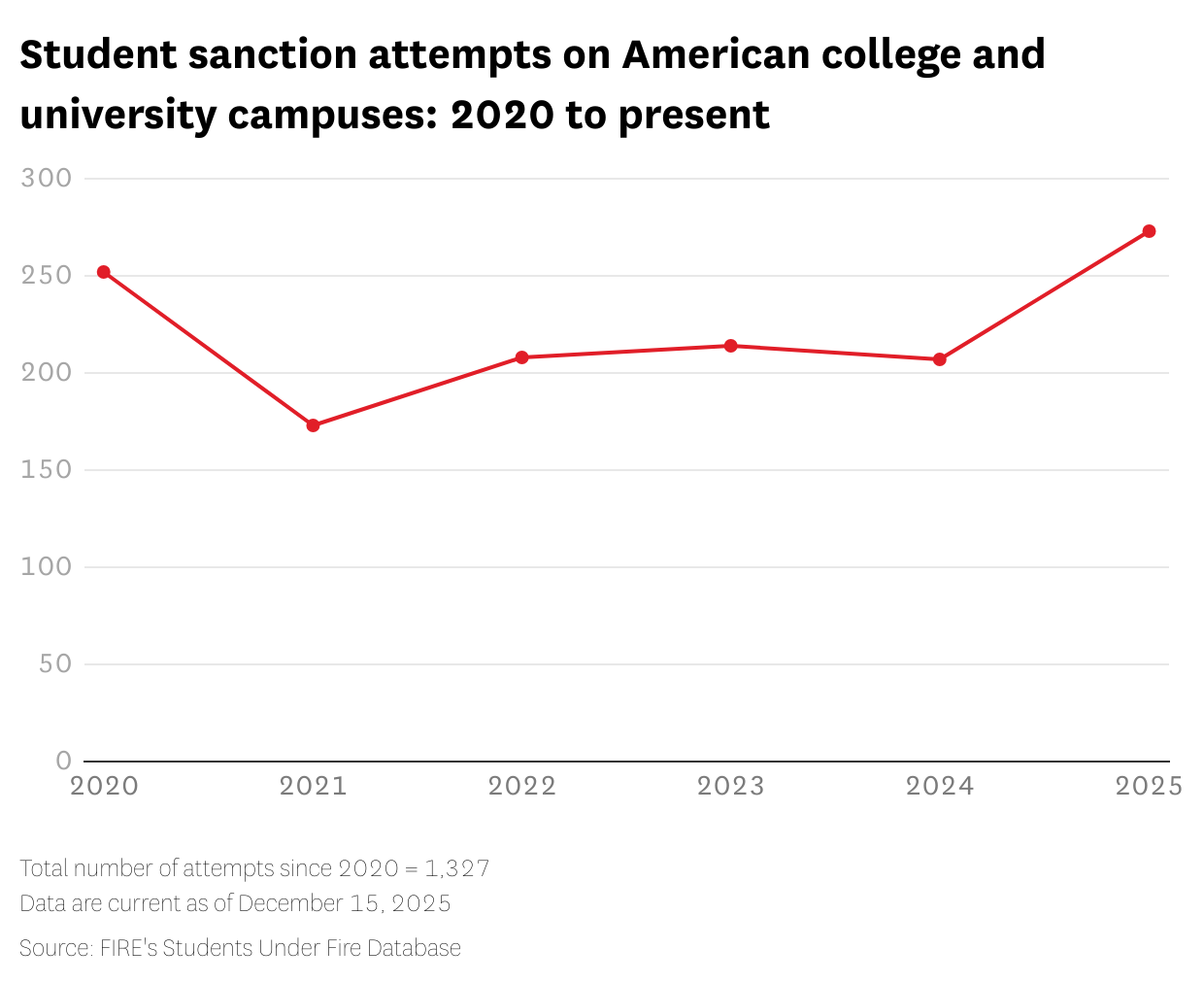
But 2025 brought something colder. Students were retaliated against for their unflattering journalism, investigated for writing op-eds, ordered to rewrite club charters and change the wording on their flyers. They were expelled for controversial social media posts, denied recognition for not aligning with school values, and had their events canceled. In one case, a student was even censored from presenting research at a conference about censorship (yes, really).
What’s causing the chill?
If 2025 stood out for anything, it was the surge in attempts by government officials to influence how universities respond to student speech — particularly after Kirk’s assassination. Some recent examples include:
Indiana’s attorney general urged constituents to pressure Indiana University to terminate a student from their campus job after they posted, “The world just got a little better today” in response to Kirk’s murder.
Rep. Derrick Van Orden announced on X that he introduced legislation to strip federal funding from Oberlin College unless the university expelled a student over their social media activity, which included posting a video in which she said, “I don’t feel bad” about the shooting and “We need to bring back political assassinations.”
Texas Representatives demanded that the University of Texas at Austin investigate and ban a student group and expel its members from the university after the group posted images of an anti-Trump rally to Instagram — including one showing a student holding a piñata of Donald Trump with its head split open.
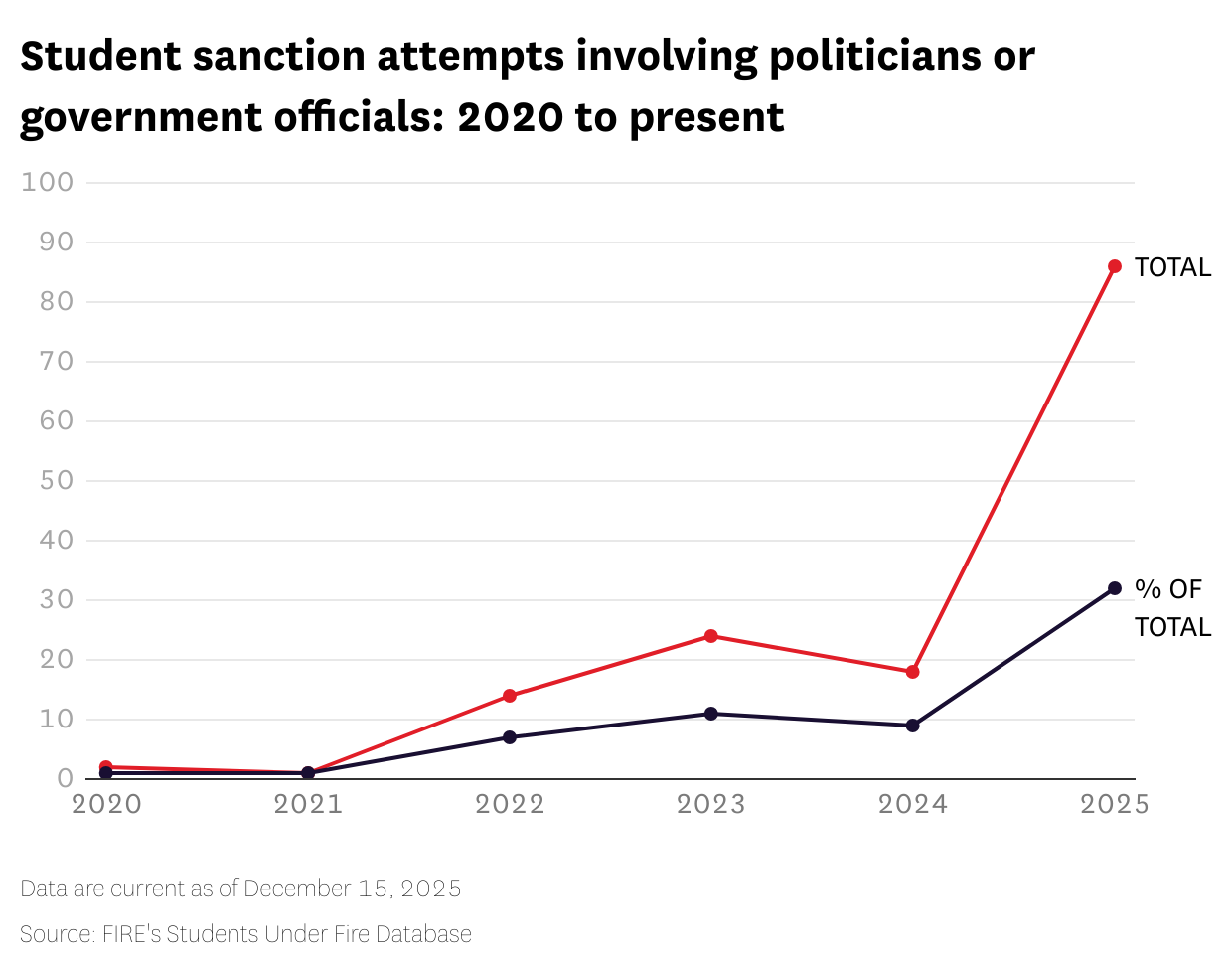
We also saw state and federal executive orders used as justification to impose system-wide bans on student-organized drag shows (Texas A&M, University of North Texas, and University of Texas system-wide bans/pauses resulted in 30 entries between the three of them alone), cancel student film festivals, and outright disband numerous student groups.
In all these cases, students were targeted or punished not because their speech was unlawful — but because it caused controversy.
As we enter 2026, FIRE urges colleges and universities to make a simple New Year’s resolution — protect the rights of your students rather than the comfort of your administrators.

As usual, grateful for your work.
A thought struck me: Many students and faculty have never seen/heard civil discourse between political and philosophical opponents. I am not talking about debates, where the intention is to win the conversation. I am talking about explorations and discoveries of commonalities and differences, and revealing new insights.
My husband is a classical liberal and independent scholar, thoroughly brainwashed (like myself) in the works of the Austrian School of Economics and those related thinkers, in part as they align to what might be called the liberty movement. He is very well-read in economics, philosophy, et al. A few years ago, on a road trip in New England, we stopped off to see an old college boy friend of mine, who, at the time, was chair of the history department of a liberal arts college and a self-identified socialist.
My old beau - I will call him Joe - and I had remained friends, and his wife and I conspired to make the visit a success. We thought the two men might like each other even though superficially they were polar opposites regarding their political and philosophical beliefs. But, if the visit was a disaster, we had already come up with a safe word - giraffe - and I would feign a migraine to facilitate a quick escape. It's what partners do.
That's not what happened. After a few minutes of painfully polite small talk, my husband asked Joe what he was working on. Joe talked, my husband asked intelligent questions. And the floodgates opened. For three hours, the libertarian and the socialist enthusiastically talked. Took notes. Interrupted each other as they agreed, disagreed, asked for clarification. His wife and I sat and took it all in, grinning at each other and shaking our heads as we watched our boys have the best times. The only we regret is we didn't tape their session.
I know this is not your purview, and groups like the Heterodox Academy make this kind of interaction their mission. Just saying we need more. And we need to honor places that host these kinds of conversations, in classrooms, public lectures, etc.