


Americans may not agree on much these days, but a surprising majority across the political spectrum think our colleges and universities have become a breeding ground for left-wing groupthink.
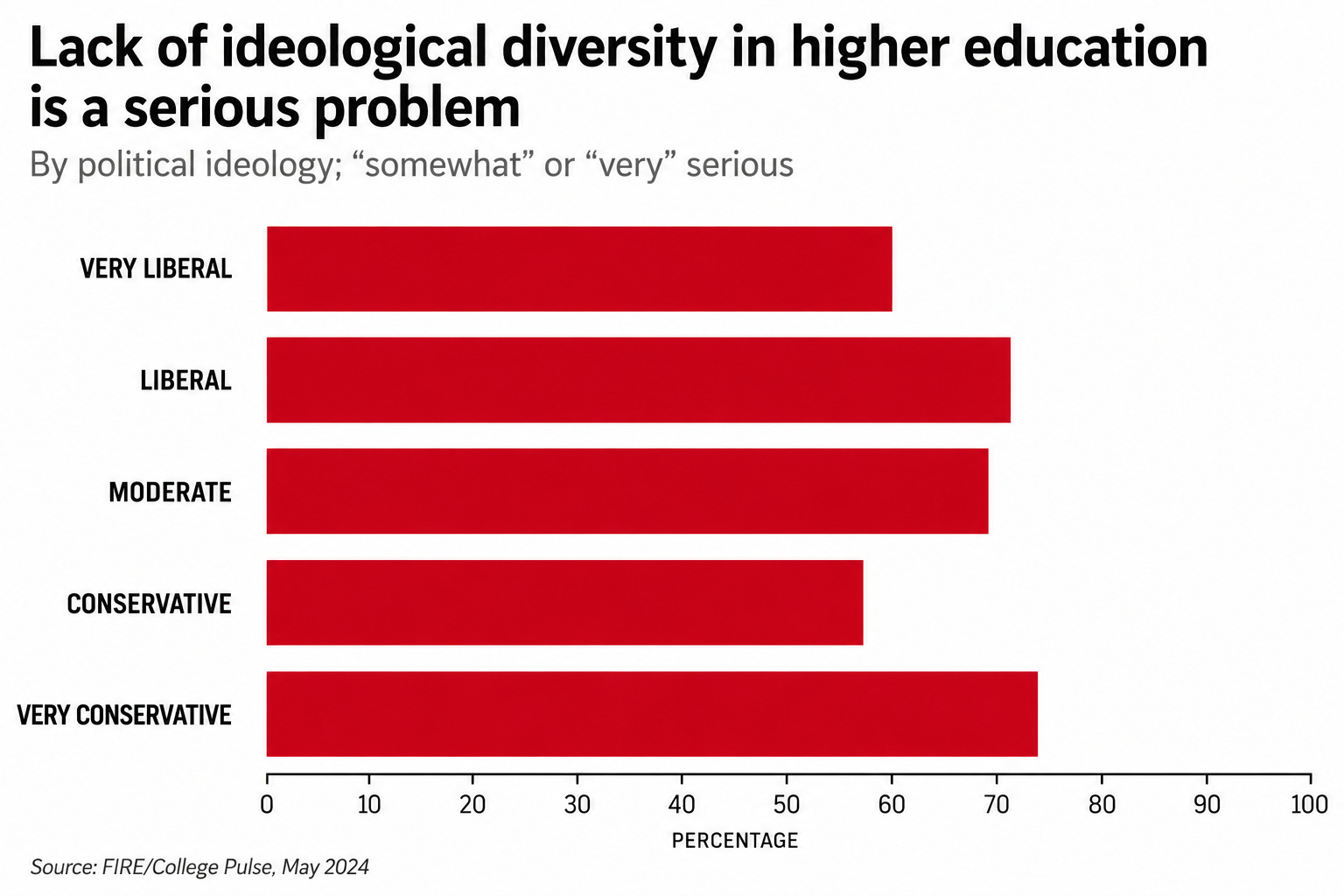
In FIRE’s latest National Speech Index, 57% of Americans — across political lines — said the lack of ideological diversity in higher education is a “somewhat” or “very” serious problem.
Half of conservative Americans and 63% of very conservative Americans say the problem is somewhat or very serious. That is not especially surprising. Nor are the 59% of moderates who say the same. What is surprising is that half of very liberal Americans and 62% of liberal Americans agree. Just 9% of liberal Americans say the lack of ideological diversity is “not a problem at all.”
This convergence comes amid a much broader collapse of public confidence in American colleges and universities.
More and more people are acknowledging that America’s colleges and universities have some serious problems. A recent review of University: A Reckoning by Lee Bollinger, the former president of Columbia University, begins with one measure of the damage: Americans’ confidence in higher education has fallen sharply over the past decade. In 2015, 57% of Americans told Gallup they were “confident,” to some degree, in higher education. By 2025, that figure had fallen to 42%. Just 35% of Americans now say attending college is “very important,” down from 70% in 2013.
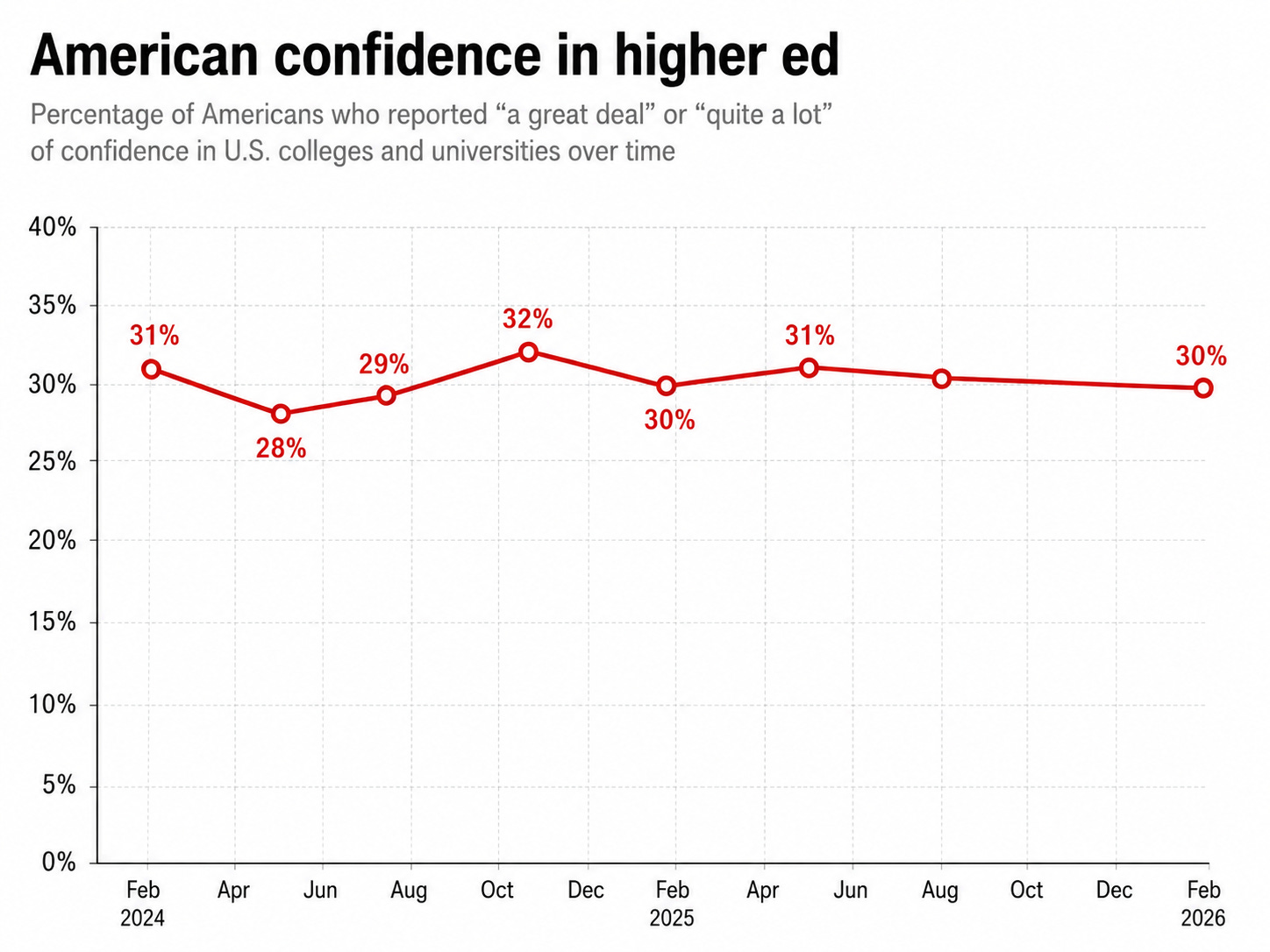
FIRE’s own data paints a bleaker picture. Since 2024, FIRE has repeatedly asked Americans through NORC at the University of Chicago’s AmeriSpeak panel: “How much confidence, if any, do you have in U.S. colleges and universities?” Across those surveys, the share of Americans saying they have “a great deal” or “quite a lot” of confidence has remained stagnant at around 30%.
Doubts about whether the predominance of liberal and progressive views among college faculty is even problematic have a long history. That makes the new finding notable. A substantial share of liberals now identify ideological groupthink as a problem worth taking seriously.
That doesn’t mean liberals and conservatives agree on what caused the problem or how severe it is. But it does open the door to discussions about what, if anything, can be done. Those conversations cannot happen if most of the people on one side do not even think there is a problem to be addressed, so this is encouraging.
What these data cannot explain is why very liberal and liberal Americans think a lack of ideological diversity in higher education is such a problem. It’s unlikely they suddenly realized there’s a significant gap — roughly 7 to 1 — between the number of liberal and conservative faculty in America, a fact that has been well documented since the 1960s, with some recent data putting the ratio at seven liberal faculty to every one conservative.
Furthermore, much of the panic over the state of higher education these days focuses more on the legislation and executive orders that conservative politicians are issuing at the state and federal level. Less attention is given to the dearth of conservative thought in American academic life.

No doubt.
There's a lot of ground between "somewhat serious" and "very serious". I'd like to see the breakdown between these levels as selected by liberal/conservative respondents.