


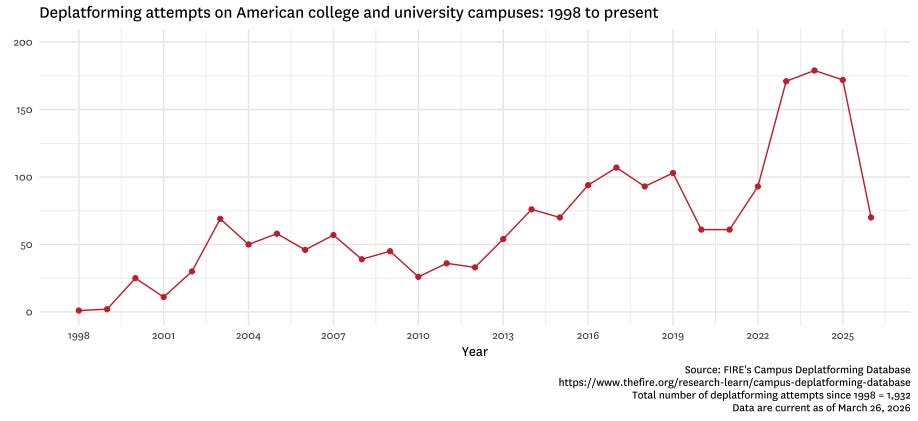
Only three months into the year, campus deplatforming is already on pace to set a disturbing new record, and if current trends hold, 2026 won’t just be a bad year for campus free speech. It’ll be the worst year on record for campus deplatformings.
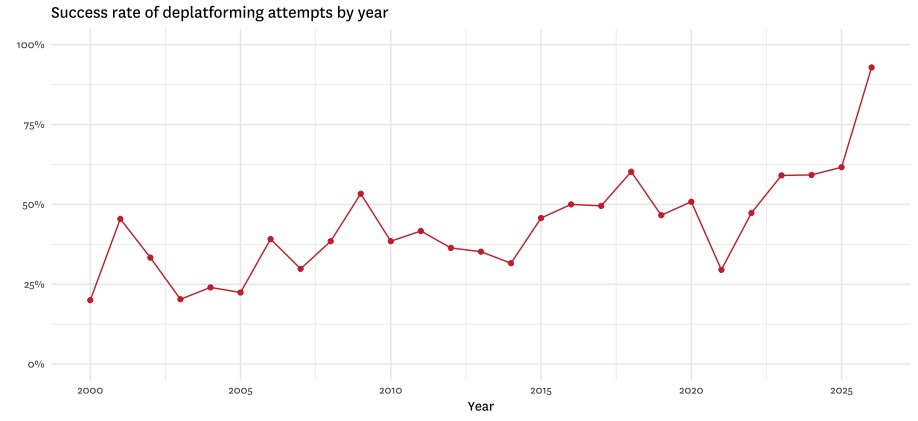
FIRE’s Campus Deplatforming Database tracks efforts to stop public expression on college campuses — disinviting speakers, canceling performances or film screenings, removing art, or disrupting events while they are happening. In just the first three months of this year, there have been 70 such attempts. Even worse, 65 of those attempts succeeded — the highest success rate we’ve ever recorded in any year with 10 or more attempts.
Universities’ responses to deplatforming attempts reveal whether their stated commitments to free inquiry and open debate mean anything in practice. Each successful cancellation teaches students, faculty, and organizers the same lesson: controversial expression is a liability, and institutions tend to care more about ducking trouble than standing on principle.
This chills future expression, and recent controversies show how broad that impulse has become.
This week, the University of Southern California scrapped a gubernatorial debate after excluded candidates complained about the race of those invited — they were all white. This shut down what should’ve been one of the clearest examples of a university serving as a forum for democratic exchange. Universities often claim to prepare students for civic participation. Canceling a debate involving major political figures because the controversy “created a significant distraction from the issues that matter to voters,” sends the opposite message. Namely, that even core political discourse can be treated as too difficult or too risky to host.
At New York University, the administration reportedly told student organizers that they could not invite certain music performers to a concert because the performers were affiliated with the No Music for Genocide boycott of Israel. That decision illustrates an especially troubling dynamic: universities are not only reacting to speech after the fact, but increasingly preempting it.
When administrators reserve the authority to decide which artists are too controversial to be invited in the first place, student autonomy shrinks and institutional gatekeeping expands. The result is a campus culture in which permission for expression becomes contingent on administrative comfort.
Other incidents this year further demonstrate this pattern.
The University of North Texas removed an art exhibit after an anonymous tip alleged the show included artwork denouncing U.S. Immigration and Customs Enforcement. UNT also just revoked approval for a drag show after the university system lifted its systemwide pause on drag performances last August.
The Catholic University of America rejected requests from the campus chapter of Students Supporting Israel to host Randy Fine and Dany Turza at two separate events because the discussions would not feature a “balanced presentation” of views about the Israeli-Palestinian conflict.
And, the University of Southern Maine terminated its agreement to host a one-day conference, “The Consequence of Palestine,” because one of the scheduled speakers (Francesca Albanese, the U.N. Human Rights Council’s special rapporteur on human rights in the Palestinian territories occupied since 1967) has been sanctioned by the U.S. government and appears on the U.S. Department of the Treasury’s office of foreign assets control’s specially designated nationals and blocked persons list. Administrators said that hosting the event with a “sanctioned scholar” would violate federal law. Albanese was scheduled to appear remotely and organizers and free-speech attorneys argue that including Albanese as a remote, uncompensated speaker in a virtual event was not prohibited and required no authorization.
These cases differ in subject matter, politics, and format. But that is exactly the point. Deplatforming is not confined to one ideology or one type of event. It can target political debate, artistic expression, student entertainment, invited lectures, or academic programming. The common thread is a willingness to suppress expression rather than answer it, criticize it, or contextualize it.
Defenders of these cancellations often frame them as prudent, values-based, or necessary for campus harmony. Sometimes they invoke safety, reputational concerns, institutional mission, or community standards. But too often those rationales are vague, inconsistently applied, or selectively enforced. Universities rarely cancel events because they are truly incapable of supporting peaceful disagreement. More often, they cancel because controversy itself is treated as unacceptable.
That is a profound mistake. The university is one of the few institutions explicitly designed to accommodate disagreement. Students should encounter ideas, performances, and speakers they dislike, distrust, or find offensive. They should also learn how to respond: through protest, questioning, criticism, counterprogramming, and debate. Those are the habits of a free society. Deplatforming replaces those habits with passivity and permission-seeking.
That is what makes the 93% success rate so alarming. Failed deplatforming attempts can still cause harm, but they at least show that institutional safeguards are holding. A successful attempt signals that those safeguards are eroding. If nearly all deplatforming efforts are now succeeding, then the problem is not simply that controversial events are being challenged. The problem is that universities appear increasingly willing to fold under pressure.
These actions can have long-term consequences. Student organizers may stop proposing ambitious or provocative events because they fear resistance. Faculty may avoid controversial programming because administrative support feels uncertain. Artists and speakers may decline invitations if they believe universities cannot or will not stand by them. Over time, the chilling effect becomes more powerful than any one deplatforming. The lesson spreads quietly: do less, invite less, say less.
Seventy attempts in three months is troubling on its own. Sixty-five successful cancellations is worse. A 93% success rate suggests a campus speech environment in which those seeking to silence expression are winning.
This should concern anyone who believes higher education exists to test ideas rather than shelter institutions from them. If universities want to remain credible as places of inquiry, they must do more than praise free expression in mission statements. They must defend it even when it is inconvenient, contested, and costly.

Thank you as usual. On a small scale, over several decades, I helped some public, school, and academic libraries deal with people who wanted to remove books from their shelves. One strategy I would suggest: Instead of removing books, help create a more balanced collection. Can you recommend books to add to our inventory? Here is our protocol for acquiring books. (Usually commonsense guidelines regarding budget, the focus of the current strategic plan, preferred sources, library customer requests, reviews, and feedback from experts. Also, addressing "holes" in the collection. Some libraries refuse self-published works; others welcome local authors.)
In one case, a school district learned that their school librarians, misinterpreting "separation of church and state", had removed all the books related to Christianity from their shelves. Books about other religions were not touched. The citizens were delighted to be asked to help, and all of their suggestions were added to the collections. The district coordinator personally visited all of the schools to make sure the books were added.
I have a lot of respect for FIRE's work. I think that the issue sometimes is that the administrators can't think of anything except binary, either/or solutions: Books? Yes or no. Lectures? Yes or no. They need help adding "add" to their toolbox.
Is 1998 the earliest for which you have data?