


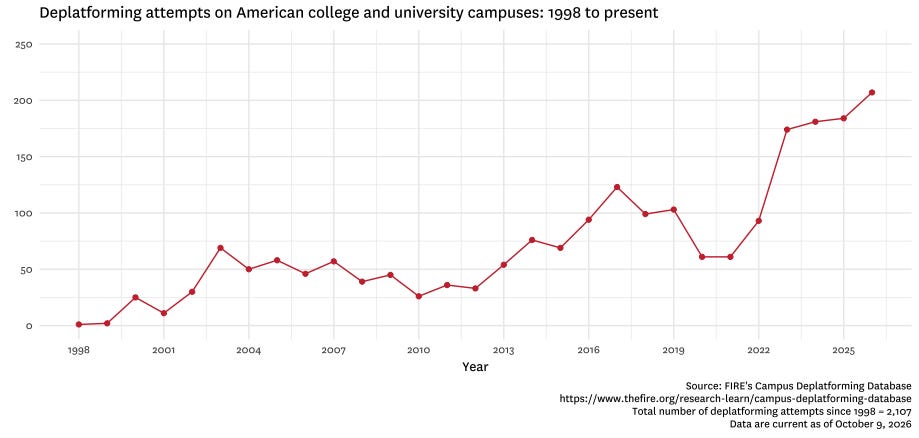
Campus deplatforming attempts have reached a disturbing new milestone. For the first time since FIRE began tracking these incidents, more than 200 attempts to prevent invited speakers from appearing on campus have been recorded in a single year — and 2026 still has nearly three months to go. The previous record, set just last year, has already been shattered. And the problem isn’t confined to one side of the political spectrum.
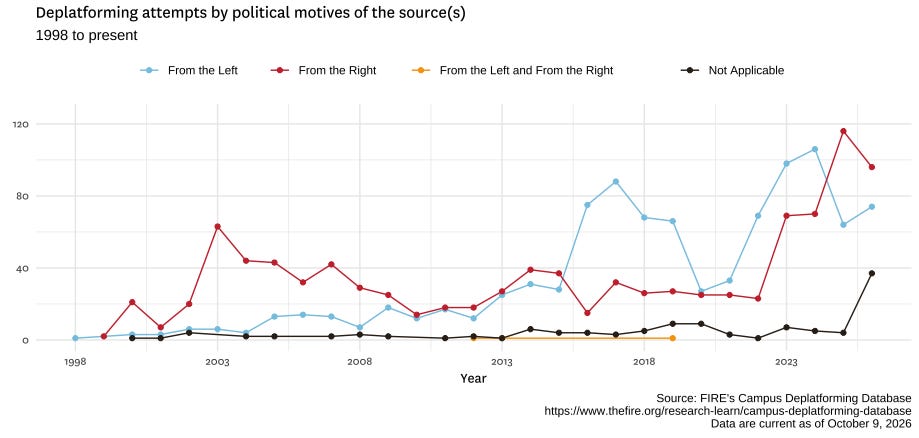
The attempts are being initiated by actors across the political spectrum — with attempts from the right of the expression exceeding attempts from the left both last year (116 to 64) and this year (96 to 74).
Recent incidents include:
Fenggang Yang, a professor of sociology and founding director of the Center on Religion and Chinese Society at Purdue University, accepted an invitation to deliver the keynote address at the U.S.-China Catholic Association’s 2026 conference at the University of St. Thomas. After Chinese government officials reportedly objected to Yang’s participation, citing his past criticism of the Chinese government, Yang withdrew from speaking at the conference.
The Chicago Thinker, a conservative student publication at the University of Chicago, reserved Breasted Hall through the university’s Turning Point USA chapter for a “fireside chat” with Tim Pool, host of Timcast IRL, and Jack Posobiec, a political activist and former U.S. Navy intelligence officer. According to the Thinker, the Institute for the Study of Ancient Cultures (ISAC), which manages the venue, confirmed the booking on Aug. 30 but canceled it nine days later. ISAC told organizers by email that the event “might be, as the terminology goes ‘controversial,’” and would require heightened security. University administrators reversed this decision.
At Harvard University, the Harvard Jewish Alumni Alliance urged the Kennedy School to disinvite New York Times columnist Nicholas Kristof after he wrote about claims of Israeli soldiers using dogs to rape Palestinian detainees. Harvard rejected the demand.
Turning Point USA scheduled a “Freedom Built to Last: Honoring Charlie Kirk” memorial at Utah Valley University, featuring a number of prominent conservative speakers. Students for a Democratic Society at UVU opposed the event honoring Kirk and his political legacy. The university declined to cancel the event, and it proceeded on Sept. 10.
This year, there have also been six attempts targeting Twitch streamer Hasan Piker, the most of any individual. These attempts failed at the University of Michigan, Michigan State University, Yale University, Cornell University, and the University of Texas at Austin. Piker’s invitation to speak at the University of Washington was revoked because, according to university officials “the planning process did not meet the required rigor for university-hosted Speaker Series events.”

But the surge in deplatforming attempts is only part of the story. An even more troubling development is emerging: Government officials are increasingly joining campaigns to silence campus speakers, and colleges and universities are becoming much more likely to give in to their demands. This is troubling because, while students, members of the public, and government officials have every right to criticize speakers and demand that their invitations be withdrawn, government officials also wield additional powers that can turn an ordinary controversy over campus speech into something far more threatening.
From 1998 through 2022, politicians or government appointees were rarely involved in these campaigns, ranging from none to at most five per year. A record high of five was set in 2009. A new high of 19 was set in 2023, although 11 of these are speakers linked to a single event which happened before Oct. 7, an on-campus literature festival celebrating Palestinian culture at the University of Pennsylvania. Then in 2025, coinciding with the start of the second Trump administration, 33 deplatforming attempts involved politicians or government appointees. At this time, 2026 is keeping pace with 2025.
Almost all of the deplatforming attempts involving politicians or government appointees since 2023 have come from the right of the expression. These attempts are far more common at state colleges and universities — roughly 70% of all attempts involving politicians since 2023. At first, colleges and universities mostly ignored these government pressure campaigns. In 2023 and 2024 just six of the 30 deplatforming attempts — one of every five — involving politicians or government appointees were successful. Over the past two years, 37 of the 59 deplatforming attempts involving politicians or government appointees were successful, or almost two out of every three. Government officials are clearly not the tip of the spear for every deplatforming attempt we have recorded over the past few years — but, given the power they wield, their increased involvement in them is concerning.

The rise in successful government-led deplatforming attempts coincides with a broader shift in the relationship between Washington and higher education. Since President Donald Trump’s return to office, colleges and universities have faced heightened federal scrutiny, including unlawful executive actions targeting diversity, equity, and inclusion programs, and with Department of Education investigations into alleged campus antisemitism. These developments do not necessarily explain every successful deplatforming campaign. But they raise an important question: Are colleges and universities becoming more willing to sacrifice expressive freedom when political pressure comes from officials who wield significant power over them?
The latest deplatforming record should concern anyone who values free expression on college campuses. Although the political identities of those seeking to silence speakers may change, the underlying threat remains the same: Giving in to demands that controversial voices be excluded from campus only encourages more such demands. And when those demands come from government officials, the stakes are even higher. Colleges and universities must resist political pressure to cancel invited speakers, regardless of whether that pressure comes from the left or the right. Otherwise, the record set in 2026 may not stand for long.

Shut those universities down!!
Democrats are Fascists, they hate free speech, hate private property and individual rights, support massive wealth redistribution, and they always have.🤷♂️