


In the wake of the assassination of conservative commentator Charlie Kirk, new survey data from Utah Valley University offers a revealing look at how attitudes around protest tactics and speaker tolerance have shifted, and where ideological divisions remain stark. This post compares data from the 2026 College Free Speech Rankings, collected prior to the incident, with responses from a follow-up survey conducted after the assassination. This comparison reveals significant, and in some cases striking, changes across political identities.
After Kirk’s assassination, student opposition to violent or obstructive protest tactics increased overall, but not evenly across ideological groups. Moderate and conservative students became significantly more likely to say protest methods like shouting down speakers, blocking entry to events, or using violence are “never acceptable.” Among liberal students, on the other hand, these shifts were much smaller or absent.
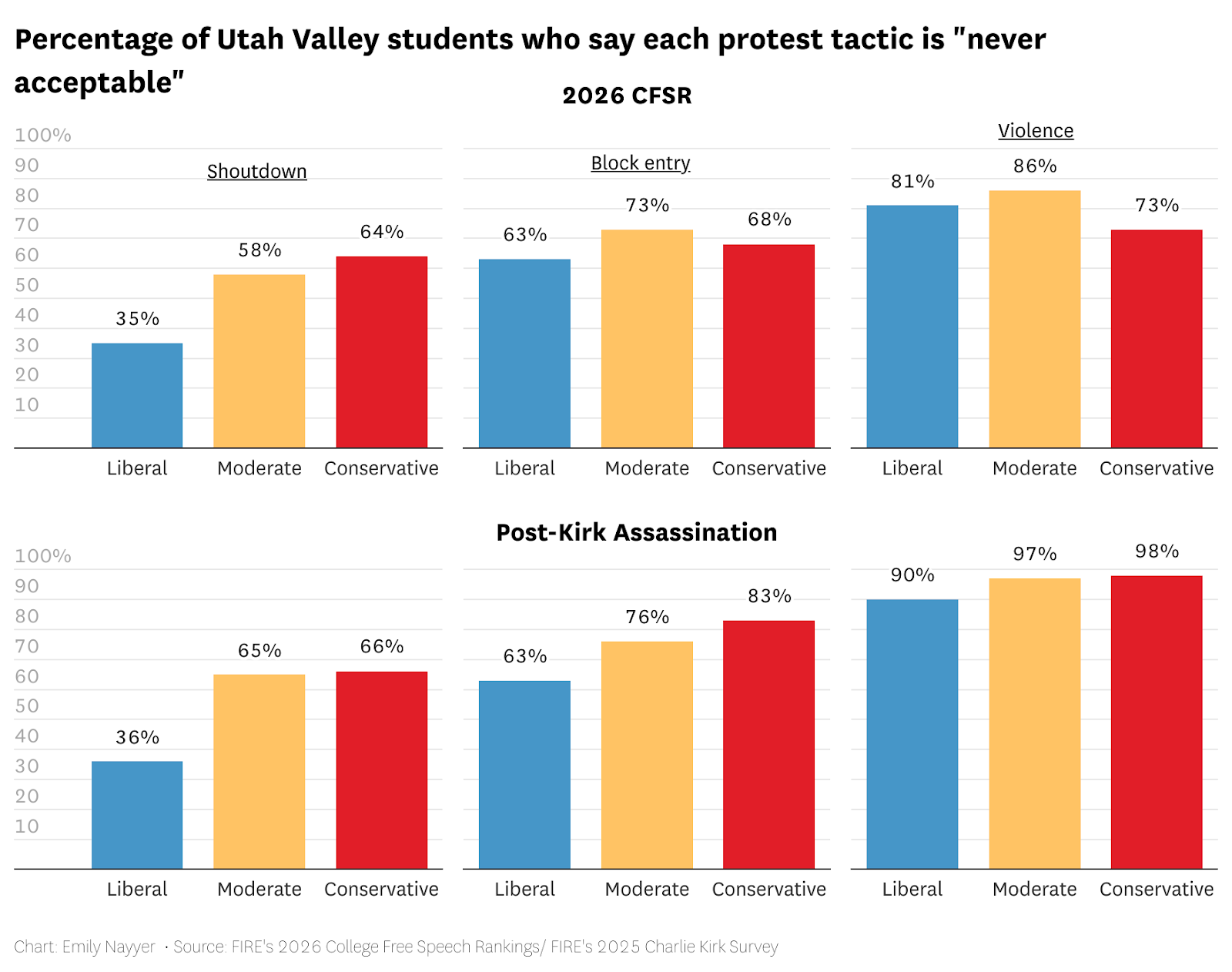
Among moderates, opposition to shoutdowns rose from 58% to 65%, while opposition to blocking entry rose from 73% to 76%. For conservatives, the increase was even sharper. Opposition to blocking entry went from 68% to 83%, while opposition to violence jumped from 73% to 98%. In contrast, among liberals, opposition to shoutdowns rose just one point from 35% to 36%, and opposition to blocking entry remained flat at 63%. Only their rejection of violence showed a notable increase, from 81% to 90%.
This suggests that the Kirk assassination may have pushed moderates and conservatives to double-down on non-violence, while liberal students barely shifted.
The trends in tolerance for controversial speakers among Utah Valley students, however, are concerning. Views on who deserves a platform to speak on campus remain deeply polarized, and in some areas, the ideological gap is widening.
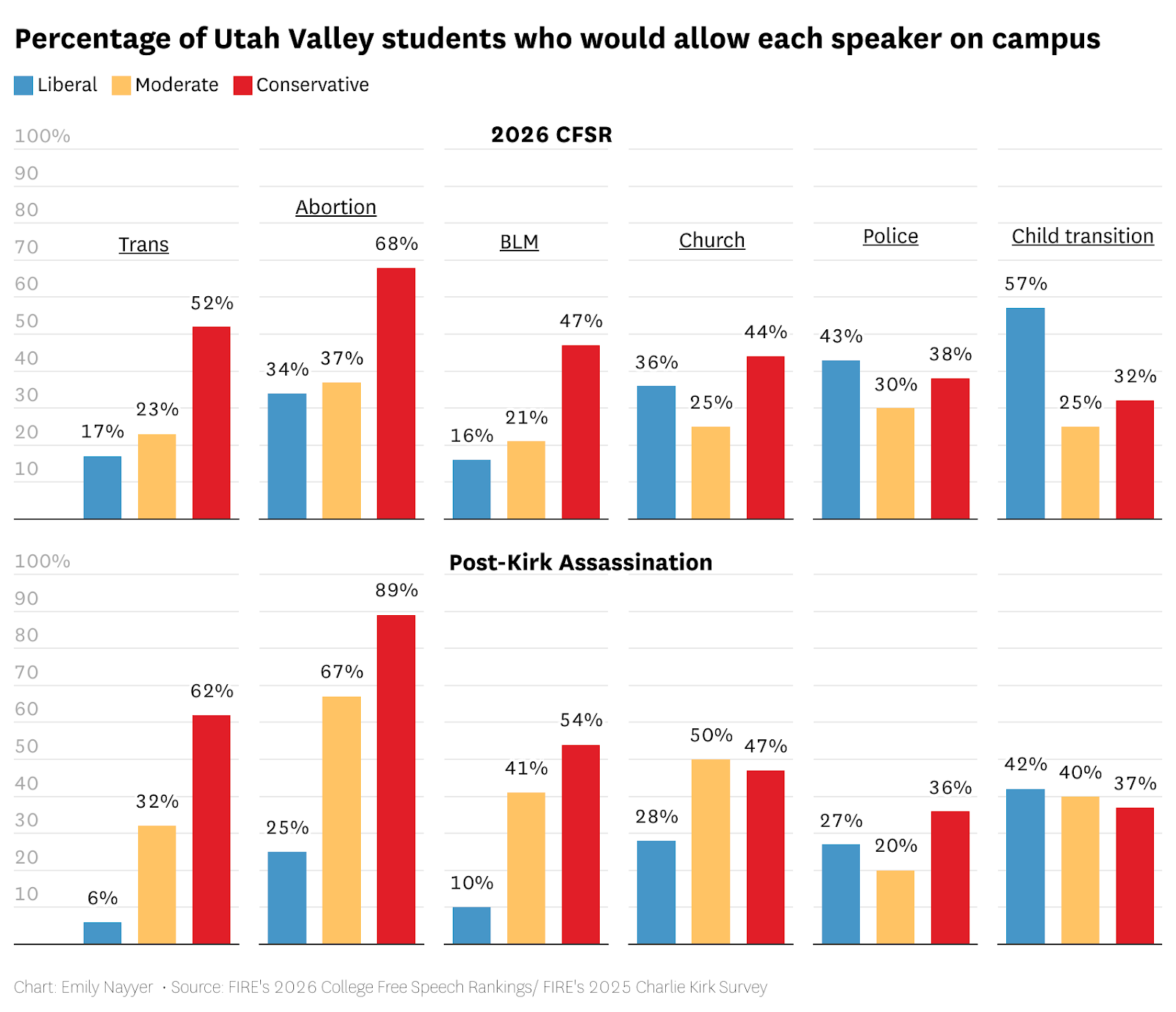
Take the speaker who previously said “abortion should be completely illegal.” Support for allowing this speaker on Utah Valley’s campus rose from 68% to 89% among conservative students, while declining from 34% to 25% among liberal students. Similarly, liberal students’ support for allowing a speaker who previously said that “transgender people have a mental disorder” fell from an already low 17% to just 6%, while conservative support ticked up from 52% to 62%.
Among moderate students, the post-Kirk assassination data shows significant increases in support for nearly every type of speaker, suggesting that students in the political middle at Utah Valley University may be leaning toward broader viewpoint tolerance, even as those more at the poles of the ideological spectrum move further apart.
But what is most striking is how liberal UVU students have become less tolerant of controversial left-leaning speakers as well. Support for allowing a speaker who previously said that “children should be able to transition without parental consent” on campus dropped from 57% to 42%. Support for allowing speakers who previously said that “the Catholic Church is a pedophilic institution” or one that said “the police are just as racist as the Ku Klux Klan” also declined significantly.
These findings paint a complicated picture. On the one hand, the near-universal rejection of violence is a hopeful sign. Conservative and moderate students at UVU also became more opposed to students blocking other students from entering an event and shouting down speakers.
On the other hand, liberal students at UVU did not shift their views on blocking entry and shouting down speakers. Furthermore, the decline in support among them for even allowing ideologically sympathetic speakers on campus, and the continuing low tolerance for opposing viewpoints, point to an increasingly polarized discourse. The risk is a chilling effect on dialogue. Not just from fear of violence, but from a growing reluctance to engage in controversial conversations or platform certain ideas.
As institutions of higher learning continue to grapple with free speech, inclusion, and the boundaries of protest, this data reminds us of both the progress and the perils. The moral clarity against violence is encouraging. But if ideological litmus tests continue to determine who gets to speak, campuses may find themselves ill-equipped to fulfill their role as forums for genuine intellectual exchange.

Interestingly the data show that liberal students already overwhelmingly opposed violence even before and at a substantially higher rate than conservative ones. You note that this is where conservatives moved the most but failed to point out that liberals already overwhelmingly opposed violence whereas conservatives were less opposed until after. Or did I miss that?
I think you may have a category error here. Those students with illiberal views may _call_ themselves liberal. They are not. They are Leftists. The Left has never been liberal.
Do you have numbers? How big is this liberal faction on campus?