


This is part of a weekly series on AI and free speech.
The internet is one of the main places where we read, learn, ask questions, and share ideas. It serves as a library, bookstore, classroom, and town square all at once. For decades, most people have been able to use those online spaces without first proving who they are.
That may be changing. Legislatures across the United States are passing laws requiring online platforms and other digital services to determine users’ ages before granting access. Some proposals focus on adult-content websites. Others target social media and app stores. Now, increasingly, they target artificial intelligence.
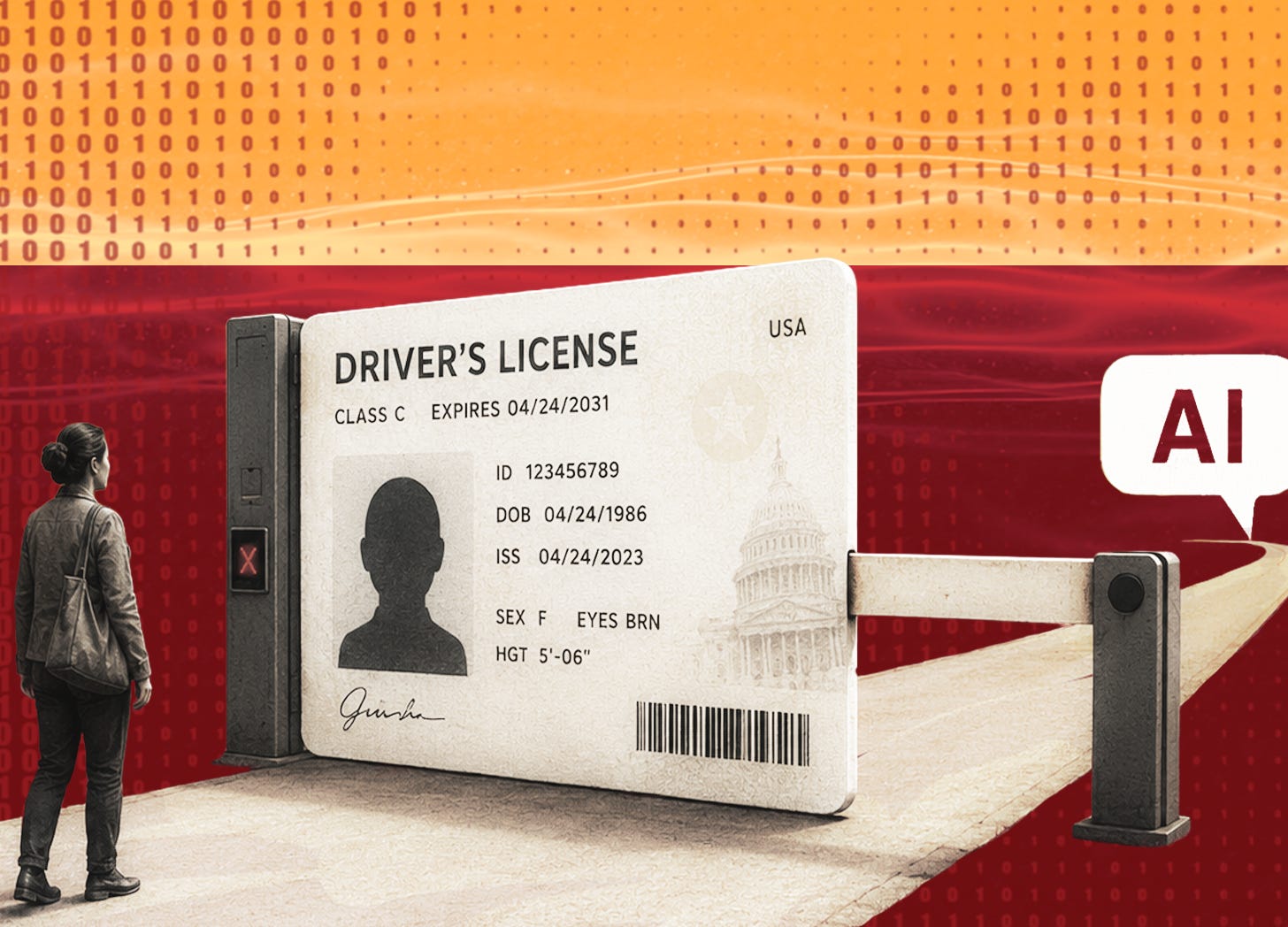
At first glance, these laws seem to ask a simple question: How old are you? But answering it isn’t so simple. Is checking a box enough? Can a company estimate your age from a selfie? Should it rely on information from your device or app store? Or must you verify your age by uploading a government-issued ID?
What begins as age assurance can result in identity verification. As systems demand more certainty about your age, the more personal information it often needs to collect.
How does the First Amendment apply to AI regulation in hiring and health care?

This is part of a weekly series on AI and free speech.
This carries consequences beyond privacy. Throughout American history, anonymity has played an important role in free expression. Alexander Hamilton, James Madison, and John Jay wrote the Federalist Papers under cloak of anonymity. Thomas Paine first published Common Sense anonymously. The Supreme Court has repeatedly recognized that anonymity encourages people to express unpopular or controversial views without fear of retaliation. And the internet has carried that tradition forward by allowing people to share and obtain information without having to stand up in a crowd.
Artificial intelligence is now one of the latest advances in human communication. Millions of people use it to search for information, learn new skills, explore unfamiliar ideas, and think through difficult questions. As lawmakers nationwide propose age-gating access to AI models, debate centers on whether identifying yourself will become a routine part of using one.
This guide explains the different approaches to age assurance, why lawmakers are considering requiring them, and what those choices could mean for free expression and free inquiry in America.
What is age assurance?
Before going further, it’s worth clarifying the terminology.
People often use the terms “age verification” and “age assurance” interchangeably, but they mean different things. Age assurance includes any method of figuring out whether you are old enough to use a product or service. Age verification is one form of age assurance that relies on a trusted credential to confirm a person’s age.
Not every age-assurance system works the same way. Some simply ask you to check a box if you’re over a certain age. Others infer your age from existing account information, payment methods, or browsing behavior. Some analyze a selfie or short video. Others ask you to upload your driver’s license, passport, or another government-issued ID.
Each approach involves tradeoffs. The honor system is simple, but people can lie. Age inference requires companies to monitor your online activity over time. Facial estimates require you to reveal unique biometric data. And providing a government-issued ID requires you to directly reveal your name and address.
When does an age-gate become an ID check?
If proving your age requires identifying biometrics, a driver’s license, passport, or other government-issued ID, guess what? Now it’s also identity verification.
Think of a store clerk deciding whether to card you. They make a quick judgment about whether you look over 18 or 21. If they’re unsure, they ask for your driver’s license. The interaction lasts a few seconds, confirms one fact, then it’s over. The clerk doesn’t keep a permanent record of your biometric data or your identity.
Online, things don’t quite work that way. A website or app can’t glance at your face and hand your ID back. Instead, many forms of age verification require processing — and sometimes storing — personal information.
The challenge doesn’t end there. Some laws don’t tell companies how to determine a user’s age. Instead, they impose age-based obligations or require “commercially reasonable” age-assurance methods, leaving companies to decide how to comply.
As a result, users may encounter multiple age checks. In some cases, the law requires a check before you access an operating system or enter an app store. Other laws leave room for interpretation, prompting companies to add additional age checks to reduce legal risk. An app might verify your age. A platform or chatbot might ask again before you can access certain features.
And no age assurance method is perfect. People lie about their age, software guesses wrong, driver’s licenses can be borrowed or forged. Every failure justifies one more check.
This is more than an inconvenience. The First Amendment protects the freedom to speak and explore unfamiliar ideas without fear. Without it, people may choose the safety of silence instead. Researchers conducting a study at Carnegie Mellon University found that nearly everyone in the study was willing to check a box to confirm their age, but only 22–28% were willing to show a government ID. The others walked away, even when they were told their information would be deleted afterward.
New technologies continue to emerge, but the constitutional questions remain — particularly whether people should have to prove their eligibility before accessing lawful speech in the first place.
Applying the First Amendment
The First Amendment protects the rights both to speak and to receive information and ideas, including the ability to do so anonymously. When a law requires people to identify themselves before posting online or accessing lawful speech, the law burdens those rights.
Yet a growing wave of state legislation requiring age assurance across the digital ecosystem are violating those principles. Many of these laws therefore face challenges in court for chilling speech and eliminating user anonymity. FIRE has participated in many of those cases as counsel or as a friend-of-the-court, including important challenges involving social media and adult-content websites. App-store age-assurance laws are also the subject of ongoing litigation in states such as Texas and Utah, and FIRE is participating on that front, too.
To understand how courts decide these challenges, it helps to understand that courts don’t treat every age-assurance law the same way. The constitutional analysis depends on what access the law conditions.
The basic rule is: Courts have set a very high constitutional bar when the government requires people to identify themselves before accessing lawful speech online.
The Supreme Court has repeatedly recognized that access to the internet — including social media — is protected by the First Amendment. It has also overturned attempts to create entirely new categories of speech with no or less constitutional protection simply because lawmakers believe they’re harmful to minors.
Democracy has a participation problem. AI may help solve it.

Chloe Ratner is a political science major at Yale University. Last summer, she worked at the Department of Justice Human Rights and Special Prosecutions Section.
If laws seek to age-gate the internet, websites, social media, or general-purpose AI tools, can the government force us to identify ourselves before participating in some of the basic ways we communicate, learn, and explore ideas online?
No. Except in limited circumstances, age-assurance laws that condition access to protected speech generally violate the First Amendment. Courts have therefore blocked many of these laws. Others remain tied up in ongoing appeals.
Why are lawmakers focusing on AI chatbots?
As Americans continue to use AI tools to ask questions, research unfamiliar topics, draft emails, write code, learn new skills, and think through difficult problems, some lawmakers are increasingly asking whether access to it should depend on a user’s age.
Supporters of age-verification requirements argue that AI chatbots can expose children to inappropriate conversations, harmful advice, or emotionally manipulative interactions. They believe companies should be required to find out when they’re interacting with minors so they can restrict certain features or content.
As FIRE has previously explained, the government has an interest in protecting children from harm. At the same time, parents — not the government — should decide how and when their children engage online. Unchecked government authority to decide what information children may access would displace parental judgment and create opportunities for officials to shape the information environment according to their own priorities.
The same problems arise with government restrictions on AI tools. Government-imposed requirements for minors to identify themselves before asking questions of an AI system violates something that has traditionally been private: the freedom to explore ideas, satisfy curiosity, and think through difficult questions before sharing them with anyone else.
These burdens don’t stop with minors. Once companies must distinguish minors from adults, everyone is forced into the same age-assurance system.
These requirements also influence how AI systems are designed, what features they include, and whether proving who you are online emerges as the default rather than the exception.
That is one reason anonymity has long been protected. It safeguards far more than wrongdoing. It allows whistleblowers to think through difficult decisions, victims of domestic abuse to seek help safely, political dissidents to explore controversial ideas, and ordinary people to explore personal topics — all without revealing their identities.
Should you have to prove who you are to talk to AI?
Asking an AI a question to research a medical condition or learn about politics all involves protected speech. Showing your face or an ID before you engage in those activities burdens something fundamental: your ability to seek knowledge before revealing who you are. That’s quite different from showing your ID to buy a beer — a physical product. Speech isn’t alcohol!
As FIRE has argued before, the global proliferation of age verification rules is moving us toward a “papers, please” internet, where online spaces for expression are open only to those willing to identify themselves. Many people will think twice before searching for sensitive information, asking difficult questions, or expressing unpopular views.
Whatever its intended benefits, it will make the internet much less free for everyone.

A lot of people may not know or remember this since it's now over 40 years ago, but before MADD got the 21 national drinking age passed in 1984, ID checks for alcohol were done only in the event of significant doubt of one's age. The gating factor was if someone looked too young, in the eyes of an average person acting in good faith--and in the event of an inadvertent underage sale, that was considered a defense. There was none of this "We ID Everyone" nonsense, either by law or in practice. If someone looked plausibly "old enough", they weren't carded. If not, they were. The opinions and strictness of various clerks might vary.
And young people close to the drinking age in age didn't start getting driver's licenses in quantity until after WWII (heck, many older adults didn't either), so often there was no ID available to check. And many times those early driver's licenses didn't have pictures, just a height-weight-eye color description.
But we as a Society declared a crisis, and Something Had To Be Done, and If It Saves One Life, yadda yadda yadda. The Care/Harm moral dimension über Alles.