


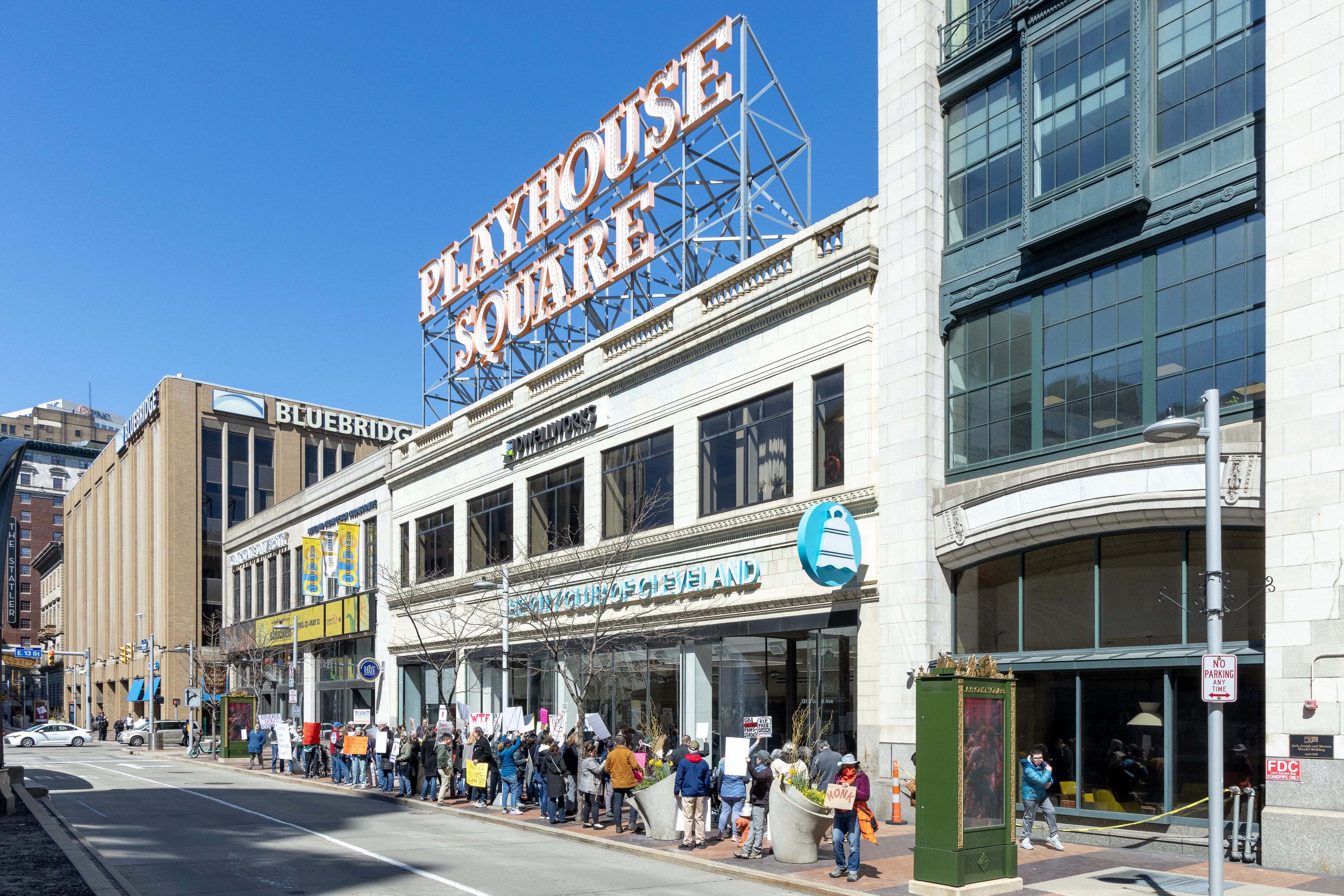
The City Club of Cleveland’s creed, written in 1912, begins, “I hail and harbor and hear persons of every belief and party; for within my portals prejudice grows less and bias dwindles.”
Over the years, figures as varied as Clarence Darrow, Babe Ruth, George Wallace, Rosa Parks, and every sitting U.S. president from Ronald Reagan to Barack Obama have appeared on the City Club’s stage. The day after Martin Luther King Jr. was assassinated, Sen. Robert F. Kennedy set aside his prepared remarks there and delivered his now-famous speech condemning “the mindless menace of violence.”
This century-long tradition of hosting “conversations of consequence that help democracy thrive” has cemented the City Club’s reputation as a “citadel of free speech.” The institution is now upholding that tradition by refusing calls to disinvite a controversial speaker.
Speaker invitation sparks backlash
In November, the City Club announced it will host a conversation with Aaron Baer, president of the Center for Christian Virtue. City Club CEO Dan Moulthrop is set to moderate the event, which includes an unscreened audience question-and-answer period.
The announcement triggered immediate calls to cancel the event from critics of CCV’s views and advocacy on LGBT issues. The City Club’s Facebook page was flooded with complaints. “We don’t support those who give hate groups platforms,” read one. “Promoting hate speech should never be the goal. Do better,” read another.
Central to the backlash is the Southern Poverty Law Center’s designation of CCV as an “anti-LGBTQ+ hate group.” The label appears to stem in part from the organization’s role in advancing an Ohio law banning medical treatments intended to assist minors with gender transition and excluding transgender girls and women from women’s K-12 and college sports.
“We’re not canceling, and we have never had any intention of canceling this.”
The controversy escalated last week when a coalition of organizations and individuals penned an open letter urging the City Club to “cancel or modify this forum in a way that does not platform” an SPLC-designated hate group. Failing outright cancellation, the letter called for an external moderator “trained in navigating civil rights or constitutional issues” and “capable of challenging extremist claims.”
The City Club stays true to its mission
Moulthrop’s response to the pushback was unequivocal:
We’re not canceling, and we have never had any intention of canceling this. We’re gonna continue to do what we always do, and have done for 113 years, which is convene conversations of consequence that help democracy thrive and do that with the leadership of relevant organizations who are shaping our communities.
That’s exactly the right response from an institution dedicated to free speech and civic dialogue.
Moulthrop told me the City Club’s mission “necessarily means making the platform available to diverse points of view and people with political influence — people who, if they’re not shaping policy, they have the ear of people who are.” So it made sense to book Baer for the Friday Forum, a “luncheon program devoted to significant national and regional concerns.” The event description notes that under Baer’s leadership, CCV “has emerged as one of the most influential nonprofit advocacy organizations in the state of Ohio, notching legislative victories on school choice and building coalitions with state government leaders.”
The City Club is not endorsing Baer’s views any more than it has endorsed the views of other speakers it has hosted. It is allowing attendees to engage with ideas that, for better or worse, have gained purchase in society. Notably, the executive director of the LGBT Community Center of Greater Cleveland, who criticized the event by arguing that free speech “should never be used to legitimize rhetoric that undermines the safety, dignity, and well-being” of LGBT people, was herself a City Club speaker just two months ago.
This is hardly the first time the City Club has weathered such controversy. In 1923, after socialist presidential candidate Eugene Debs was invited to speak, prominent business leaders resigned their memberships in protest. More recently, the announcement of a forum featuring President Donald Trump’s former campaign manager Corey Lewandowski provoked outrage.
In an era when cancellation demands are widespread and too often successful, the City Club’s refusal to yield is a welcome affirmation of the values of free speech and open discourse. FIRE’s Campus Deplatforming Database has recorded 1,824 attempts to disinvite speakers or cancel controversial performances, screenings, or exhibits on campus since 1998. Nearly half (847) succeeded. And the pace has accelerated sharply in recent years. This year alone has seen 151 attempts, about two-thirds (98) of which were successful.
Deplatforming is unwise
This trend comes at a cost. As FIRE President Greg Lukianoff often argues, we are not better off knowing less about what people think or why they think it. That point has even more force when it comes to someone like Baer, who wields significant influence over policies affecting a state’s 11.9 million residents.
“Whether you agree or disagree with these individuals, a chance to hear directly from them, rather than just about them in the media or from a researcher, is the kind of thing that makes democracy work better,” Moulthrop told The Buckeye Flame last month. In a fuller response he later shared with me, he added, “It’s a chance for speakers to understand how their ideas are heard and felt and it’s a chance for audiences to understand where different political philosophies and beliefs are born.”
Deplatforming attempts often rest on the flawed assumption that giving someone a platform inevitably makes their ideas more popular. But if the ideas are truly indefensible, exposing them to scrutiny may have the opposite effect. To that end, Baer will face questions from Moulthrop and from audience members who are unlikely to be uniformly supportive. The alternative is for him to speak only in ideologically friendly spaces where his views go unchallenged and perhaps harden further.
Baer’s critics should also consider that attempts to silence speakers often backfire by bringing them more attention. Before this controversy, I had no idea who Baer was. Media coverage of the dispute will only increase public curiosity about him and CCV. The Streisand effect strikes again.
Meanwhile, the targeted speaker obtains a rhetorical advantage. He can cast himself as a victim of suppression at the hands of intolerant critics who can’t refute his ideas on the merits.
Free speech is more than the First Amendment
When private institutions resist deplatforming demands in the name of free speech, critics often retort that it’s not a free speech issue because the First Amendment restrains only government action. That response misunderstands what sustains free speech in practice. Constitutional protection is indispensable. But culture matters too.
If silencing and punishment, rather than persuasion and criticism, gain wide acceptance as righteous responses to objectionable speech — the logic that justifies those practices may soon be turned against legal protections for free speech as well.
True, the First Amendment does not require private forums to facilitate the free exchange of ideas. It also doesn’t compel private universities to uphold free speech and academic freedom in the pursuit of knowledge, publishers to offer readers a wide range of perspectives and information, or private businesses to exercise restraint when faced with calls to fire an employee whose political opinion offended an online mob. But these norms and institutions sustain a healthy culture of free expression. They create conditions in which free speech can flourish and reinforce related values like curiosity, intellectual humility, and engagement with different points of view.
And if we abandon these norms — if silencing and punishment, rather than persuasion and criticism, gain wide acceptance as righteous responses to objectionable speech — the logic that justifies those practices may soon be turned against legal protections for free speech as well.
In standing its ground, the City Club of Cleveland has done more than defend a single event. It has defended the broader cultural foundations on which free speech depends.

That is an awesome founding creed.
It's interesting that the SPLC is the authority on labelling hate groups.
How did the SPLC seize this power?
Why do Americans believe their labels over other sources?
Someone should write a history of the SPLC.