


This piece originally appeared at The Dispatch on Sept. 25, 2026. To read the counterpoint by Tal Fortgang, “To protect legitimate speech, get serious about penalizing civil terrorism,” click here.
Defining exactly what constitutes a terrorist act continues to be maddeningly elusive to terrorism experts, international organizations, and legislators across the globe. One reason remains the impulse, by democratic and authoritarian countries alike, to redefine political dissent and low-level criminality as terrorism.
In 1992, Alex P. Schmid, one of the world’s leading terrorism experts, proposed a short but morally clarifying definition of terrorism: “the peacetime equivalent of a war crime.” Schmid wanted to distill what made terrorism an atrocity, and he would later warn about the danger of giving national governments the power to redefine terrorism in their own self-interest. By attaching “a pejorative label for certain acts of political agitation and violence” to critics, Schmid wrote, government officials can weaponize the terrorist smear “to muzzle printed press, television and social media.”
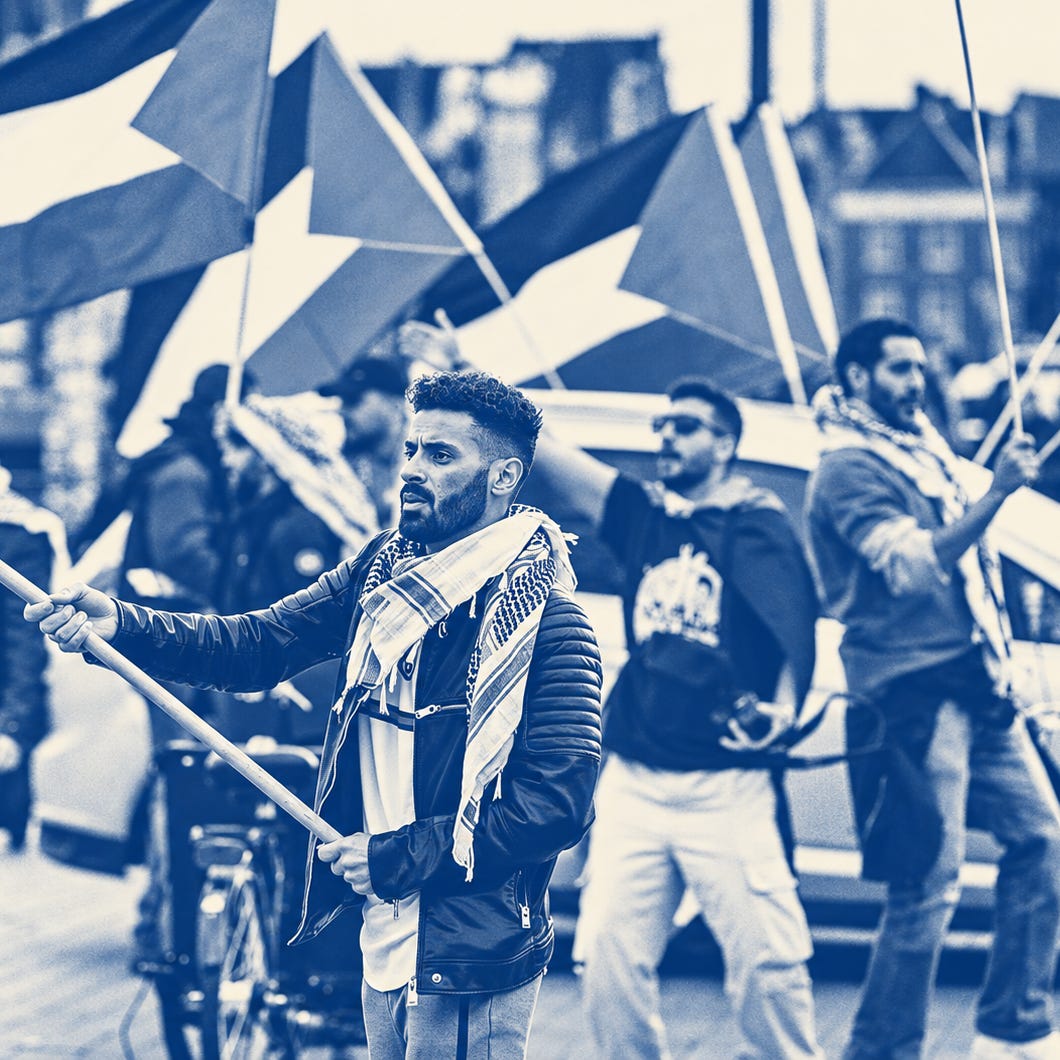
Tal Fortgang, a legal policy fellow at the Manhattan Institute, takes the opposite approach. Rather than define terrorism precisely to avoid such authoritarian overreaches, he wants to broaden it to encompass misdemeanor offenses that make modern life more difficult. In early June, Fortgang published “Model Legislation: An Act to Combat Civil Terrorism.” His proposal aims to make political activists think twice before they engage in or help facilitate coordinated acts of civil disobedience and low-level crimes—like blocking a road, destroying property, and vandalism—by elevating them to felonies. It takes aim at precisely the kind of unlawful blocking of traffic pro-Palestinian and anti-Zionist protesters engaged in yesterday to protest Israeli Prime Minister Benjamin Netanyahu’s speech before the United Nations General Assembly in Manhattan.
His draft legislation is supposed to be a serious public policy proposal. It’s not. Instead, it threatens all Americans’ First Amendment rights, whether you’re on the left or the right.
Partisan legislation, bipartisan abuse
Fortgang’s stated legislative purpose is “to promote civil tranquility by holding those who seek to disrupt it for political purposes accountable.” What exactly is “civil tranquility”? Fortgang never defines it.
But there’s a lot of mischief lurking in that concept, considering how easy it is to “disrupt” something so nebulous as “civil tranquility” for “political purposes.” After all, protest marches disrupt civil tranquility. So do even the most tepid pro-life protests where drivers honk their horns expressing agreement that abortion is murder. Hell, a provocative op-ed or social media post arguably could upset Fortgang’s ideal of civil tranquility.

All of those examples involve core political speech protected by the First Amendment, as Fortgang would no doubt agree. As Justice William O. Douglas wrote back in 1949, “A function of free speech under our system of government is to invite dispute. It may indeed best serve its high purpose when it induces a condition of unrest, creates dissatisfaction with conditions as they are, or even stirs people to anger.”
Yet Fortgang’s legislative purpose runs the other direction. How comfortable would you be organizing or participating in a protest, or promoting it on social media, if it could “stir people to anger” or “induce a condition of unrest” in which some people cross the line into illegal activity? A chilling effect could result, particularly because Fortgang’s proposal also targets whoever “knowingly aids, abets, funds, organizes or otherwise facilitates” the low-level crimes he associates with civil terrorism.
Beyond Fortgang’s definitional problems lies a much bigger one: how officials will abuse his proposal as some activists cross the line into illegal conduct. Like most idealistic projects gone wrong, reasonable goals and partisan politics mix in poisonous ways.
In his Wall Street Journal op-ed, “Block a Road, Go to Prison,” Fortgang says as much. His legislative targets are “left-wing radicals” who are “trying to circumvent the political process by making life miserable until Americans cry uncle.” The “radicals” do so by “blocking roads, occupying campus spaces, vandalizing property, stealing and burning government-owned flags, and even assaulting law enforcement.”
To bring these “civil terrorists” to heel, Fortgang argues, legislators need to throw the book at them by upgrading their “favored misdemeanors to felonies when done in groups or with the intent to support criminal enterprises.”
In an America plagued by tribalism, the one thing we should be able to agree on is that public officials can and do misuse the legal system to stifle protected speech. No political party has a monopoly on censorship or weaponizing the law for partisan purposes.
Conservatives upset at pro-Palestinian or Black Lives Matter protest tactics should remember their response to Attorney General Merrick Garland’s October 2021 memo. That directive instructed the FBI to partner with state and local law enforcement on strategies to crack down on the alleged harassment and intimidation of public school officials at school board meetings by angry parents during COVID. In response, the FBI’s counterterrorism and criminal divisions created a threat tag called “EDUOFFICIALS” for investigations and assessments into alleged threats targeting teachers, school staff, school board members, and administrators.
According to FBI whistleblowers cited by House Judiciary Republicans, the FBI quickly used counterterrorism resources to investigate protected speech. In one instance, the FBI interviewed a woman who told a local school board that “we are coming for you,” because she belonged to the right-wing advocacy group Moms for Liberty and owned a gun. According to the woman, she meant Moms for Liberty was coming for school board members’ seats during the next election.
That same conflation of protected speech and low-level crimes with terrorism is already happening at the state level. In 2024, the International Center for Not-for-Profit Law (ICNL) published a report calling out this trend and the ways state officials were already abusing domestic terrorism laws to stifle First Amendment rights of speech, assembly, and petition.
Take Oklahoma as an example of the dangers created by a sprawling definition of terrorism. In the state, notes the ICNL, “a predicate offense for terrorism includes any act of violence that results in damage to property or the threat of such violence.” Armed with this statute, an Oklahoma City prosecutor in 2020 brought terrorism charges against five young defendants, including three teenagers, for setting a sheriff’s van on fire and breaking windows of a local bail bonds business at a Black Lives Matter protest. If convicted, these alleged vandals could have been sentenced to life in prison—life.
One of the five defendants charged with terrorism, Eric Christopher Ruffin, eventually reached a plea deal with the district attorney. In exchange for pleading guilty to third-degree arson, Ruffin, who continues to maintain his innocence, received a three-year deferred sentence. Ruffin’s ordeal shows how authorities can leverage terrorism charges to get defendants to plead down to lesser charges for fear of the consequences. And it raises the question: What kind of threat was Ruffin to public safety if this “terrorist” will never see the inside of a prison cell?
It’s not just people engaging in protest who need to worry, but those who support, work with, fundraise for, or donate to organizations connected to protest. The ICNL calls out Tennessee as one absurd example, because any offense is a predicate offense of terrorism in the state.
“As such, under Tennessee law,” notes the ICNL report, “knowingly providing material support or resources for an act of terrorism, such as providing a water bottle to someone involved in an unlawful sit-in that is deemed to be attempting to influence government policy by intimidation, is a felony punishable by up to 60 years in jail.”
Blocking a road chanting “Free Palestine” and turning a Ryder rental truck into an improvised explosive device don’t belong on the same spectrum. Calling both terrorism isn’t a matter of degree. It’s a category error that invites censorship and repression.
These examples give good reason to worry that police and prosecutors across the country already have too much discretion to turn protesters who break the law into “domestic terrorists” without Fortgang’s legislative contribution. Conservatives would do well to remember that administrations come and go and political maps shift. If enacted, the type of legislation proposed by Fortgang is a loaded gun waiting to be picked up by any governor or mayor’s office and aimed directly at its political opponents.
A disproportionate response to a real problem
No one likes some idiot who lies down in the road and makes it harder to get to work or pick the kids up from school on time. But they’re not terrorists—civil or otherwise—unless you want to rob that word of all meaning.
Fortgang will no doubt argue I’m hyperventilating here. He’s anticipated these critiques before. “Civil terrorism simply refers to the illegal acts, which use the logic and tactics of terrorism without the degree of violence generally associated with the term,” Fortgang wrote in City Journal last March. “Panicking over the word ‘terrorism’ is just a knee-jerk reaction to accurate legal language.”
Yet stating “without the degree of violence” gives up the game. That’s why Schmid’s definition is so useful: “the peacetime equivalent of a war crime.”
Anyone who looked up at the New York City skyline a few weeks ago and saw the two light beams shooting up into the sky understands what true terrorism is—nearly 3,000 people murdered across lower Manhattan, at the Pentagon, and in a field in rural Pennsylvania; 168 people, including 19 children, killed by a truck bomb in Oklahoma City; mail deliveries turned into nightmarish games of peek-a-boo.
Blocking a road chanting “Free Palestine” and turning a Ryder rental truck into an improvised explosive device don’t belong on the same spectrum. Calling both terrorism isn’t a matter of degree. It’s a category error that invites censorship and repression.
Schmid’s short yet elegant definition gets the proportions correct so the response can also be proportionate. Unlike Fortgang’s “civil terrorism,” it separates real terrorists from pro-life protesters who block the sidewalk in front of an abortion clinic or pro-Palestinian protesters who block entrances to campus.
Anyone remotely reasonable understands activists who break the law deserve to be punished, sometimes harshly based on the facts. But they don’t deserve to rot behind bars or be smeared with a radioactive label associated with some of the worst people, groups, and movements in history for blocking a road, smashing windows, or scuffling with police.
Fortgang’s proposal is understandable and his targets unsympathetic. That’s what makes it so dangerous to free speech.