


Ronnie London is general counsel and director of litigation at FIRE.
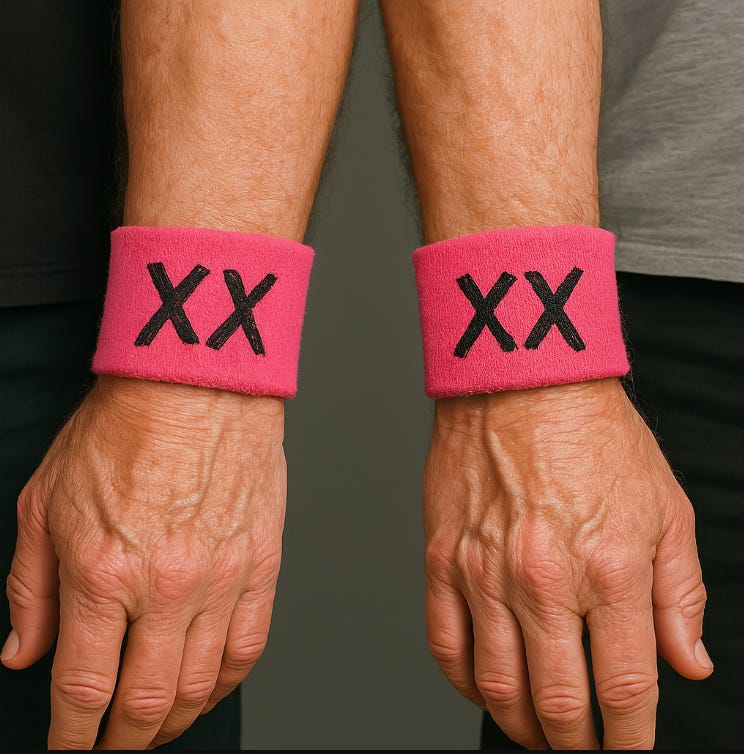
A federal appeals court held Wednesday that a New Hampshire school district likely violated the First Amendment when officials punished parents for silently donning pink “XX” wristbands at halftime — and refusing to remove them — in protest of the opposing girls’ soccer team fielding a transgender player.
That tracks with FIRE’s amicus brief arguing the trial court’s extension of student-speech precedent to adults in public forums is unprecedented, unwarranted, and a serious threat to adults’ exercise of First Amendment rights — rights school officials shouldn’t be policing at events open to the public simply because they disagree with the message.
The court reached its decision without answering whether speech by adults at a public high school event should be governed by the First Amendment rules for public forums, or those that give schools more authority over student speech, such as Tinker v. Des Moines, Hazelwood v. Kuhlmeier, Morse v. Frederick, and B.L. v. Mahanoy. The court also declined to decide whether those student-speech rules give schools the same power over parental or other adult speech.
Rather, the court focused on what it called the narrower “question at the center of this appeal” of whether school officials violated the First Amendment when they used the district’s “Public Conduct on School Property” policy to punish parents for wearing pink “XX” wristbands to protest transgender girls playing girls’ high school sports.
On that score, the court said, “the record evidence demonstrates the likelihood that the school district imposed sanctions … because it disagreed with the protest message conveyed.” That does not square with longstanding Supreme Court law holding “the government must abstain from regulating speech when the specific motivating ideology or the opinion or perspective of the speaker is the rationale for the restriction.”
The court cited the various school officials’ reasons for sanctioning the parents, including the superintendent’s statements that the “XX” symbol conveyed an “exclusionary” message about gender that was “intimidating, threatening, harassing, and discouraging,” and those by the principal who ordered the parents to remove the wristbands, who called the symbol “hateful” and “anti-trans.” In the court’s view, those statements showed school officials were objecting to the viewpoint behind what the parents were saying.
The court also rejected the school’s argument that it had a legitimate interest in restricting the parents’ speech because it might cause a disruption, a standard schools often invoke under Tinker. The evidence showed there was no disruption until school officials chose to intervene to punish the parents. The parents “did not stage any pregame demonstrations; did not march, shout, chant, or otherwise disrupt the game;” and did not confront the opposing player. Instead, they “waited until halftime before donning the ‘XX’ wristbands in a passive, silent gesture of protest.”
There was also “no evidence of harassment, given there is no evidence … any player actually saw the wristbands.” That undercut the school district’s claim it had an affirmative duty under Title IX to protect students from the speech, especially given the later-decided Supreme Court case that recently upheld state laws restricting sports participation based on sex assigned at birth.
As the court put it, “The characteristics of the school as a place of learning reinforce that administrators cannot favor one side of a debate involving parental speech on an issue of prominent public concern, and which, in those parents’ views, concerned the safety of their children.”
Because the silent display of the “XX” symbol fell short of disruption or harassment, the appeals court held the district court was wrong to conclude those interests justified restricting the speech. It accordingly returned the case to the trial court to determine whether to grant an injunction or if relief like a declaratory judgment would suffice.
They were not protesting 'trans school athletes". They were protesting male athletes competing in female competitions.
Kudos to the judges and to FIRE for highlighting the unconstitutionality of viewpoint discrimination. Is FIRE going to say anything about the recent flagrant viewpoint discrimination of 128 retired judges?
Almost a week ago, on Aug. 23 David Lat (a member of FIRE's Advisory Council) highlighted that on Aug. 18 a veritable militia of retired federal and state judges tried to have an attorney sanctioned based expressly on viewpoint discrimination. See https://davidlat.substack.com/p/dhs-general-counsel-james-percival-chief-judge-yvonne-gonzalez-rogers/comments.
128 retired judges sought to have an attorney "disciplined" for his speech, and with their own words they condemned themselves (and Florida's Supreme Court and the highest courts of other states). They proved clearly and convincingly that they were motivated by unconstitutional viewpoint discrimination. They repeatedly focused on speech that they thought might merely "impugn" the purported "integrity" of a judge. They focused on attorneys' "making disrespectful" so-called "attacks on judges" instead of providing mere "respectful critique" of "rulings." They repeatedly focused on "statements" that "disparage the judges," "disparaging remarks against a judge;" "disparaging comments" and “ad hominem attacks on the judiciary." Some 21 times, the judges' letter used some variation of the word "attack." Viewpoint discrimination permeated their letter and condemned them, their complaint and the courts and judges who have acted on similar sentiments and words.
The truth about the Florida rule, itself, is that it is the epitome of unconstitutional viewpoint discrimination. All such so-called "rules" of every state (targeting attorney speech that merely "impugns" the "qualifications or integrity" of actual or potential public servants) clearly and irrefutably violate our Constitution. They expressly target only criticism (not false flattery) of judges.
Regarding this controversy, it is very well worth thinking about what made the Sedition Act of 1798 unconstitutional. Many people like to say the Act was unconstitutional. But very few can say why. The reason is highly relevant here.
In New York Times Co. v. Sullivan, SCOTUS discussed "the Sedition Act of 1798" without ever bothering to explain how it violated our Constitution. In fact, the Act actually did (and John Adams emphasized that it was meant to) powerfully protect criticism of our public servants. It expressly permitted (and protected) criticism that would bring any national government official "into contempt or disrepute; or to excite against them" even "the hatred of the good people of the United States" unless and until the government proved--to a JURY (of the people) beyond a reasonable doubt--first and foremost, how such speech was "false" and then also proved how it was both "scandalous and malicious."
Even so, the Act violated our Constitution--for a reason that wasn't emphasized until well after Sullivan. Now, we commonly call it "viewpoint discrimination." “Viewpoint discrimination is poison to a free society;” so now we acknowledge that “it is especially important” that courts emphasize “that the First Amendment does not tolerate viewpoint discrimination” by any public servant against any people. Iancu v. Brunetti, 588 U.S. 388, 399 (2019) (Alito, J., concurring). It “is a bedrock principle underlying the First Amendment” that “government may not prohibit the expression of an idea simply because” somebody (especially a public servant) “finds the idea” merely “offensive or disagreeable.” Texas v. Johnson, 491 U.S. 397, 414 (1989).
Any “regulation of speech because of disagreement with the message it conveys” violates our Constitution. Ward v. Rock Against Racism, 491 U.S. 781, 791 (1989). Judges “target[ing]” an attorney's “particular views” commit “blatant” and “egregious” “violation[s] of the First Amendment.” Rosenberger v. Rector & Visitors of the Univ. of Va., 515 U.S. 819, 829 (1995). Courts are “limited public forum[s]” in which judges “may not” ever “discriminate against speech on the basis of its viewpoint.” Id.
FIRE should (finally) start telling the truth about unconstitutional viewpoint discrimination to which Americans have been subjected by judges in recent years. All Americans should impugn the qualification, as well as the integrity, of any judge who contends or pretends that any attorney may be punished or penalized for any expression because it merely is disrespectful to or disparaging of a judge or merely impugns the qualifications or integrity of a judge and it merely is "unfounded."
The standard stated in all such state rules of professional conduct comes directly from New York Times Co. v. Sullivan. In Sullivan, SCOTUS unanimously emphasized "the First Amendment guarantees” establish the impropriety of imposing "any test of truth" that "puts the burden of proving truth on the speaker." "The constitutional guarantees require" a "federal rule that prohibits a public official from" penalizing or punishing criticism "relating to [any] official conduct" for its content until someone "proves that the statement was" (first and foremost) a "falsehood" and then proves that it also was "made with ‘actual malice’—that is, with knowledge that it was false or with reckless disregard of whether it was false or not."
At the same time, in Sullivan SCOTUS (foreshadowing the subsequent statements in Garrison v. Louisiana) focused specifically on criticism of judges and invoked prior precedent focusing on criticism of judges:
"Injury to official reputation error affords no more warrant for repressing speech that would otherwise be free than does factual error. Where judicial officers are involved, this Court has held that concern for the dignity and reputation of the courts does not justify the punishment as criminal contempt of criticism of the judge or his decision. [citing Bridges v. California]. This is true even though the utterance contains ‘half-truths’ and ‘misinformation.’ [citing Pennekamp v. Florida]. Such repression can be justified, if at all, only by a clear and present danger of the obstruction of justice. [citing Craig v. Harney and Wood v. Georgia]."
Clearly "judges are to be treated as ‘men of fortitude, able to thrive in a hardy climate.' " (quoting Craig v. Harney). "Criticism of their official conduct does not lose its constitutional protection merely because it is effective criticism and hence diminishes their official reputations."
Months later, in Garrison v. Louisiana, SCOTUS (again unanimously) focused squarely and directly on statements by a government attorney who did something very similar to Percival. Garrison publicly implied eight judges were inexcusably lazy or maybe even criminally corrupt. Even so, SCOTUS emphasized that judges are "public servants" and the “public interest in a free flow of information to the people concerning public officials, their servants” is “paramount,” so “anything which” even “might touch on an official’s fitness for office is relevant” and protected, including judges’ “dishonesty, malfeasance, or improper motivation.”
“Truth may not be the subject of” any type of content-based “sanctions” “where discussion of public affairs is concerned,” so “only” such “statements” as have been proved to be “false” may be punished with “either civil or criminal sanctions.” Our Constitution “absolutely prohibits” any content-based “punishment of truthful criticism” of any public servant’s public service.
As emphasized in Milkovich v. Lorain Journal Co. in 1990, expression and communication by even a government-employed attorney “relating to matters of public concern” must be proved (by the government) to “contain” at least a “false factual connotation.” Until the government bears that burden such expression and communication must “receive full constitutional protection.” Punished speech must be proved to at least “imply” an “assertion of fact” that was proved “false.” Our Constitution requires “a federal rule that prohibits a public official from” punishing or penalizing criticism “relating” to “official conduct” “unless [someone] proves” material facts establishing how it was a “falsehood” and how it “was made” with “actual malice.” “This rule” necessarily precludes any purported “rule compelling the critic of official conduct to guarantee the truth of all his factual assertions.” (Milkovich quoting Gertz v. Robert Welch, Inc., 418 U.S. 323 (1974) (quoting Sullivan).