


Last year, attempts to censor faculty speech on campus hit record levels, with more than one attempt per day. In total, FIRE’s Scholars Under Fire database recorded 525 sanction attempts, with 460 resulting in some form of punishment, including 29 firings. Even if we count multiple incidents at the U.S. Naval Academy as a single entry, 2025’s total still breaks records going back 25 years.
Almost all these sanction attempts came from the right of the faculty member’s expression.
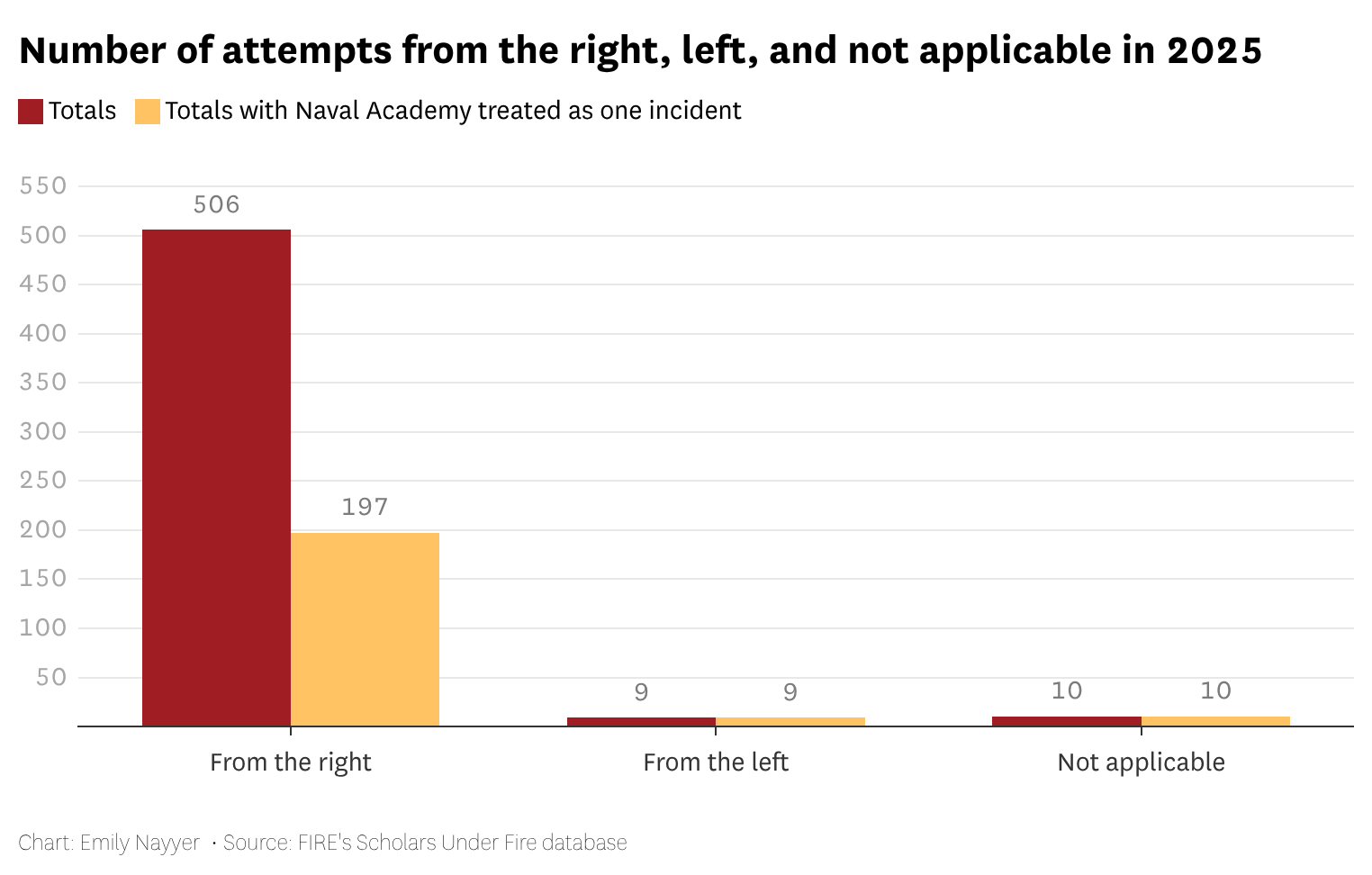
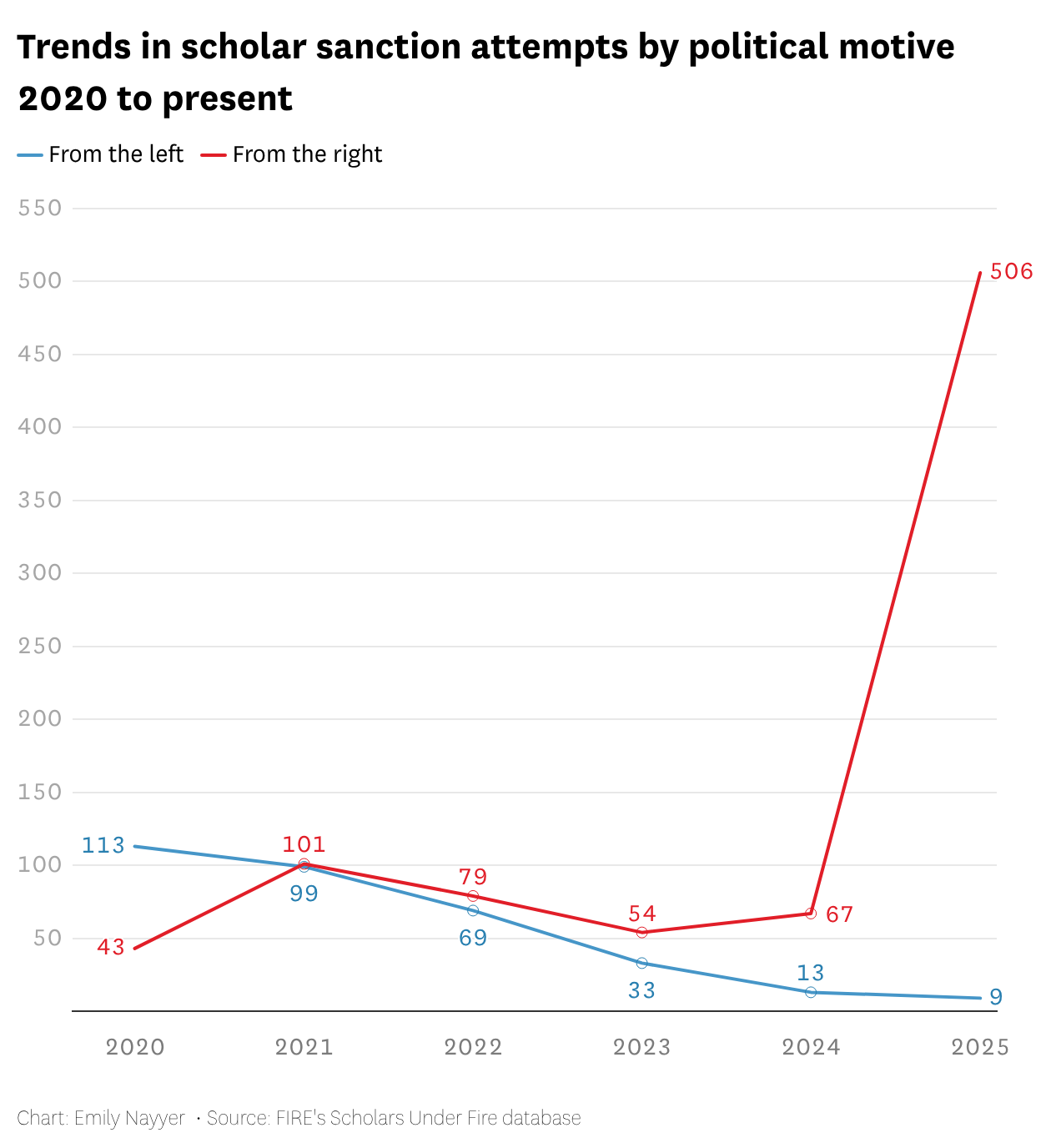
This accelerated a long-term trend — attempts to sanction scholars coming from the left of their expression have declined every year since 2020, while attempts from the right have exceeded those from the left every year since 2021.
As we’ve noted, government actors targeting faculty expression were the main driving force last year behind the surge in attempts to sanction scholars. This includes the removal of almost 400 books from the shelves of the Naval Academy’s Nimitz Library following directives from the Pentagon to comply with President Trump’s executive orders opposing diversity, equity, and inclusion efforts.
Many of these books were authored, co-authored, or edited by academics, including:
The Man Who Would Be Queen: The Science of Gender-Bending and Transsexualism (2003) by Michael J. Bailey, which sparked backlash from transgender activists for defending sexologist Ray Blanchard’s typology, which divides trans women into “homosexuals” who are attracted to men and “autogynephilics” who are aroused by the idea of having a female body.
Getting to Diversity: What Works and What Doesn’t (2022) by Frank Dobbin and Alexandra Kalev, which summarizes decades of research on common diversity initiatives like bias-training to conclude that such efforts often fail to achieve their goals.
The New White Nationalism in America: Its Challenge to Integration (2004) by Carol M. Swain, which argues that the best response to white nationalism is debate, not deplatforming. Swain, who retired from academia in 2017 following a cancellation campaign over her position that Islam poses a threat to America, said, “I will not miss what American universities have allowed themselves to become.”
The actions of state legislatures also chilled faculty expression in 2025.
One particularly egregious example occurred at Texas A&M University last fall. Melissa McCoul, a senior lecturer of English, was fired after a student secretly recorded part of her Literature for Children class, which included a discussion of gender identity and a slide image of a gender unicorn — a graphic used to teach children about gender identity and sexuality. In the video, the student challenged McCoul, claiming the material was “illegal” under state policy and citing Trump’s executive order on gender identity. The student then reached out to the university’s president, Mark Welsh, who defended McCoul’s inclusion of the content.
But the course was still canceled. Brian Harrison, a state representative, then posted the student’s video on X and wrote a letter to the Trump administration, calling for an investigation. Harmeet K. Dhillon, assistant attorney general for the Justice Department’s Civil Rights Division, called the incident “deeply concerning” and said her division would “look into this.” Texas Gov. Greg Abbott said McCoul acted “contrary to Texas law.”
McCoul was fired and Mark Zoran, the dean of the College of Arts and Sciences, as well as Emily Johansen, the head of the English department, were demoted. Harrison and Lt. Gov. Dan Patrick then demanded Welsh’s termination too. A week later, Welsh resigned. Mission accomplished. But unfortunately, these actions have ripple effects that do not end when the cancellation efforts cease.
What is needed most is courage. Courage from faculty, from students, but especially from administrators. With governors, state legislatures, members of Congress, and even the White House moving aggressively to police campus expression, college and university administrators have an opportunity to reclaim their role as stewards of free inquiry by recommitting to academic freedom in a way that allows expression even when it’s unpopular or offensive.

Bottom line: the government cannot be involved in advocating OR opposing DEI. We, the people, can do that all on our own.
It sure would be nice if the cultural pendulum would swing a lot less. Perhaps a sway? Or an oscillation? Imagine the potential if we could somehow get it down to a wobble!
Would FIRE count this as censorship, or cancel culture? https://nypost.com/2026/01/28/us-news/virginia-nurse-malinda-cook-fired-after-encouraging-colleagues-to-inject-ice-agents-with-paralytic-drug/