


“The federal government and state governments, using the levers of state power, are now the leading forces behind attempts to punish campus speech.”
— Greg Lukianoff, writing for The Dispatch on government threats to free speech on campus.
Federal judge blocks detention of British activist
A U.S. federal court issued an injunction preventing the Trump administration from detaining or deporting the activist Imran Ahmed, a British national and lawful permanent U.S. resident, while his constitutional claims are litigated.
The Trump administration is targeting Ahmed — the founder and CEO of the Center for Countering Digital Hate, a nonprofit that campaigns to deplatform people it believes promote hate or disinformation online — for pressuring U.S. tech platforms to suppress disfavored speech, but Ahmed claims the government is acting beyond its authority and in retaliation for protected advocacy.
Ex-CEO sues Alamo over ousting
Kate Rogers — former CEO of the Alamo Trust, a non-profit organization that operates the famed Texas site — is pursuing a federal lawsuit against the Trust and Lt. Gov. Dan Patrick, claiming she was forced out for being “woke” due to her 2023 doctoral dissertation about including indigenous peoples’ history in the story of the Alamo, an Alamo Trust social-media post recognizing Indigenous Peoples’ Day, and a “land acknowledgment” plaque to be placed in the lobby of the visitors’ center.
Rogers is seeking reinstatement and damages, claiming state officials pressured the Trust to remove her in retaliation for protected academic and personal speech.
Below the fold
The U.S. Court of Appeals for the Eighth Circuit revived a First Amendment lawsuit by Missouri school employees, ruling that the alleged chilling effect of mandatory anti-racism training qualifies as an injury for standing, potentially broadening how courts assess compelled speech in public employment.
In the frame
Public Access, premiering at the 2026 Sundance Film Festival, chronicles the chaotic rise of New York City’s public-access TV scene in the 1970s and 80s, when minimal oversight turned cable into a raw free-speech experiment. Using archival footage and interviews, the film — featuring TV Party, Glenn O’Brien, and Chris Stein, and executive-produced by Steve Buscemi and Benny Safdie — frames public access as an analog precursor to today’s platform battles over tolerating offensive speech.
Now listening
On the Media aired an episode today looking at YouTube channel Jubilee and how its debate format shapes political speech, raising questions about platform gatekeeping and the risks of legitimizing extreme views. The episode also covers the Trump administration’s pressure on museums and monuments to alter historical narratives in a clear example of viewpoint discrimination.
By the numbers
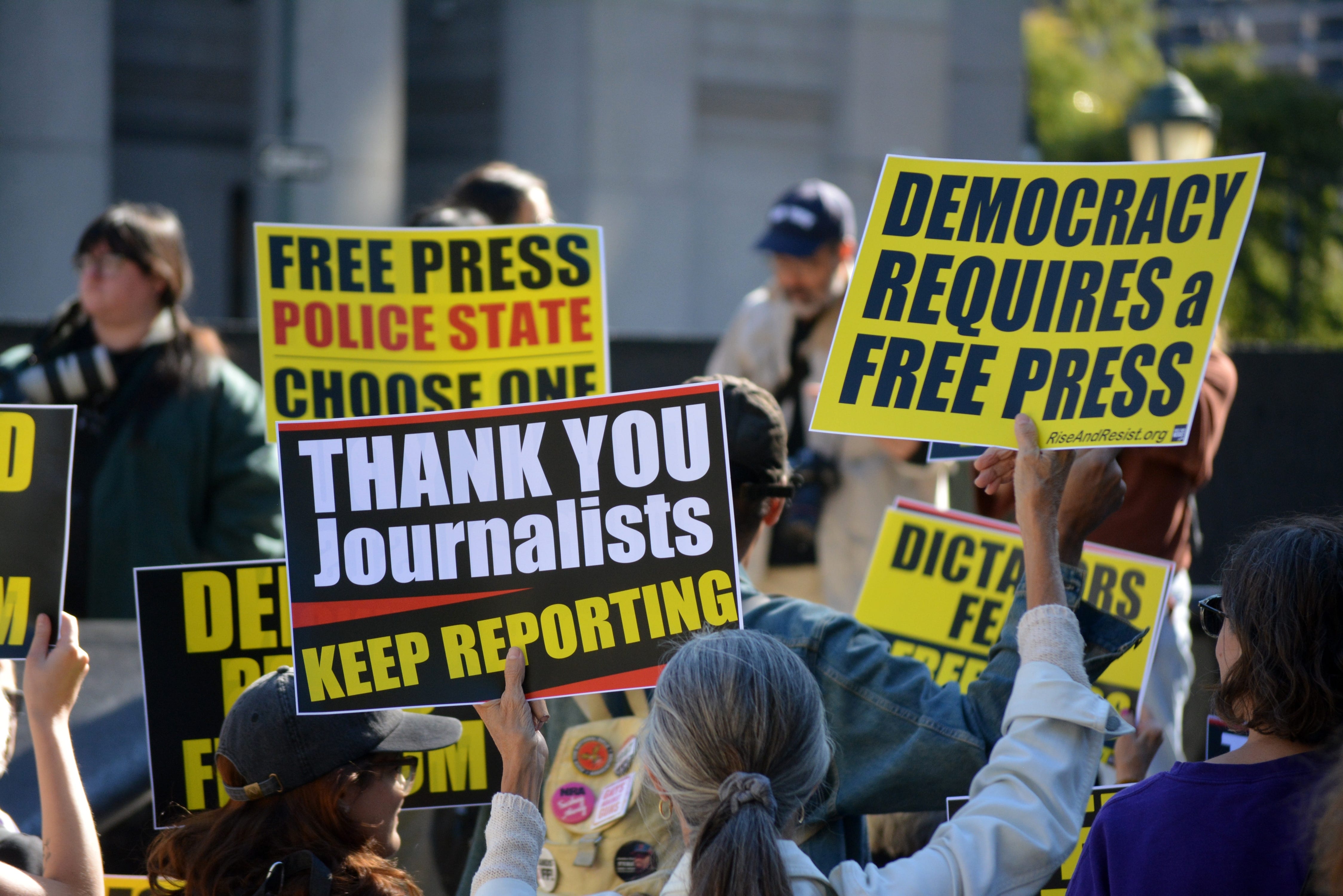
The Associated Press reports press freedom hit a grim low in 2025. A record 126 journalists were killed worldwide, 85 in Gaza alone, and at least 323 are now imprisoned. In the United States, reporters faced 170 assaults, over 94% by law enforcement during coverage of immigration enforcement. Meanwhile, the U.S. journalism workforce keeps collapsing, from 40 journalists per 100,000 people in 2002 to barely eight today. All together, this compounds concerns about accountability, public access to information, and the long-term health of a free press.
Indigenous Peoples Day? Why not Neanderthal Day? Reason enough to fire her.