


“Part of art is about expression, so if we start censoring ourselves then we shut down the core of our creativity, which is where we can discover truth and answers.”
— Demi Moore speaking this week at the Cannes Film Festival.
ABC accuses FCC of chilling speech
ABC accused the Trump administration and the FCC of chilling protected speech by revisiting whether The View qualifies as a “bona fide news program” exempt from equal-time rules for competing political candidates. But as FIRE explained on X:
ABC’s refusal to quietly allow the federal government to dictate the range of viewpoints it may air without fear of retaliation is welcome and commendable. The Federal Communications Commission is not and cannot become the nation’s censor-in-chief, as its chairman once recognized.
Below the fold
Amid reports that President Trump recently labeled Iran coverage “treason,” Marie McMullan warns that officials are increasingly ignoring the post-Watergate law designed to protect reporters from government probes.
A federal judge ordered Texas State University to continue paying philosophy professor Idris Robinson for up to one year or until his lawsuit ends, after the school fired him over a talk he gave about the war in Gaza. He was represented by Samantha Harris and Michael Allen of Allen Harris and FIRE’s JT Morris.
Last month, a bipartisan congressional hearing on free speech in higher education exposed deep disagreements between Republicans and Democrats, Michael Hurley reports, but it also revealed a rare consensus that free expression is indispensable to our democracy.
Figures of speech
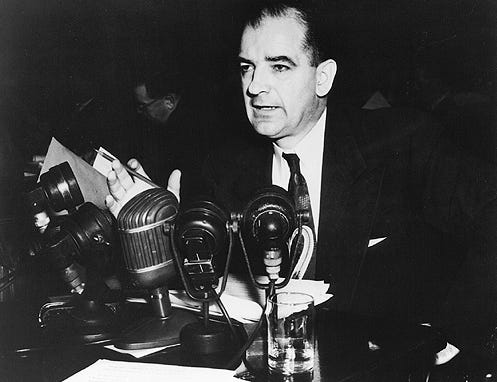
This year, the United States celebrates its 250th anniversary. To commemorate the occasion, FIRE is proud to present the limited series “Figures of Speech,” looking at the heroes and villains of free speech in American history. We begin with the senator who became our censor-in-chief and gave America a new term for political oppression: Joseph McCarthy.
In the frame
Pegah Ahangarani’s Rehearsals for a Revolution, which premiered this week at the Cannes Film Festival, is an intimate documentary about censorship, state violence, and resistance in modern Iran. Rather than constructing a straightforward historical narrative, Ahangarani builds the film through the fragments of family archives, protest footage, personal reflections, and portraits of people she sees as embodiments of dissent across generations. The film traces the arc from the 1979 Iranian Revolution through the Green Movement and more recent protest waves, portraying a society caught in recurring cycles of hope and suppression.
But the documentary is less a journalistic explainer than a cinematic memoir, as it mainly tells the story of Ahangarani, who has suffered oppression by Iranian authorities because of her work. She was arrested after publicly supporting the Green Movement in the wake of Iran’s disputed 2009 presidential election. In 2011, she wasarrested again before leaving to Germany to cover the Women’s World Cup for Deutsche Welle. In her new film, she confronts the machinery of censorship in Iran by incorporating underground recordings, protest archives, and personal materials tied to the very events the government has sought to suppress. The film itself, therefore, is not simply about dissent but an act of dissent itself.
Terms of service
In this episode of Free Speech Future, we look at the history of tech censorship — from video games to social media — and discuss what worked, what didn’t, and where we go from here. The discussion panel includes Nico Perrino, FIRE’s executive vice president and host of the podcast So to Speak; Corbin Barthold, internet policy counsel at TechFreedom and host of Tech Policy Podcast; Christopher J. Ferguson, professor of psychology at Stetson University and co-author of Moral Combat: Why the War on Violent Video Games Is Wrong; and Kmele Foster, co-host of The Fifth Column and editor-at-large at Tangle News. Enjoy.
This week in history
On May 12, 1963, Bob Dylan appeared on The Ed Sullivan Show, then the highest-rated variety program on American television. But during rehearsals, CBS executives objected to the song he planned to perform, “Talkin’ John Birch Paranoid Blues,” a satirical attack on the ultra-conservative John Birch Society and its obsession with Communist conspiracies. The song had been approved, but network officials later feared the lyrics could provoke a defamation lawsuit. Rather than comply with the censorship demand and choose another song, Dylan walked off the show.
The incident generated widespread media attention and backlash. Even Ed Sullivan publicly criticized the network’s decision. In the aftermath, Columbia Records, which was owned by CBS and shared concerns about possible legal liability, removed the song from Dylan’s album The Freewheelin’ Bob Dylan. The controversy became one of the earliest high-profile examples of Dylan clashing with institutional censorship. He would later face similar censorship battles with the BBC and other broadcasters.
By the numbers
Last week, FIRE released results from April’s National Speech Index, a quarterly poll designed to track Americans’ changing attitudes and beliefs about free speech. The results show that the average American opposes censorship far more than college students in this country. We also found that liberals seem to support all forms of protest, even illegal ones, while conservatives tend to oppose protest tactics, even some legal ones.