


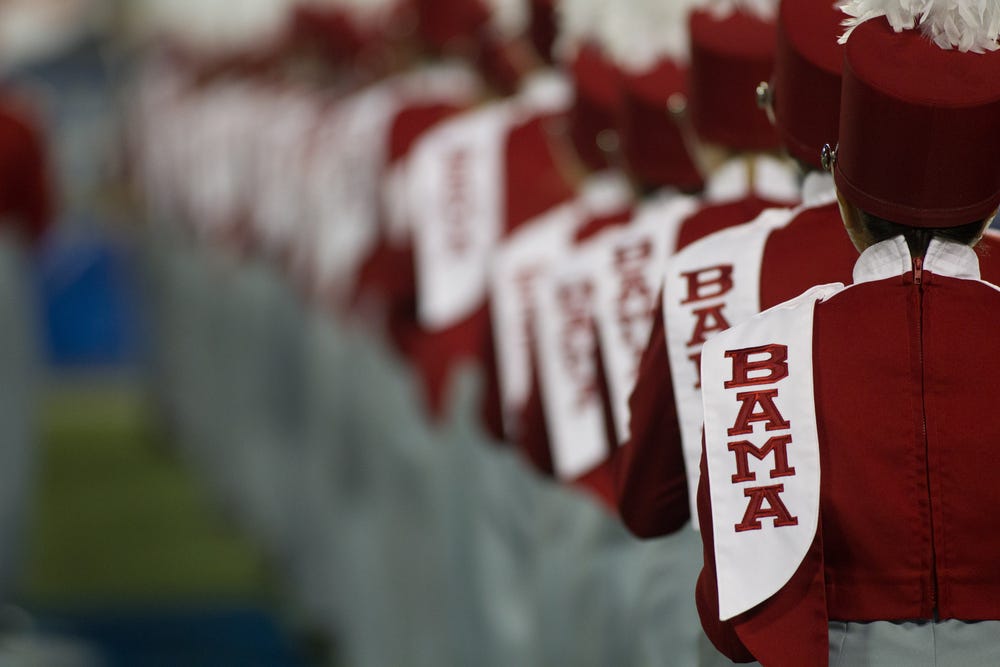
We need to talk about Bama.
The University of Alabama delivered a real blow to the student magazine editors, writers, and photographers who staffed Alice and Nineteen Fifty-Six last December. UA shut down these publications, which focused on women and black students, citing a nonbinding memo from then-U.S. Attorney General Pam Bondi that warned against the use of “unlawful proxies” for discrimination.
What followed was a scene from a student media horror story: Student journalists lost access to their old facilities, and administrators refused to reopen the publications, even after condemnation from student press advocates — including FIRE’s Student Press Freedom Initiative — came flooding in.
Then the next chapter began. Eight student journalists sued UA to get those magazines reinstated and have their free speech rights vindicated.
But we turned the page to find a federal district court’s decision upholding UA’s closure of Alice and Nineteen Fifty-Six — a ruling that threatens student press freedoms nationwide. On May 22, the U.S. District Court for the Northern District of Alabama ruled the university likely did not violate the First Amendment and denied the students’ request for a preliminary injunction.
American Diabetes Association ejects researchers from conference for sharing editorial from its own journal

Last week, several medical researchers were kicked out of an American Diabetes Association conference after handing out copies of an editorial published in the organization’s own flagship journal.
FIRE condemns UA’s censorship of these magazines, and we’re deeply concerned by this ruling.
The court disregarded decades of student press law designating student-run publications as student speech, not government speech. In reaching its decision, the court marked the magazines as akin to curriculum, concluding that “decisions about what educational opportunities to offer belong to the University,” and thus are “University speech, not the speech of students petitioning for a particular class or publication.”
That characterization isn’t just a problem for student journalists at Bama. It risks silencing student media across the country if copied by other courts. Student media is more than just an educational opportunity. Student publications are living examples of democratic values in action — forums for student voices to be shared without administrators interfering with editorial decisions. Student media doesn’t exist to be a mouthpiece for the university. In fact, student media can be the most valuable critics and watchdogs of a college.
Citing Hazelwood v. Kuhlmeier — thus taking a standard designed for high school into the college setting — the court found a workaround for censoring those voices: just silence those publications entirely. The court reasoned that the university could freely open and close a student publication — and the decision, in the court’s words, “will not be reversed based on the government’s intent,” opening the door for potential viewpoint discrimination that, in effect, “drive[s] certain ideas or viewpoints from the marketplace.”
And on the topic of viewpoint discrimination, the court also ruled the magazines were defined by their women or black-focused content instead of a particular viewpoint, dodging the concerns of viewpoint discrimination FIRE and other student press advocates raised.
Viewpoint-based restrictions on speech don’t merely prohibit speech on a particular topic — they shut down a specific side of a debate, a specific point of view on that topic. In Rosenberger v. Rectors and Visitors of University of Virginia, the University of Virginia subsidized publishing costs for nonreligious groups but denied those funds to a Christian student newspaper. The Supreme Court held that the university engaged in unlawful viewpoint discrimination, even though UVA said its restriction applied to all religious groups equally.
A study isn’t 'worthless' because it’s incomplete

This essay was originally published by the American Enterprise Institute on June 2, 2026.
While the district court in the Alice and Nineteen Fifty-Six case decided Rosenberger was inapplicable because of a slightly different publication setup, it’s hard to see why this would make a difference constitutionally, since there’s little doubt that it was the “specific perspective[s] of the speaker[s]” (aimed at female and black readers) that motivated the university to shut down these magazines.
Nonetheless, the students, who are represented by the Southern Poverty Law Center, the ACLU, and the NAACP Legal Defense Fund, are continuing their fight.
Our work at FIRE is far from over — whether it’s supporting student journalists with our advocacy or working to enshrine free speech protections on campus through policy reform. When performing an annual update to FIRE’s Spotlight Database of speech codes recently, FIRE gave UA our highest, “green light” policy rating, a designation for when a college or university’s policies do not seriously imperil speech. That rating does not itself guarantee a school actively supports free expression or a free student press. It simply means the college’s written policies do not threaten students’ free speech rights.
A climate of free expression demands more than the right written policies. Freedom of speech and freedom of the press are fundamental to our nation, and there’s no place where these rights should be more valued and protected than on our college campuses. Shutting down publications degrades the “marketplace of ideas” a public university is expected to preserve. We’ll continue advocating for ‘Bama students — including student journalists — to defend their First Amendment rights.
