


This one’s pretty self-explanatory:
So that’s not great.
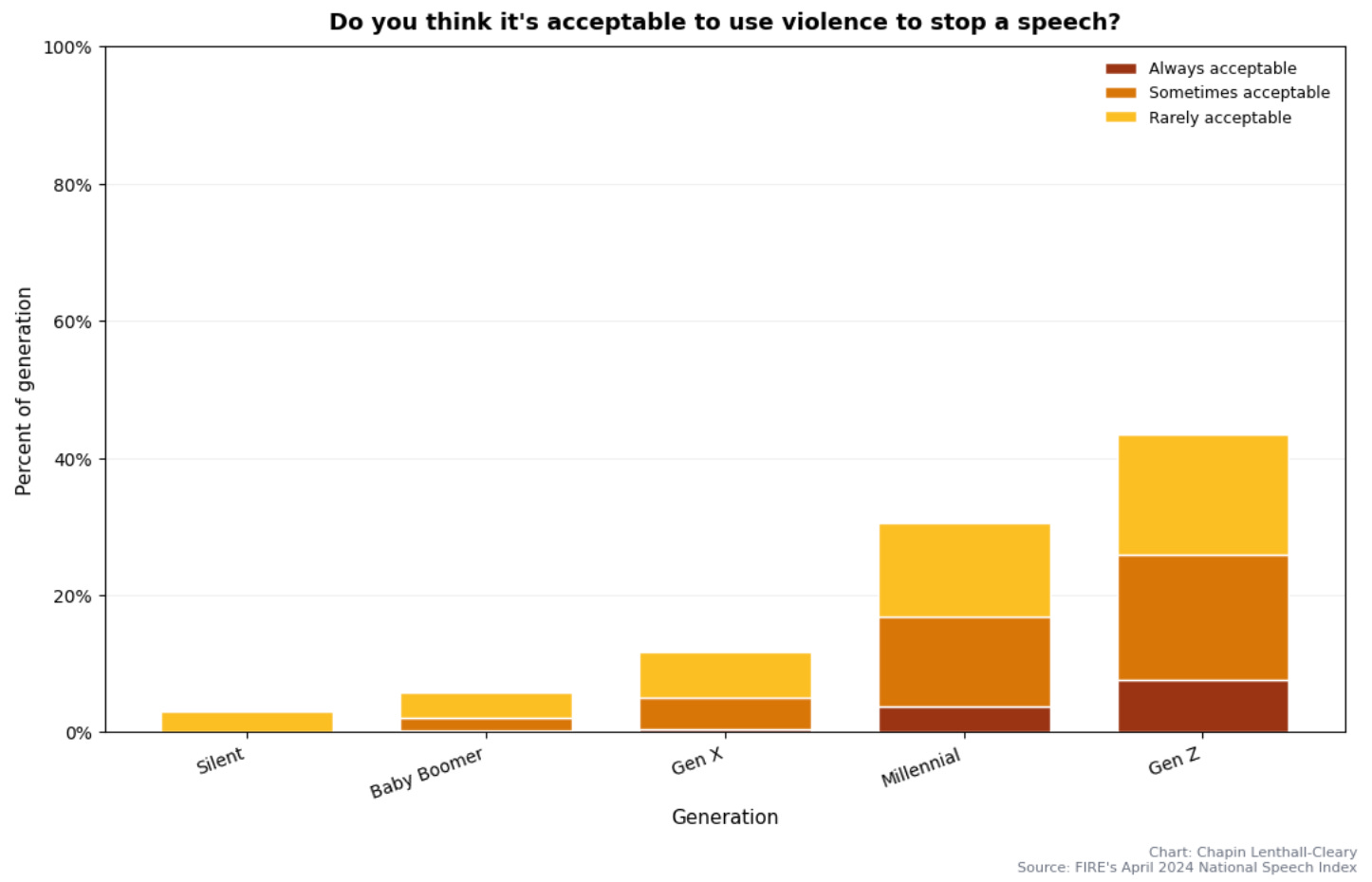
In our National Speech Index, FIRE asks the general public a variety of questions related to free speech, including: How acceptable is it to use physical violence to stop someone giving a speech in their community? Gen Z are 9.6 times more accepting of violence against speakers than Baby Boomers1, and over 25 times more accepting of violence against speakers than the Silent Generation2. Each successive generation is more supportive of violence against speakers than the last, in most cases more than twice as supportive. About 43% of Gen Z say violence against speakers is at least rarely acceptable, and over a quarter say it’s sometimes or always acceptable3.
I consider this an illegitimate (and ineffective) response to legitimate grievances. Whether one believes that there’s a lot wrong with our country or leadership; that Gen Z has gotten a raw deal economically; or even that our politics are completely broken — that break is in part because we have lost the ability to sit down and talk our problems out. Hurting or killing speakers doesn’t fix political issues. It doesn’t do anything about the problems driving the grievances people have. It just foments chaos and creates a new problem to fix.
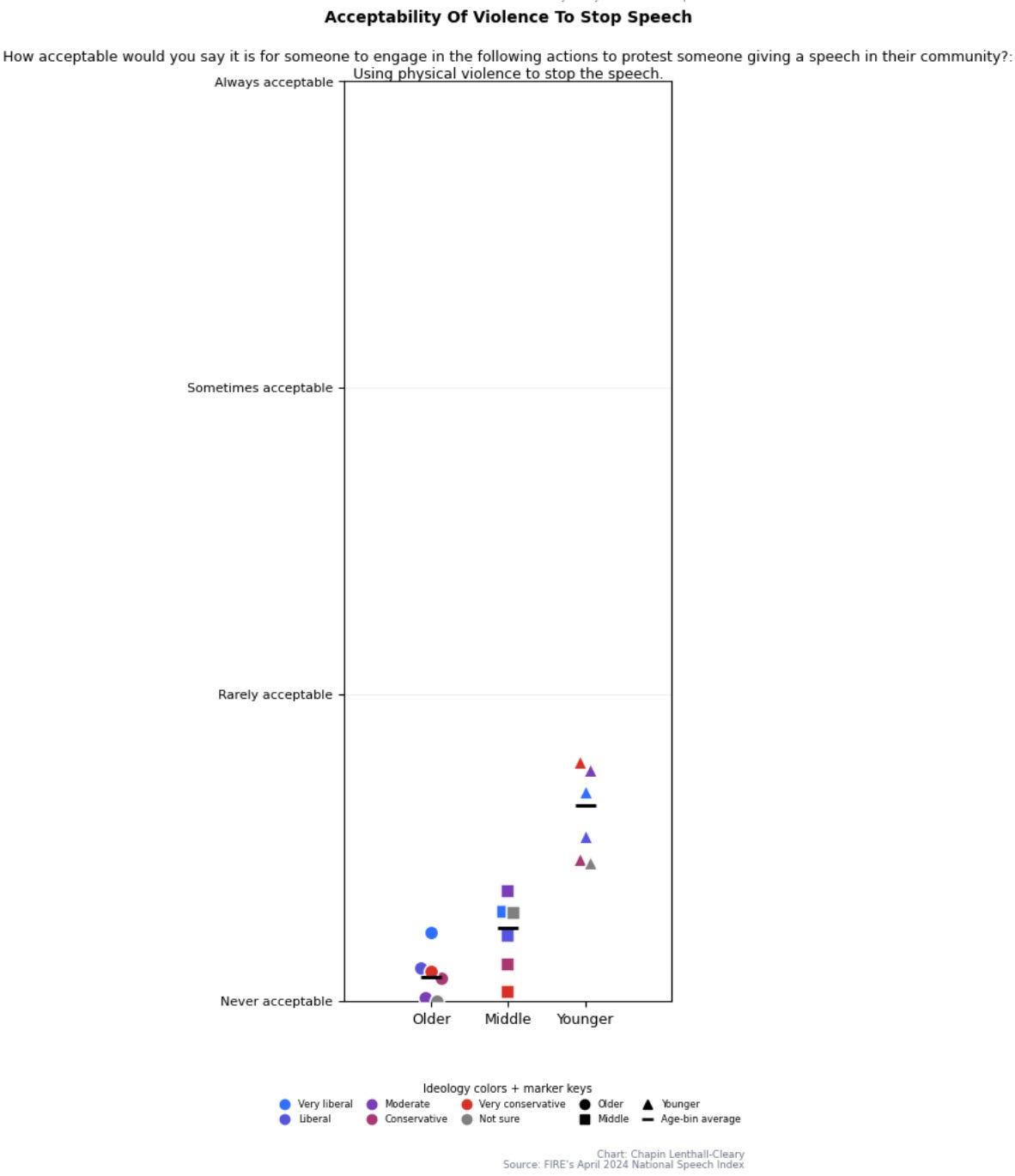
But is this support for violence more a liberal problem? Young people tend to be more liberal, so maybe that’s the real source of the effect. To check, let’s separate the age groups by ideology:
Nope4.
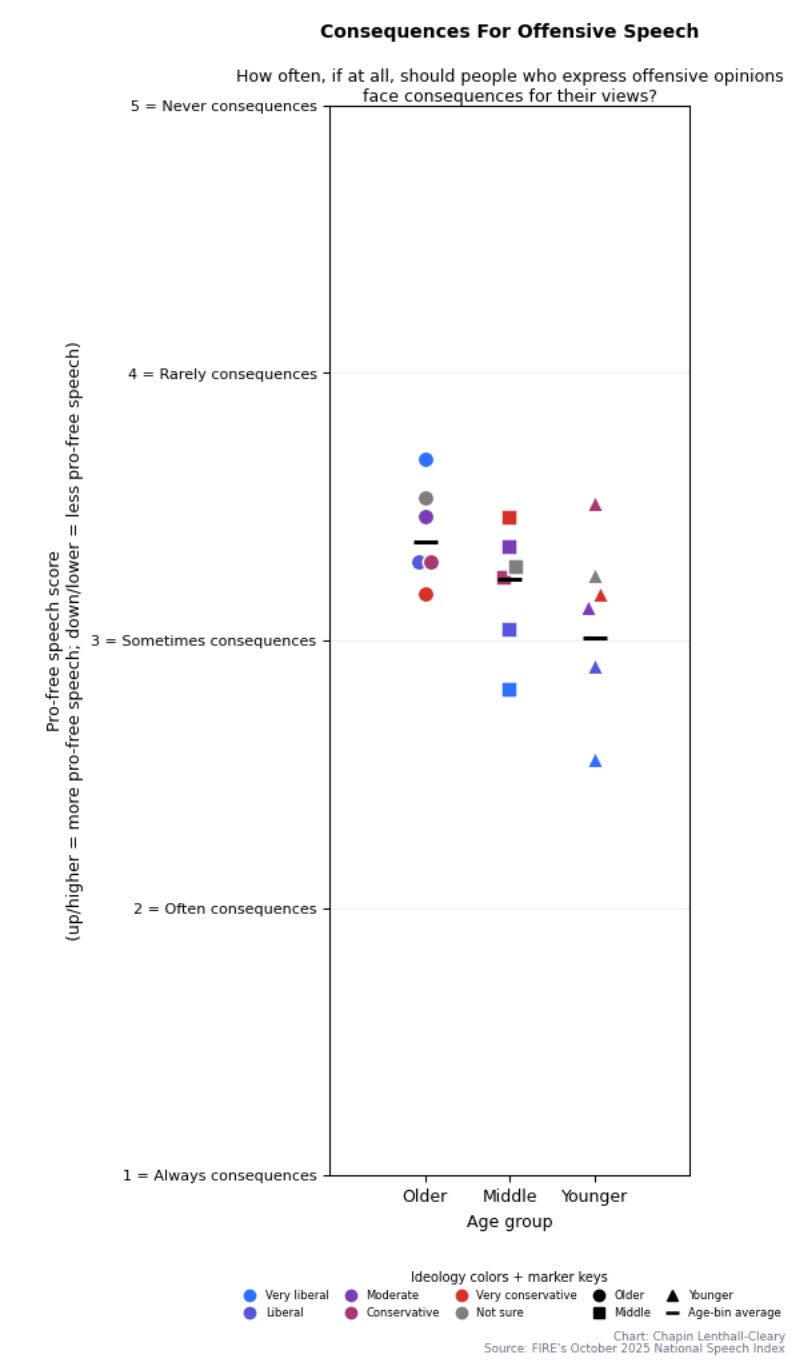
Regardless of ideology, Gen Z is vastly more likely to endorse violence against speakers than Boomers, with that effect being strongest among the “very conservative.” This is primarily a generational divide, and the impact of ideology is a distant second. But the intersection of age and ideology does produce some very interesting effects. When we ask, for instance, about whether offensive speakers should face consequences, we see the opposite effect for old and young liberals:
Heck of a fall.
Compared to any other ideology, young and middle-aged liberals show more support for punishing offensive speakers. When it comes to older people, the opposite is true. In our data, young liberals are the most censorious group while old liberals are the least censorious5. One explanation is simply that we are seeing a semantic shift whereby for many measures, “liberal” has come to represent the opposite of what it once did. Think “woke” vs. old-school Progressives and Classical Liberals.
For those who care about free speech and a culture of open discourse, this should warrant serious attention. I don’t have a silver bullet here. I don’t think there is one. But when this many people start to say they are willing to resort to such a desperate solution, we have to confront the problem before the problem confronts us.
The code, data, and codebook used to generate these plots can be found here.
Measured by average score with never acceptable=0, rarely=1, sometimes=2, and always=3.
Though the sample for the Silent Generation is fairly small.
I know there’s an argument that a better way to measure violence by generation would be data on what those generations though when they were the age Gen Z is now, to account for any changes in attitudes as people age. We unfortunately don’t have that data, but the effect is so strong that those changes seem unlikely to override it anyway.
The age bins here are roughly 20-39, 40-59, and 60+. The young people are Millennials and Gen Z. The middle group is most Gen X, with some older Millennials. The oldest group is boomers and older. Each point is at the mean for people in it, using never acceptable=0, rarely=1, sometimes=2, and always=3.
We should have a bit of caution here: depending upon what sort of free-speech-proxy question we ask, this generational-liberal-swap effect is often smaller or nonexistent. But it does seem to be very real for certain ways of measuring the issue.

Curious. Is there any data about what older generations thought about this issue when they were the same age of gen z respondents today? Like was something like this asked 20 years ago? That would help rule out age -- independent of generation -- as being a contributing factor.
A potential hypothesis is an extension of Mary Harrington's take on support for trans activism amongst gen z; to paraphrase "you can reskin your digital avatar, so why not your meat avatar?"
To extend this to support for political violence amongst gen z: "you can agitate to get someone's account banned/deleted online, so why not agitate to get someone "deleted" in real life?"
Although as the porr fellow who was debating Charlie Kirk at the moment of his assassination found out, it's not at all the same thing.