


Ryan Tsapatsaris holds a PhD in communication and is currently a master of law candidate at the University of Pennsylvania Penn Carey Law.
A professor can survive an online mob. What can change a career is what happens when a university decides to join it.
Over the past quarter century, almost 2,000 scholars have faced sanctions over their speech, with more than 300 of these campaigns resulting in termination or forced resignation. A recent FIRE survey of more than 200 faculty members found that many scholars targeted for their speech experience lasting professional and personal consequences. Many feel betrayed by colleagues and institutions designed to protect them and resent their abandonment. This post draws on over two dozen semi-structured interviews with professors who participated in FIRE’s survey aggregating scholars’ individual sanction narratives into a larger portrait of the contemporary university.
Two initial conclusions from these interviews are clear. First, no targeted scholar emerges unscathed — professional, social, or psychological consequences appear in all interviews. Second, scholars themselves draw an important distinction between being sanctioned (internal, official) and being canceled (external, unofficial).
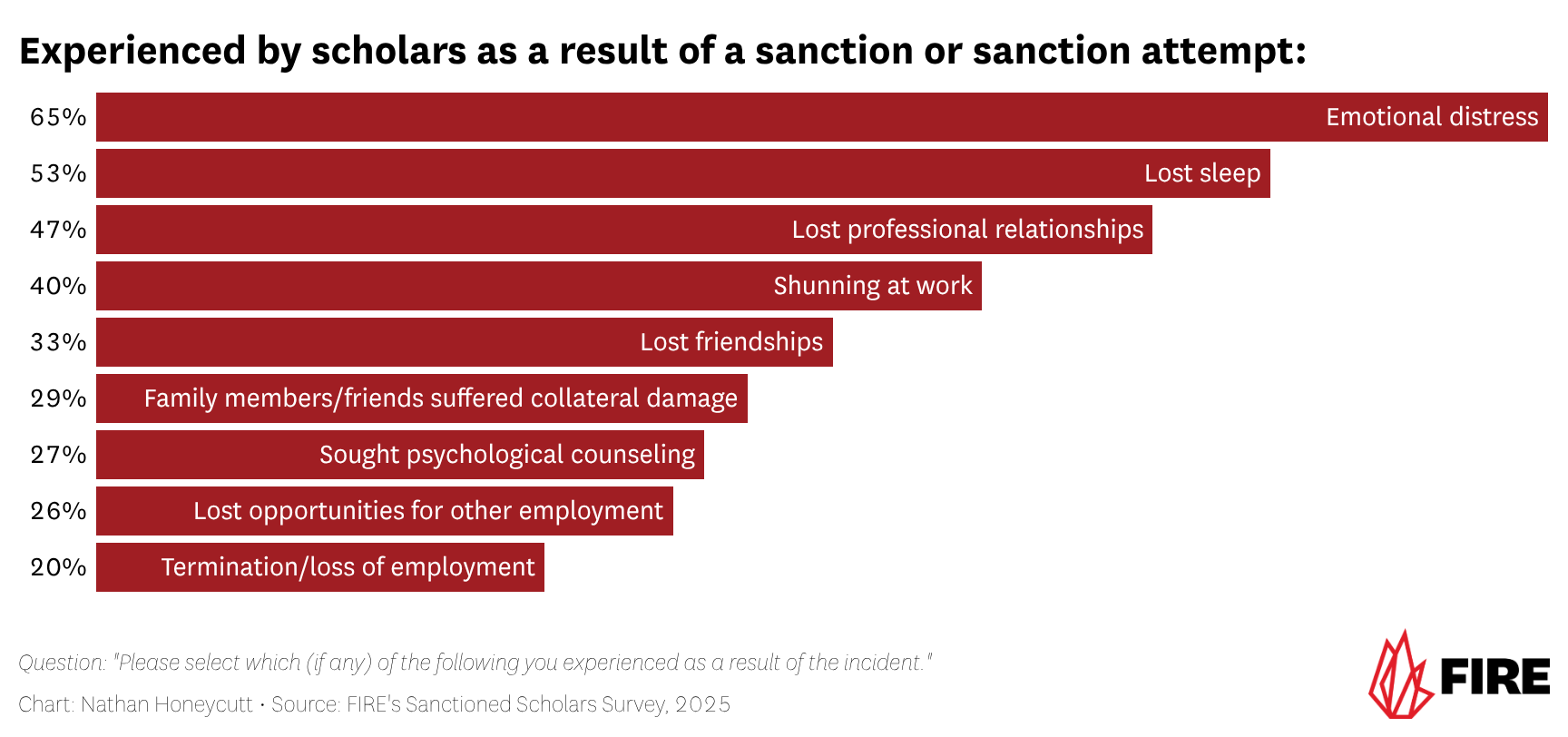
In only 12% of cases did an academic say their careers ultimately benefited from the targeting. But even those scholars described the experience as intensely unpleasant.
“I had all these great things happen after,” one scholar said. But, the person added, “in the middle of things, it was very stressful and disturbing and stuff.”
Another scholar said, “I think professionally, I probably gained more than I lost in the end,” adding, “the whole thing made me stronger,” but only after “a very intense psychological reaction” that included days without sleep and an inability to think about much else.
A scholar who described their sanctioning as professionally “elevating” still called it “emotionally difficult” and “a hard thing to go through,” remembering the early days as “hellish.”
For others, the professional consequences did not fade. One scholar who faced backlash after publishing an essay said that being placed on a Turning Point USA watchlist coincided with a sharp decline in speaking invitations: “What I have noticed, since I was on the list, my speaking engagements have radically dropped.”
Financial consequences were a common concern among both cancelled and sanctioned academics.
But the interviews also showed why faculty were clear to distinguish sanction from cancellation. One interviewee, asked to discuss the event that got them sanctioned, immediately objected: “I haven’t been sanctioned.” Emphasizing that they had never faced official institutional punishment, they instead described the experience as being “targeted” or “canceled.”
Another scholar who has had at least one hairy run-in with his university offered a similar definition: “I hear the word sanction as being some sort of official [disciplining].”
Sanctions are particularly virulent to intellectual expression because they make a scholar vulnerable by removing institutional safeguards and encouraging non-collegial behavior. As the target of a cancellation-cum-(failed) sanction said, “I think there was just plain underlying academic jealousy” and “just this oversized reaction,” and that colleagues seemed to hold the sentiment that they were “finally going to punish” this scholar “for everything that has built up for the last two decades.”
Reflecting during the interview, this interviewee realized other members of their department removed them from Covid-era Zoom department meetings. However, even if the scholar had noticed their exclusion at the time, who would they have turned to for help? The university issuing press releases condemning them? The vulnerability of a sanctioned scholar cannot be understated. Another academic told a story of having their teaching interrupted so an adjunct faculty member from their department could “scream” at them that they “shouldn’t even be at this university.”
Sometimes, the cause for sanction, targeting, or cancellation are sufficiently carcinogenic to free inquiry on their own. Although a cancelled professor retains their institutional protections, many institutions are ill-equipped to handle external actors. One scholar remembers:
I had the chancellor of my campus calling me, asking me, “what can we do to help you?” I just remember looking at my husband, because I had her on speakerphone. I don’t fucking know. Shouldn’t you guys know? Why are you asking the pre-tenure chick? Isn’t there a manual or something?
Levels of support differ vastly across institutions when a scholar is targeted. One academic who has faced numerous cancellation campaigns across two universities said that at their first university, “It would have been great to have reassurance by someone in a leadership power position” to say that such illiberal campaigns “will not impact you negatively, when you go up for tenure, promotion, etc.” At the scholar’s second university, “the Provost didn’t just have a meeting with me, he convened a meeting of both my entire department and [other relevant] department[s] to answer questions related to academic freedom and people being attacked.”
Whether an institution supports a cancelled scholar or not, being targeted is often more dangerous than being sanctioned. The same academic, highlighting the role of social media in cancellation, darkly described how online, “Women get rape threats, men get death threats.” Threats of physical violence are more likely to arise from cancellation primarily because of the presence of outside actors. One academic discussed hiring full-time bodyguards to protect themselves and their family during a particularly tenuous period where they were in the public eye. Even when these threats are illegitimate or mitigated, scholarly production is often chilled, one academic reveals that after cancellation they “sat on research and didn’t put anything out for a while.”
Sanction and cancellation are bad enough on their own, but a successful cancellation-cum-sanction is a beast all its own. The most vicious threats were reported by an untenured scholar whose sanctioning included their university inviting a speaker whose talk implicitly called for violence against the academic. After deactivating their social media, their husband received a:
threat in which somebody said they were going to dismember our then 3-year-old child and scatter his body parts so wide around the [area] where we live that nobody would find all the body parts. Then [they] would proceed to rape me while he was forced to watch, then decapitate me, and then finally, murder him. [His] family all lives [out of the country and at the same time] reported receiving strange messages on Facebook in a language they didn’t know.
Thankfully, nothing has ever come of these threats. However, the scholar remains a part-time adjunct.
Whereas cancellation is primarily beyond the scope of a university’s purview, at a minimum the university must not legitimate external targeting of a scholar through sanction. In one case, a single email from a random person with no affiliation to the university triggered an internal investigation of a scholar. This is incompatible with free inquiry. In contrast to cancellation, an institution is almost wholly in control of whether a scholar is sanctioned. In these cases, the ethic of institutional neutrality becomes paramount.
Institutional neutrality is a principle meant to prevent universities from taking positions on hotly contested topics. By remaining neutral, a university preempts the formation of a hierarchy of viewpoints and the seductions of becoming an echo chamber. If a university is avowedly institutionally neutral, it is much more difficult to sanction a scholar for their views. The scholar cannot diverge from the university’s position because the university has no position! As the Kalven Report elegantly put it, “The university is the home and sponsor of critics; it is not itself the critic.” When sanctioning a scholar over their expression or trajectory of inquiry, the university forgets itself and its purpose.