


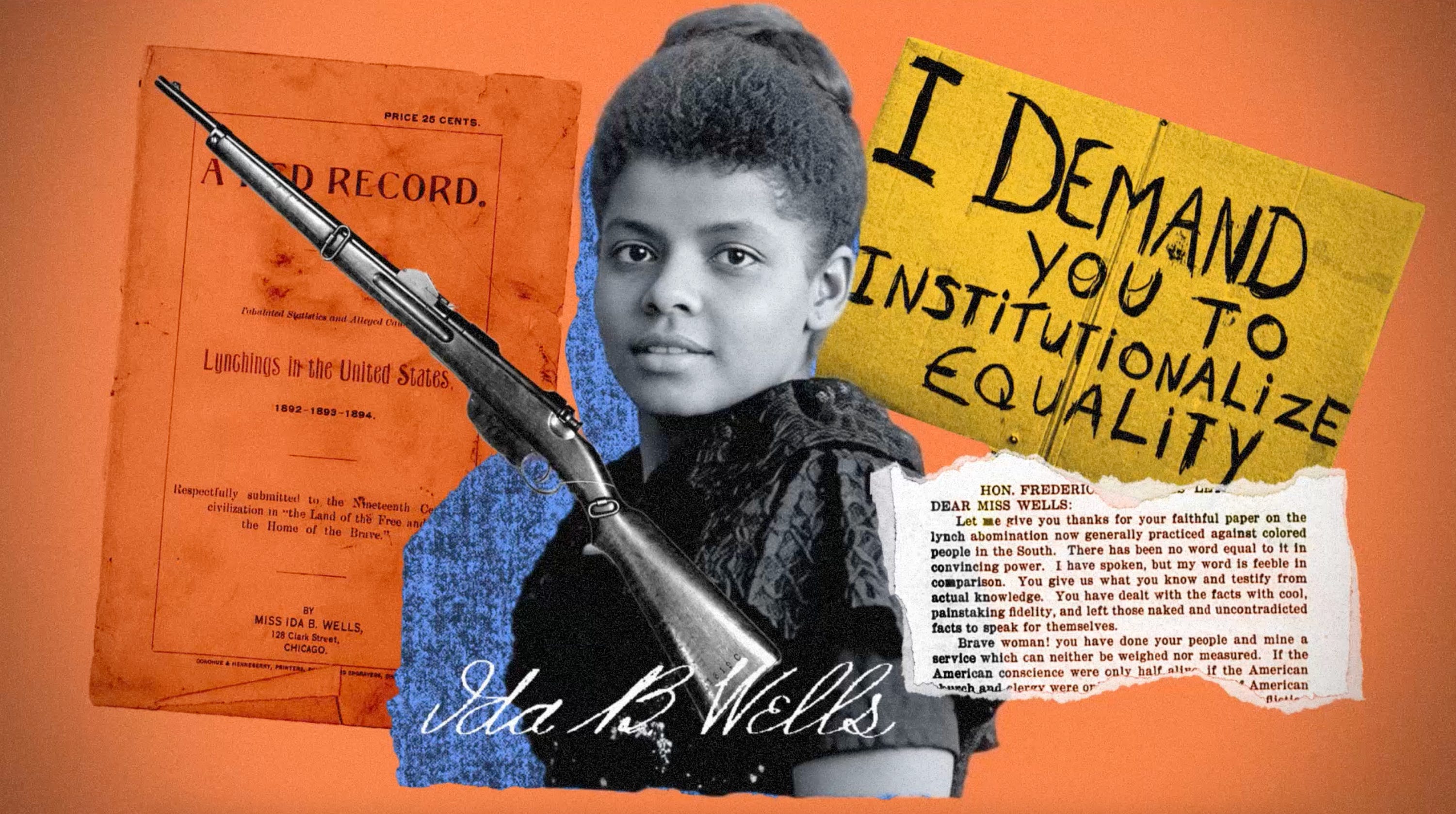
This year, the United States celebrates its 250th anniversary. To commemorate the occasion, FIRE is proud to present the limited series “Figures of Speech,” looking at the heroes and villains of free speech in American history. We began with Joseph McCarthy, the senator who scared America silent. Then we looked at Thomas Paine, American history’s winter soldier, and Woodrow Wilson, our worst president for free speech. Today we turn to Ida B. Wells, a journalist, activist, civil rights icon, and free speech hero.
If you visited the Chicago home of Ida B. Wells in the late 1890s, you’d likely find a gun within the lady’s reach.
“A Winchester rifle should have a place of honor in every black home,” she wrote in her 1892 pamphlet Southern Horrors: Lynch Law in All Its Phases, “and it should be used for that protection which the law refuses to give.”
Unfortunately, she lived at a time when the law gave her very little. But as a journalist, activist, and public speaker, she rose above her circumstances to become one of America’s most important civil rights icons. Through her detailed reporting on lynching in the United States after the Civil War, Wells did more than most to demonstrate the power of using one’s voice in the pursuit of truth and justice.
Ida Bell Wells was born July 16, 1862, the first child of James and Elizabeth Wells, two slaves on the Boling plantation in Holly Springs, Mississippi. The Emancipation Proclamation would be issued six months later, and Ida’s parents moved quickly to assert their independence. James, a carpenter by trade, founded his own business and became well known in Holly Springs for his political activism. Elizabeth joined her children in school until she learned to read and write, showcasing a steadfastness and perseverance that Ida would later embody in her own work.
When Wells was 16, a yellow fever epidemic struck the south, claiming her parents and youngest brother. Refusing to allow the surviving family to be split up, Wells found work as a teacher in a nearby town to support her siblings. Two years later, she moved with her two youngest sisters to live with an aunt in Memphis Tennessee, and continued her work as an educator in various schools nearby.
Soon after arriving in Memphis, two incidents involving the Chesapeake, Ohio & Southwestern Railroad company lit a fire in Wells, kickstarting her journalistic and activist career. After refusing to give up her first class seat on the conductor’s orders, Wells was forcibly removed from the train car. She was furious and sued the railroad over her mistreatment. She initially won, but the Tennessee Supreme Court would later overturn the ruling, claiming that Wells’ purpose with the lawsuit was to “harass” the railroad company.
Perhaps naively, Wells was shocked by this outcome. “I have firmly believed all along that the law was on our side and would, when we appealed it, give us justice,” she later wrote. “I feel shorn of that belief and utterly discouraged.”
Soon after, Wells began writing for the Memphis publications The Living Way and The Evening Star, attacking racist Jim Crow policies and exposing the conditions of African American schools in the region. Her criticisms led to her teaching contract not being renewed, and while she lamented the loss of a beloved profession, she was undeterred. She soon bought a partnership in and became editor of the local Memphis paper Free Speech and Headlight. Circulation tripled under her stewardship, and it is in the pages of Free Speech that the next major turning point in Wells’ life would occur.
The way to right wrongs is to turn the light of truth upon them.
After the lynching of her friend Thomas Moss and two others by a racist mob in 1892, Wells dedicated her life to exposing the horrors of lynching across the country. Writing first for Free Speech, and later in dedicated pamphlets like Southern Horrors, Wells would single-handedly bring what she labeled an “awful indictment against American civilization” to the public’s attention, and craft one of the first data-driven journalistic exposés in American history.
However, this also led to more controversy and danger for Wells. She published an editorial in Free Speech refuting “that old threadbare lie that Negro men rape white women,” and commented that, “if Southern men are not careful, a conclusion might be reached which will be very damaging to the moral reputation of their women.” The article was republished in various other Memphis newspapers, along with commentary decrying Wells’ “loathsome and repulsive calumnies.”
“Patience under such circumstances is not a virtue,” another newspaper forebodingly added, mistakenly thinking Wells was a man. “If the Negroes themselves do not apply the remedy without delay it will be the duty of those whom he has attacked to tie the wretch who utters these calumnies to a stake at the intersection of Main and Madison Sts., brand him in the forehead with a hot iron and perform upon him a surgical operation with a pair of tailor’s shears.”
Days later a mob descended upon the offices of Free Speech and Headlight, destroying it. Creditors seized and sold the newspaper’s assets. Co-owner James L. Fleming was forced to flee Memphis. Reverend Taylor Nightingale, who had founded the paper but sold it to Fleming and Wells, was assaulted and forced at gunpoint to sign a letter retracting the editorial.
Wells had been vacationing in New York City during the sacking of Free Speech, but trains were reportedly being monitored in case she returned. She never did. She stayed in New York City, working briefly for The New York Age before permanently relocating to Chicago the following year.

Her work investigating and campaigning against lynchings, however, remained uninterrupted. In 1895 Wells published A Red Record, a 100-page pamphlet outlining her sociological research on lynching in the United States since emancipation, as well as the overall struggles of African Americans after the Civil War. Since 1865, she wrote, “ten thousand Negroes have been killed in cold blood without the formality of judicial trial and legal execution.”
Wells’ reporting brought lynching to the forefront of the American consciousness — particularly in the North, where the general public knew very little about it. She also gained international notoriety, traveling to Europe on lecture tours and helping to build anti-lynching coalitions in Britain.
In Chicago, Wells continued her work in journalism but also expanded her efforts to include civil rights activism. Because women could not vote at the time, Wells used women’s clubs in Chicago to raise their voices and advocate for issues important to their cause. She founded the League of Colored Women to pursue self-education, start kindergartens and libraries in the African American community, and lobby the government to secure women’s suffrage. She was instrumental in the creation of the NAACP, was an active member of the National Equal Rights League, fought against school segregation in the South, and marched for civil rights in Washington D.C.
By the time of her death in 1931, Ida B. Wells had become a civil rights icon and a model for how exercising our expressive rights can help us seek and secure justice. Among other posthumous accolades and commemorations, she was awarded the Pulitzer Prize in 2020 “for her outstanding and courageous reporting on the horrific and vicious violence against African Americans during the era of lynching.”
To this day, she remains an inspiration to all who raise their voices to combat injustice and fight for their civil liberties.
“The way to right wrongs is to turn the light of truth upon them,” she wrote in her unfinished autobiography. And as the legacy of her work continues to ignite and inspire, few have lived these words better.