


The Foundation for Individual Rights and Expression has long defended the core freedoms that make open inquiry possible in America — speech, conscience, due process, and the free exchange of ideas.
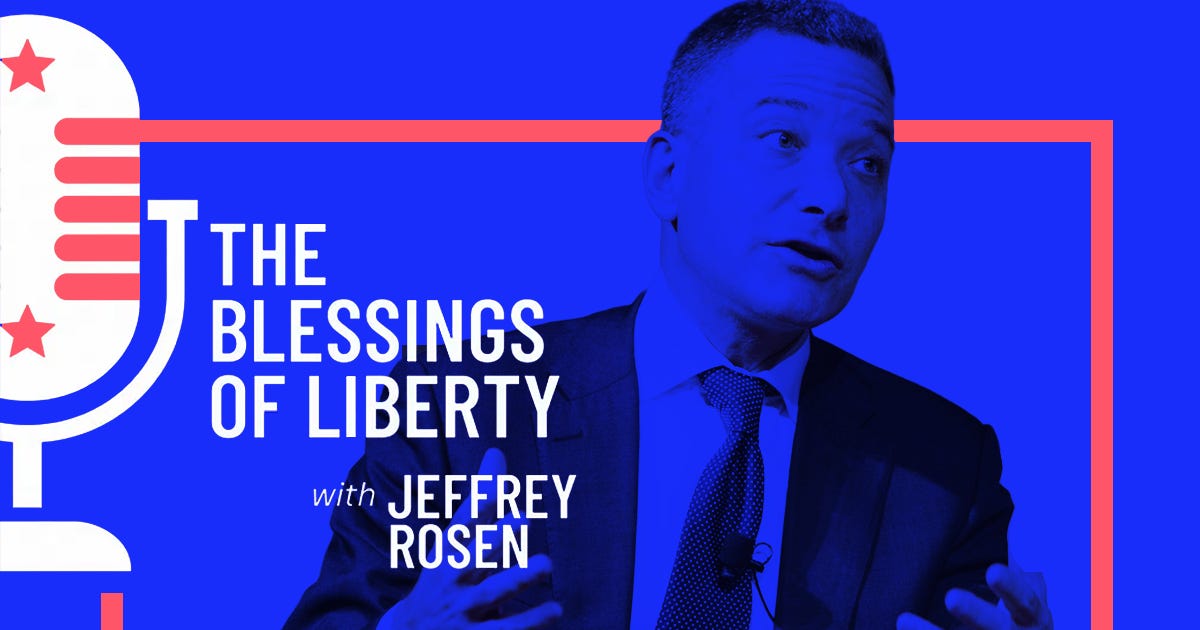
Now, as the nation approaches the 250th anniversary of the Declaration of Independence, bestselling author and constitutional scholar Jeffrey Rosen is launching a new project aimed at deepening public engagement with the principles behind the American experiment.
Rosen’s new podcast, The Blessings of Liberty, explores constitutional history, Supreme Court debates, the lives of the Founders, and the enduring meaning of the “American Idea.” The show hopes to model the kind of civil dialogue that feels increasingly rare in modern public life, and FIRE couldn’t be prouder to be the podcast’s presenting sponsor.
Rosen was kind enough to sit down with FIRE and discuss the podcast and what it hopes to accomplish in these divided times.
You’ve spent your career helping Americans engage more deeply with the Constitution and the ideas behind it. What made this the right moment to launch The Blessings of Liberty and what kind of conversations are you hoping listeners will hear that they’re not finding elsewhere?
America 250 is the perfect time to launch a podcast that focuses on the Constitution, History, and the American Idea. In traveling around the country, talking to audiences in red and blue America, including rural bookstores, I’ve found that there’s such a hunger for conversations about American history and our founding principles that focus on deep reading rather than partisan politics. With deep dives into history, the Constitution, the lives of the Founders, landmark Supreme Court decisions, and great new books that are shaping our national debates, The Blessings of Liberty will examine not only what the Constitution means, but why the American Idea still matters.
The podcast will bring together guests from across the ideological spectrum at a moment when many Americans feel political and cultural divisions are only growing deeper. Why do you believe civil dialogue still matters, and what can we learn from the Founders about disagreeing well?
In his last message to Congress, George Washington proposed to create a National University whose “primary object” would be “the education of youth in the science of government.” He wanted to bring together people of different perspectives to set aside their geographic and partisan loyalties and to practice the habits of civil dialogue that all the Founders believed were necessary to sustain the American experiment. The goal of the podcast is to model that civil dialogue and inspire listeners to practice it through deep reading of great new books and conversations with thoughtful people of different perspectives.
Your first guest is Supreme Court Justice Neil Gorsuch. Without giving too many spoilers away, what stood out to you most from that conversation?
We had such a great conversation about his bestselling new children’s book, Heroes of 1776, and his contribution to the National Constitution Center’s new volume, The Promise of America. Justice Gorsuch loves liberty, and the biggest surprise is what a good storyteller he is about the heroes who shaped the Revolution — both the familiar names and lesser-known men and women whose stories emerged from primary sources. He and his co-author Janie Nitze understand that the best way to teach history is by telling great stories, and it was an honor to have him launch The Blessings of Liberty.

The show explores constitutional history, Supreme Court debates, and the broader “American Idea.” For listeners who may feel disconnected from those subjects, why do you think these topics matter in everyday life?
It’s so important for citizens to follow the major Supreme Court cases, read the majority opinions and the dissents, and make up their own minds. They’re written not just for lawyers but for all Americans. By bringing together liberal and conservative scholars of different perspectives for civil conversations, I’m hoping to inspire citizens to open their minds to the possibility that the most convincing constitutional answer may not always coincide with their political views. And without understanding the reasoning behind the Supreme Court decisions, in the spirit of humility that Learned Hand described as “the spirit which is not too sure that it is right,” it’s impossible for citizens to defend their liberties, as the Founders intended.
In these polarized times, it turns out that most Americans agree about the big principles of the American Idea embodied in the Declaration of Independence — liberty, equality, and government by consent — even though we may disagree about how to balance those values. By featuring compelling conversations about history and the Constitution from diverse perspectives, I’m hoping to inspire citizens to read the primary sources, come to their own conclusions, and become lifelong learners.
You’ve interviewed presidents, justices, historians, and leading public intellectuals over the years. How has your own thinking about the Constitution, and about America itself, evolved through those conversations? Have you completely changed your mind on any constitutional issues since starting out?
I spent more than 20 years as an opinion journalist overconfidently insisting that my opinions about the Constitution were right and anyone who disagreed with me was wrong. At the National Constitution Center, by contrast, I wasn’t allowed to express opinions about politics and got out of the habit of focusing on them. It was an incredibly liberating experience.
Honestly, I’ve now lost interest in my own opinions and am more interested in listening to and learning from others. On most constitutional questions, there are good arguments on both sides. When I teach and write about the Constitution, I try to present the competing arguments as well as possible, so people can make up their own minds. I no longer believe there’s a single right answer to most constitutional questions — except for the First Amendment, where I remain an absolutist in the tradition of my heroes Louis Brandeis and Hugo Black.
From campus controversies to social media fights, free speech has become one of the biggest flashpoints in American life. Why do you think so many people suddenly feel conflicted about free expression and what’s at stake if our culture of open debate continues to erode?
People have always been conflicted about free expression. As Justice Oliver Wendell Holmes said, “the principle of free thought [is] not free thought for those who agree with us but freedom for the thought that we hate.” What’s unusual about our current moment is that the greatest threats to free speech are coming not only from the government but also from cancel culture on the left and right — a phenomenon dramatically exacerbated by social media, which allows the instant formation of the illiberal mobs that James Madison most feared. That’s why I’m so excited and honored to be joining FIRE, America’s leading nonpartisan defender of free speech and open inquiry.