


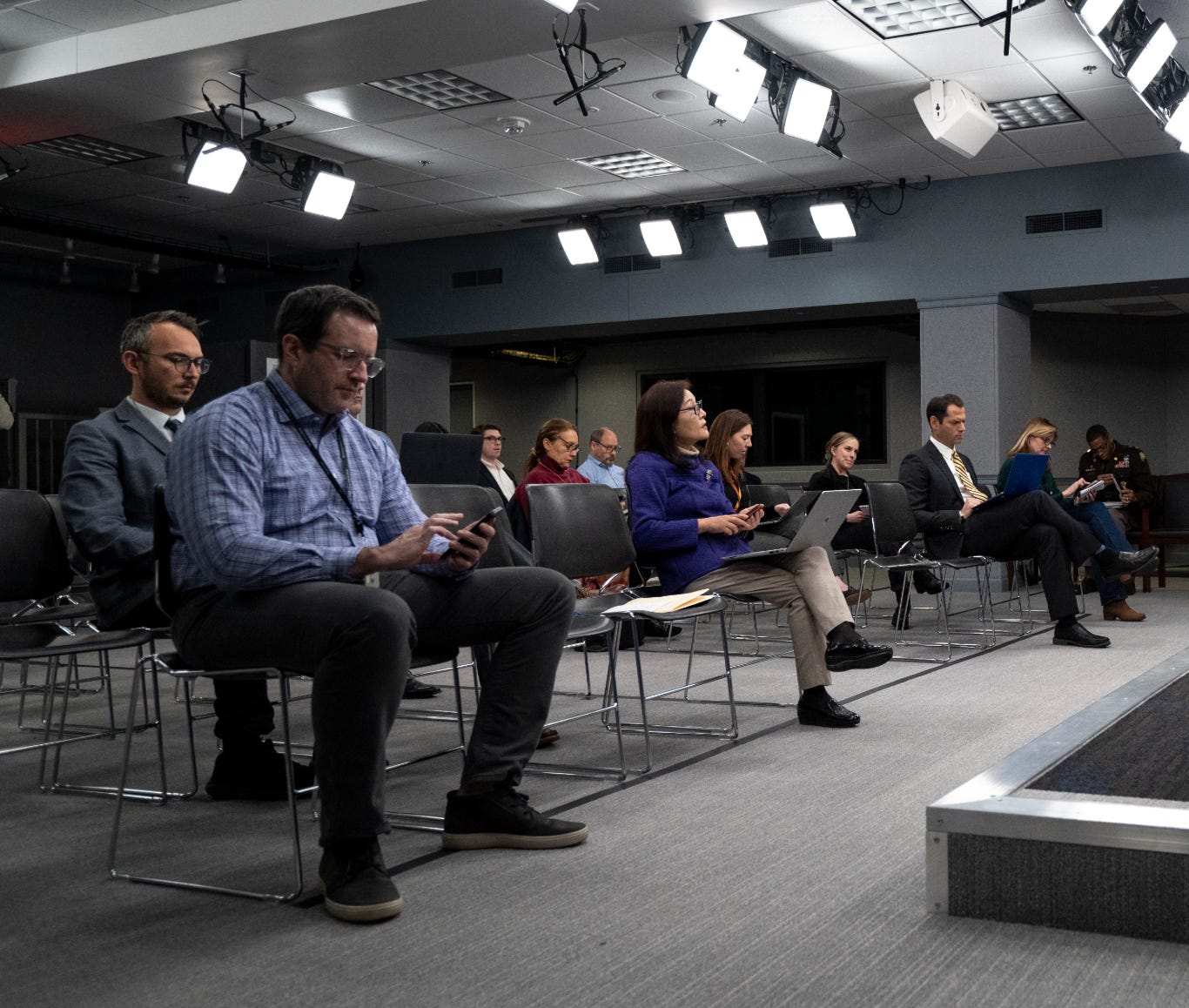
The Pentagon has declared war on its press pool. Although it may adopt certain rules about who enters, those rules must comply with the Constitution. And rules that punish journalists for asking questions or publishing information officials would rather keep hidden violate the Constitution at every turn.
Yet since May 2025, the Department of Defense has done precisely that through its restrictions on the Pentagon press corps. The New York Times has challenged those restrictions in two lawsuits. The Pentagon won a temporary victory in the most recent battle, successfully obtaining a hold on an earlier District Court ruling halting part of its policy, but the war is far from won as the courts continue to consider constitutional challenges to the Pentagon’s current policy.
The Pentagon restricts access
In May 2025, Defense Secretary Pete Hegseth issued a memorandum limiting journalists’ physical access inside the Pentagon. After news organizations reported in June that an early U.S. intelligence assessment found American strikes on Iranian nuclear facilities had caused less damage than President Donald Trump and Hegseth publicly claimed, the department clamped down even harder, limiting reporters’ movement and threatening their credentials if they “solicited” or obtained information officials had not authorized for release — even unclassified information. The Times sued, arguing that the policy violated both the First Amendment and the Fifth Amendment’s guarantee of due process.
“This policy reeks of prior restraint,” the Society of Professional Journalists said in a statement.
Pentagon’s press badge policy unites journalists by offending the Constitution

Journalists from FOX News, ABC, and over a dozen other news organizations are refusing to sign the Pentagon’s new policy for press credentials, saying in a joint statement that it “threatens core journalistic protections.” They’re right about that. At least a couple of the
If they wanted to keep their credentials, Pentagon reporters had until Oct. 14, 2025, to sign on to the new rules. Instead, more than 30 news organizations — including The New York Times, The Washington Post, CNN, and Fox News, Hegseth’s previous employer — refused. The next day, dozens of journalists surrendered their badges and left the building, ending some news organizations’ decades-long presence there.
A week later, Pentagon spokesman Sean Parnell suggested the changes were also aimed at reshaping coverage, attacking the departing journalists as “self-righteous” activists, and praising their replacements as people who would “circumvent the lies of the mainstream media and get real news to the American people.” The Pentagon then credentialed a new group that included administration-friendly outlets and influencers. Mainstream outlets, including those who walked out, have continued to report on the U.S. military from outside the Pentagon.
The restrictions get blocked
The Times challenged the policy in court and on March 20, Senior U.S. District Judge Paul L. Friedman ruled that the policy violates the First and Fifth Amendments. He agreed with The Times’ assertions that the policy discriminated based on viewpoint, having been implemented with the intent to “chill” news coverage the DoD considers unfavorable.
Friedman cited episodes in the months leading up to the October policy in which Hegseth, Parnell, and other DoD officials responded to negative coverage in the media by attacking the outlets, including calling them “Trump-hating media” and The Times a “Fake News” publication. The court observed that their replacements were specifically “individuals and outlets who had expressed ideological agreement with and support for the Trump administration in the past.”
The DoD had argued that the policy did not discriminate based on viewpoint because it applied to all members of the press corps. However, just because a policy applies to all publications does not mean it is content-neutral if it was adopted “because of disagreement with the message [the restricted speech] conveys.” Ultimately, Friedman enjoined and vacated the challenged portions of the October policy, barred the department from using them against Times journalists, and ordered the Pentagon to re-credential Barnes and other Times journalists.
The Pentagon creates new restrictions
Three days later, the Pentagon issued an interim policy that moved reporters’ workspaces from their traditional location inside the building to an external annex, and required journalists to have an official escort before entering the Pentagon and limiting entry to scheduled interviews, briefings, and other approved events.
The interim policy also replaced the former ban on “soliciting” unauthorized information with a new ban on “intentionally encouraging, inducing, or requesting” an unauthorized employee to disclose it. And violations could still cost a journalist Pentagon credentials.
But that didn’t solve the constitutional problems Friedman noted because reporters gather news by requesting information. A rule that treats those acts as potential credentialing offenses gives officials enormous leverage over the reporting produced about them.
The interim policy also treats a promise of confidentiality as possible evidence that a reporter induced an unauthorized disclosure. But confidentiality is a routine reporting tool, especially when sources fear retaliation for discussing lawful, unclassified, or embarrassing information. Treating it as evidence of misconduct risks punishing protected newsgathering without proof of wrongdoing.
On April 9, Friedman ruled that parts of the interim policy violated his March order and blocked them as applied to Times journalists. The D.C. Circuit later allowed the escort requirement to remain in effect during the appeal, and the Times filed a second suit directly challenging that requirement and other portions of the interim policy.
What it all means
The practical consequences of escort policies that reduce access are substantial. Journalism often begins with an unplanned conversation: a question in a hallway or a clarification after a briefing. An escort’s constant presence makes those exchanges difficult and may deter employees from speaking at all. By relocating the press corps to an outside annex and permitting entry mostly for scheduled events, the rules replace independent reporting with managed access.
The department’s briefing record also illustrates the cost of reduced access. Hegseth went more than eight months between appearances at the Pentagon briefing-room podium, between June 26, 2025, and March 2, 2026. Even during active military operations, formal briefings have been sporadic, making independent access to knowledgeable officials more important. Despite the ongoing war in Iran, the Pentagon has not held a formal press briefing in over two-and-a-half months, citing operational security concerns as the reason.

The Pentagon may impose neutral security rules, protect genuinely classified material, and punish its employees who unlawfully disclose it. What it cannot do is make favorable coverage the price of access or transform ordinary reporting methods into evidence of lawbreaking.
Thankfully, the journalists who surrendered their credentials have continued reporting from outside the building, and their work shows that the Pentagon cannot eliminate scrutiny simply by emptying the press room. But distance, escorts, and managed appearances do make scrutiny harder. That’s a problem for all of us. If the government can control every encounter it has with the press, it can control every detail of what the public gets to know. And that’s no way to protect America’s enduring promise that the government is accountable to the people, not the other way around.

Executive and judicial officers should be reminded that long before the First Amendment many of the foremost leading Americans showed us the meaning of some of the rights and freedoms that were merely enumerated in the First Amendment.
Past SCOTUS justices who cared to inform Americans about the crucial truth about and vital purposes of our freedom of expression and communication kindly and conscientiously quoted a crucial clarification by the First Continental Congress in 1774. SCOTUS justices did so in majority opinions in Near v. Minnesota, 283 U.S. 697 (1931) and Roth v. United States, 354 U.S. 476 (1957).
On October 26, 1774, the First Continental Congress penned its Letter to the Inhabitants of Quebec and declared “five great rights” of all American citizens. That august assemblage included some of the brightest stars, not only of the American Revolution, but also of the future new government under our Constitution starting in 1789. It included the commander in chief of the Continental Army (George Washington) and our first two presidents, Washington and John Adams, and our first SCOTUS Chief Justice, John Jay (each of whom also was a member of the Second Continental Congress).
One of the “great rights” they declared was “the freedom of the press.” Fortunately, the 1774 Congress did more than merely write that right. They emphasized its meaning and power:
"The importance of this consists," in part, in "the advancement of truth" and the "diffusion of liberal sentiments on the administration of Government," by "ready communication of thoughts between [citizens], and its consequential promotion of union among [citizens], whereby oppressive officers are shamed or intimidated, into more honourable and just modes of conducting affairs."
SCOTUS also quoted the same language from 1774 in Thornhill v. Alabama, 310 U.S. 88 (1940), but SCOTUS substituted “ashamed” for “shamed.” Thornhill is a profoundly important opinion that is almost unknown to Americans. The Thornhill SCOTUS justices faithfully supported our Constitution with the following crucial elaboration:
"The freedom of speech and of the press" (the freedom of expression and communication) that the People "guaranteed by the Constitution embraces at the least the liberty to discuss publicly and truthfully all matters of public concern without previous restraint or fear of subsequent punishment. The exigencies of the colonial period and the efforts to secure freedom from oppressive administration developed a broadened conception of these liberties as adequate to supply the public need for information and education with respect to the significant issues of the times. . . . Freedom of discussion, if it would fulfill its historic function in this nation, must embrace all issues about which information is needed or appropriate to enable the members of society to cope with the exigencies of their period."