


FIRE’s National Speech Index has been taking America’s temperature on expressive freedom every three months since January 2024, asking many of the same questions each run. That repetition is the point. When you keep the wording constant, shifts are harder to dismiss as noise. Patterns more readily stand out. And looking back, two notable trends stand out overall.
First, compared to last year, Americans are about five percentage points more likely to say the country is headed in the wrong direction when it comes to freedom of expression. Second, the small increase in trust the public had in President Trump to protect their First Amendment rights when he took office in January 2025 has now largely evaporated.
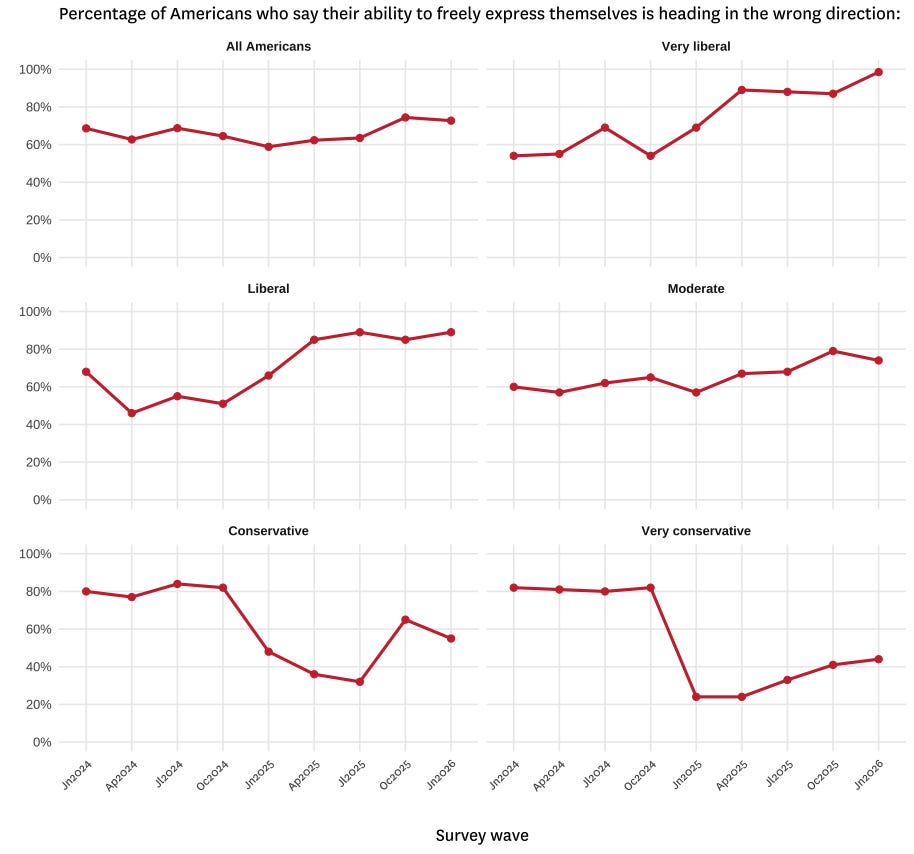
All together, the percentage of people who say things are headed in the wrong direction is consistently high. Recently, it’s even higher. In January 2024, 69% said things were headed in the wrong direction. The number dipped to 63% in April, then fell to its lowest level right after Trump took office in January 2025, reaching 59%. But that reprieve didn’t last.
By April, around the time Mahmoud Khalil and Rumeysa Ozturk were arrested and the Trump administration launched its campaign to “reform” higher education, two-third of Americans felt free expression was headed in the wrong direction. That spiked to about three-quarters in October, during the brief removal of Jimmy Kimmel, where it remained as of last month.
Ideology clearly impacts how people answer these questions, but it doesn’t explain everything. Conservatives appear especially sensitive to changes in party control. Throughout 2024, three-quarters or more said free speech was headed in the wrong direction. This dropped to one-third in January 2025 after Trump took office, but has been rising over the past year. Very conservative Americans show an even sharper relief pattern from roughly 80% in 2024 down to roughly a quarter in early 2025.
This is what you’d expect if “wrong direction” is partly a referendum on who’s running the executive branch. But the story can’t be reduced to just that. The liberal side’s volatility over the past few years indicates something beyond simple party-in-power logic and suggests that recent events have driven their perception of the country’s expressive environment. So while the color of the president’s necktie sets a baseline, it doesn’t lock perceptions in place. Events and institutions beyond the presidency also plausibly shape how safe people feel speaking freely.
The second big trend is even cleaner: confidence in Trump to defend First Amendment rights has declined compared to January 2025, regardless of one’s political beliefs.
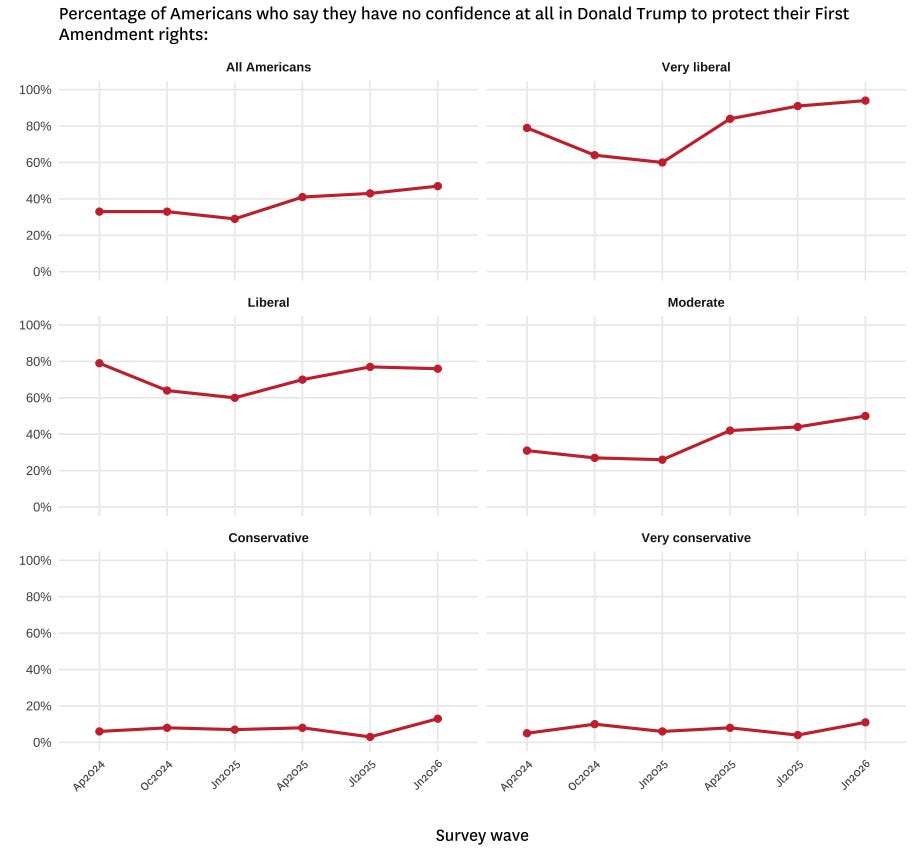
In January 2025, shortly after Trump returned to office, 29% of Americans said they had “no confidence at all” that he would defend their expressive rights. One year later, 47% say the same, an increase of almost 20 percentage points in just a year. In April, a whopping 84% of very liberal Americans said they had no confidence in Trump to defend their expressive rights. Now 94% of them say this. The percentage of very conservative respondents who agree rose from 4% in July 2025 to 11% now, and among conservatives, from 3% in July to 13% now.
If we put the two trendlines together, the message is hard to miss. Americans increasingly feel less free to speak, and many of them increasingly doubt that the president will protect the right that makes that possible. The brief post-inauguration thaw in January 2025 now looks less like a durable reset than a momentary hope that the temperature would drop. Instead, the year that followed supplied vivid reminders that expressive freedom isn’t just debated online or litigated in courtrooms — it can be tested by arrests, pressure campaigns, and street conflict.
The most important takeaway from the NSI data may be that free speech is becoming a significant political issue again. When Americans see government power aimed at protected expression, they update their beliefs quickly and not just along partisan lines. If this trajectory continues, the country risks settling into a new normal where large majorities assume expressive freedom is deteriorating and where trust in leaders to defend it becomes the exception rather than the rule. Reversing that won’t come from rhetoric alone. It will require visible restraint from officials, institutional guardrails that hold in moments of anger, and a public commitment to the principle that the First Amendment protects unpopular speakers precisely when it’s hardest to do so.

Trump's GOP opposes free speech
https://philosophicalrebellion.substack.com/p/fuck-trump?r=211fuw&utm_campaign=post&utm_medium=web
Fuck Trump!
It is. Fascism hates free speech and people who question the regime