


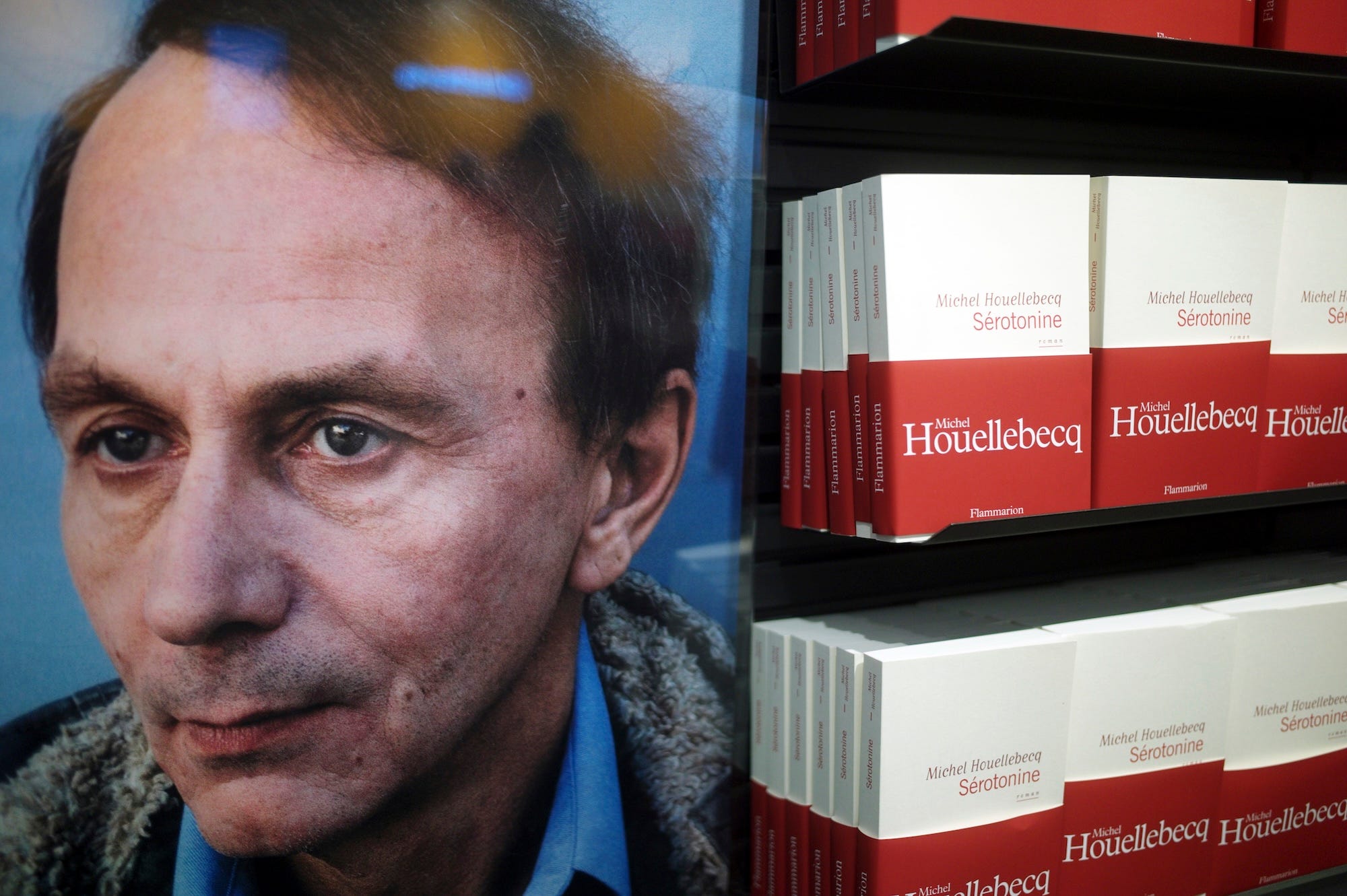
Most people probably don’t recall all of the things they said last week, let alone four years ago. But for widely-read French writer Michel Houellebecq, comments he made in a 2022 magazine interview may spell legal trouble for him today.
Houellebecq is now formally facing a judge-led investigation in a Paris suburb for “complicity in incitement to discrimination, hatred or violence against a group of people on account of their origin or their belonging or not belonging to a particular ethnicity, nation, race or religion.”
The Union of Mosques of France first filed a complaint in 2023 against Houellebecq, the magazine Front Populaire, and philosopher Michel Onfray. The reason? Houellebecq’s comments about Islam, terrorism, and France in a 2022 interview with Front Populaire.
“I believe that the wish of the native French population, as they say, is not for Muslims to assimilate, but for them to stop stealing from and assaulting them, in short, for their violence to decrease, for them to respect the law and other people,” Houellebecq said to Onfray. “Or, another good solution, for them to leave.” When asked by Onfray about claims that white Europeans are being “replaced” by Muslims, Houellebecq said it’s “not a theory, it’s a fact.”
Houellebecq later walked back the “clumsy” comments, and the Grand Mosque of Paris dropped its plan to pursue legal action after talking with him. But the Union of Mosques of France went forward with its complaint, and now years later Houellebecq is under judicial investigation.
Silencing social media won’t stop the unrest in France

Human beings possess many wonderful qualities but one widespread, and less laudable, trait is this: We’re often pretty damn lazy, too. We seek easy fixes for complex problems, reaching for Band-Aids for wounds that need stitches or a fresh coat of paint to conceal a crack in a house’s foundation.
Should authorities pursue charges and find him guilty, Houellebecq could face large fines and up to a year in prison. Even if they ultimately drop the investigation, the message is clear to both Houellebecq and everyone else: If you speak your mind on a controversial issue in France, you might get wrapped up in a lengthy and chilling investigation.
You might even end up in jail.
Houellebecq’s comments are no doubt deeply upsetting to some and, yes, maybe even hateful to others. But so are criticisms of Christianity, or Catholicism, or Judaism, or far left politics, or far right, or — you get the point.
People must be free to speak freely on the vital matters of politics and faith that shape and influence the world we all live in, or they may be left unable to say anything of importance at all.
Houellebecq’s comments, and the critics who want to challenge him on them, belong in the court of public opinion. Not a court of law.
It is indeed often difficult to make our way through a world where people hold and express views that so fundamentally attack the parts of ourselves and our identities we hold dear. But in asking the state to play referee in those debates, and using the deeply subjective concept of “hate” as an infraction, we hand authorities the power to censor dissent.
Understanding the risk of giving the government that mighty power, the United States, for example, does not recognize the fluid concept of “hate” as an exception to the First Amendment. And incitement is narrowly defined as speech “directed to inciting or producing imminent lawless action and is likely to incite or produce such action.”
There’s a key word there: imminent.
It’s absurd that Houellebecq’s comments could apparently be so incendiary that a judge feels it necessary to investigate them for incitement to hatred — but not so incendiary that years could pass before the formal investigation began. It doesn’t pass muster.
“His place is not in a courtroom,” Houellebecq’s lawyers, Thibault de Montbrial and Louis Cailliez, said of the case. That’s exactly right.
Free societies must allow people to debate even deeply painful and controversial issues without the threat of investigations, or even prison, hanging over their heads. Houellebecq’s comments, and the critics who want to challenge him on them, belong in the court of public opinion. Not a court of law.
