


On Oct. 17, the Maryland Terrapins squandered a double-digit halftime lead against Rutgers — marking their fifth straight defeat of the season, at home, on homecoming. Four days later, the university announced head football coach Mike Locksley would be leaving.
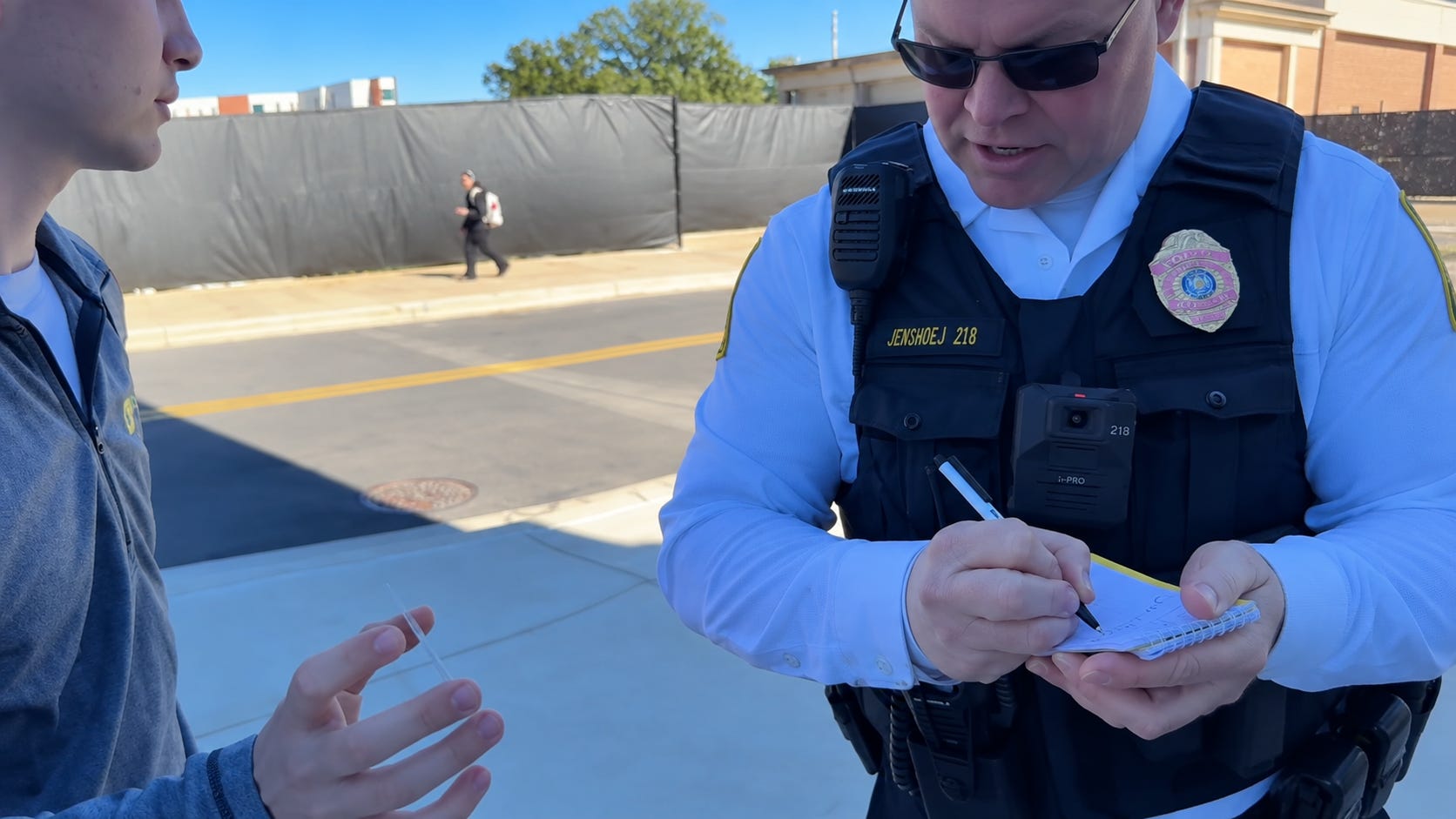
Nolan Rogalski and Jude Wilkenfeld, managing editor and deputy editor of the student-run Testudo Times, headed to the team’s practice facility to get players’ reactions after they received a tip about a players’ meeting. But then a UMD Athletics staff member called the cops.
Rogalski later posted on X: “Wilkenfeld and I were outside Jones-Hill House trying to get players to comment. An athletics staffer took pictures of us, and a police dispatch was called for suspicious activity; a cop and 2 cop cars pulled up, and officers ID’d us and asked us to leave.”
“We certainly didn’t mean to cause any trouble,” Rogalski says in the video he posted, “But as far as we were aware, we were standing in places we were allowed to stand.”
“I don’t disagree with you,” replies the officer.
Wilkenfeld said the staffer had never asked who he or Rogalski were, nor did they ask if they were student journalists.
“If the staffer had asked us who we were and what we were doing, the whole situation could have been avoided entirely,” Wilkenfeld told FIRE.
The Testudo Times later reposted Rogalski’s video along with an official statement from the University of Maryland’s Police Department and Maryland Athletics. “Due to heightened concerns for staff and player safety around the football program in recent weeks,” the statement said, “there has been increased security around athletics facilities. A UMPD officer approached the two individuals, learned they were with a campus media organization, recorded student IDs, and no report was taken.”
It added, “UMPD and Maryland Athletics respect the First Amendment rights of all journalists reporting in public spaces.”
Since the incident, UMD is making good on that statement. The UMD Athletics Department has agreed to meet with FIRE’s Student Press Freedom Initiative to make sure students and staff alike are on the same page when it comes to their free speech rights. It’s a step in the right direction, and one FIRE would love to see from more universities across the country.
Student journalists shouldn’t always have to fight to use their protected rights.
The Supreme Court has held that a college campus has “many of the characteristics of a public forum.” A large, open quad, for instance, has the same basic look and function of a city park. Sidewalks, like the one on which these student journalists stood, are also considered traditional public forums. As such, students — including student journalists — have the right to freely express themselves in these public spaces.
Luckily, Rogalski and Wilkenfeld knew their rights and stood up for themselves. Like other student journalists, they couldn’t simply rely on government officials to defend their rights, or even properly understand what they might be. Just last week, Cat Murphy — a student at UMD’s graduate school for journalism — had to stand her ground when U.S. Rep. Andy Harris falsely claimed that Maryland law required her to get his permission before recording him (that rule only covers private conversations). Harris even told his security to take her phone and get police to escort her out.

UMD students aren’t the only ones who have had to stand up for their rights in the field over the past few months. Dylan Hembrough, editor-in-chief of the independent student paper The Alestle at Southern Illinois University Edwardsville, was reported to police by a university communications official when he simply tried to assert his and his campus newspaper’s right to free expression. An SIUE administrator stopped a reporter for The Alestle from interviewing staff without her present. In an email, Hembrough called out the university’s marketing and communications team for interfering with the student outlet’s newsgathering process, at which point the administrator reported Hembrough’s email as harassment. (It was not.) Hembrough has vocally defended his right to report, and SPFI’s case with SIUE remains ongoing.
Courts have held time and time again that universities have an obligation to maintain, among other constitutional rights, a free student press. As Supreme Court Justice Potter Stewart wrote in Shelton v. Tucker: “The vigilant protection of constitutional freedoms is nowhere more vital than in the community of American schools.” It’s also important for universities to adequately articulate to faculty and staff what that maintenance looks like to protect the free, open “marketplace of ideas” college campuses are meant to be. Policies and practices safeguarding students’ right to free expression need to be fully articulated to all faculty and staff, and they should have support to uphold and follow through on those safeguards.
Among those safeguards must be a way to prevent students from self-censorship to avoid punishment or other retribution, keeping what’s called the “chilling effect” at bay. When authorities are called to investigate students standing on a sidewalk, that negatively affects student journalists’ ability to gather news and exercise their First Amendment rights and bolsters the chill. Not only does the call rattle student journalists in the moment, but it dissuades other student journalists in the future from using their own free expression to engage in reporting that benefits the whole community.
It’s great to see student journalists assert their rights. But public universities must also help by upholding their First Amendment obligations. Student journalists shouldn’t always have to fight to use their protected rights, and universities should cultivate an environment where student journalists feel comfortable enough to exercise those rights without fear of censorship, retaliation, or challenge.
