


Since 2018, More in Common, a nonprofit focused on reducing political polarization, has tried to explain American politics less by demographics and more by the core values that shape how people see the country. That approach matters because it shifts the conversation from who people are to why they think as they do, and it often reveals divisions hiding in plain sight.
Last month, MiC released Beyond MAGA: A Profile of the Trump Coalition, a study based on more than 18,000 interviews with Americans who voted for Donald Trump in 2024. The headline finding is simple but consequential: Trump voters are not one bloc. They fall into four distinct types, and their views diverge sharply on two issues now at the center of American cultural conflict: freedom of speech and whether presidents should use federal funding to pressure colleges and universities over DEI and CRT-related content.
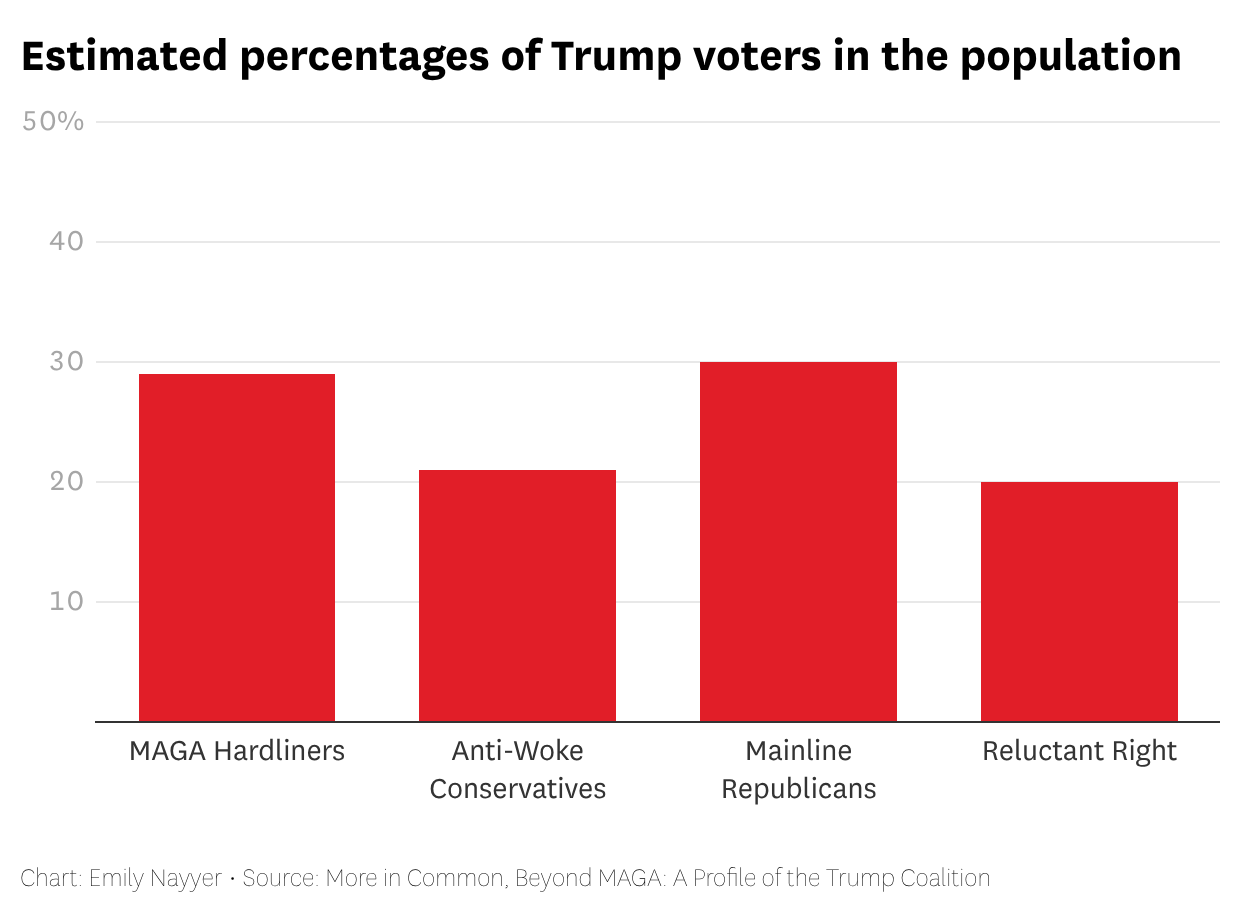
Here are the four types of Trump voters:
MAGA Hardliners are mostly evangelical Trump supporters who believe a “deep state” runs politics and that “the Left” hates America. About 25% hold college degrees.
Anti-woke Conservatives say American identity is fading and “woke” ideology has ruined American education, news, and entertainment. They are the least religious group (31% atheist, agnostic, or unaffiliated) and about 40% hold college degrees.
Mainline Republicans are the most optimistic about the American dream and least likely to say the country is in decline. About 25% have some college experience but no degree, and 38% hold only a high school diploma.
Reluctant Right voted for Trump because he seemed “less bad” than Kamala Harris. They are the least likely to identify as Republican, the least hopeful about the next four years, and the most likely to say they vote across party lines.
Those distinctions aren’t just academic. They predict meaningful differences in how Trump voters weigh rights, institutions, and presidential power.
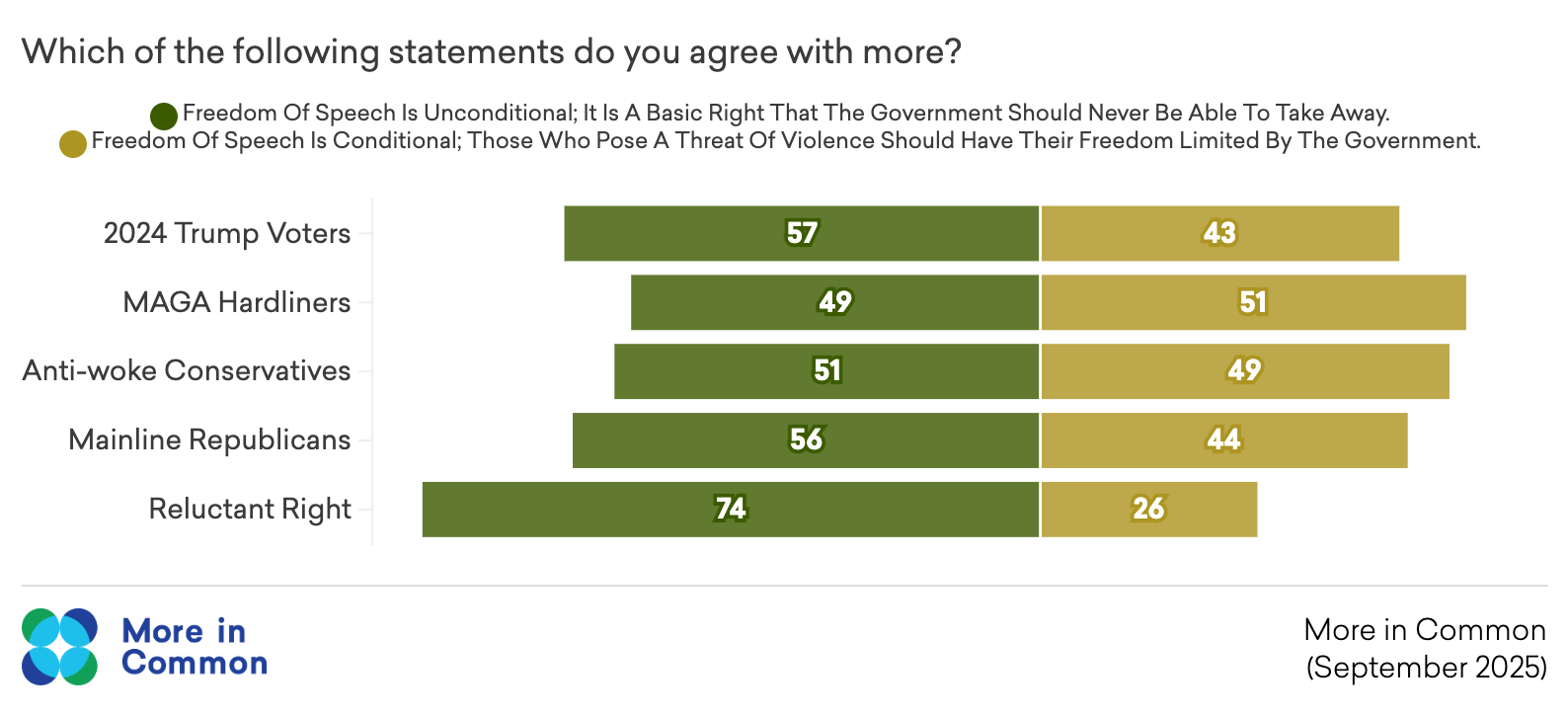
Consider freedom of speech. When asked whether it is an “unconditional basic right that the government should never be able to take away,” support among MAGA Hardliners and Anti-woke Conservatives is notably mixed: roughly half in each group say speech is unconditional, while the other half view it as conditional when expression poses a “threat of violence.” Mainline Republicans look similar, though slightly more supportive of an unconditional right (56%). The outlier is the Reluctant Right: roughly three-quarters say freedom of speech is unconditional and should not be taken away by the government.
If you’ve grown accustomed to assuming that the political right is uniformly absolutist on speech, this complicates that picture. The strongest free-speech instincts in the Trump coalition may be concentrated among voters who are also least committed to the Republican identity and least enthusiastic about the coming years.
The split is even clearer on federal funding for higher education and DEI/CRT-related issues. Nearly all MAGA Hardliners and Anti-woke Conservatives (96% in each group) agree that “younger Americans are worse off because of ideas pushed by the Left.” And at least nine in 10 (93% and 90%) say President Trump should punish public universities that promote ideas like DEI or CRT by withholding federal funding.
The internal debate among Trump voters is not only about ideology, but about authority.
By contrast, Mainline Republicans are closer to a 50–50 coalition on these questions: 54% say younger Americans are worse off because of ideas pushed by the Left, and 53% support withholding funds to punish universities. The Reluctant Right matches Mainline Republicans on the first claim (55%), but breaks sharply on presidential intervention: 66% say it’s not the president’s role to determine what is taught in universities and that federal funding should continue.
Taken together, these findings point to a political reality that institutions, especially higher education, often miss: the internal debate among Trump voters is not only about ideology, but about authority. Even many voters who feel alienated by progressive (woke) cultural influence are uneasy about using the presidency to police what universities teach.
The decline of confidence in higher ed

Americans’ confidence in U.S. colleges and universities remains near historic lows. Although some have suggested that public opinion about higher education may be stabilizing or rising, our latest survey finds little evidence of meaningful recovery.
That nuance matters for anyone trying to lower the temperature. If universities respond as if all Trump voters want punitive crackdowns, they risk hardening opposition and confirming the most cynical narratives. And if policymakers assume a single “MAGA mandate” for sweeping funding threats, they may overread the coalition’s unity and underestimate the backlash from within it.
MiC’s report doesn’t argue that campus conflicts are imaginary; it shows they are politically complicated. The Trump coalition contains voters who want aggressive retaliation, voters who want cultural change without federal coercion, and voters who still hold a surprisingly robust commitment to unconditional free speech. Treating them as one bloc guarantees miscommunication and miscalculation. If we want fewer zero-sum showdowns, the first step is accuracy: recognizing that the next fight over speech and universities won’t only run left versus right. It will run through the right as well, and the outcome will depend on which faction leaders choose to represent.

I love this kinda stuff. Now do the left:-)
As a centrist (approximately), I'm constantly annoyed by the way many on the right and left see the opposition as a solid bloc. This is _so_ not true. I know not everybody falls for this image of a unified opponent, but I wish far fewer did. Of course, thinking of the opposition as diverse doesn't fit as well on a bumper sticker or in a meme, tweet or TikTok (hmmm, it would be an interesting challenge to see what _would_ fit and be effective)
Very helpful piece, thanks!
Boy, it’d sure be nice to see how Kamala voters answer that last question about free speech (whether broken up into different groups of Democrats or not).
It is worth noting, however, that the binary as posed, by including the word “violence” in it, is misleading.
The First Amendment doesn’t protect incitement to violence, and I suspect that part colored the answer to the question substantially.
E.g. I would be shocked indeed if anti-woke conservatives were only 50-50 pro free speech if the reference to violence was removed.