


Athena Rem is a rising junior at the University of California, Los Angeles.
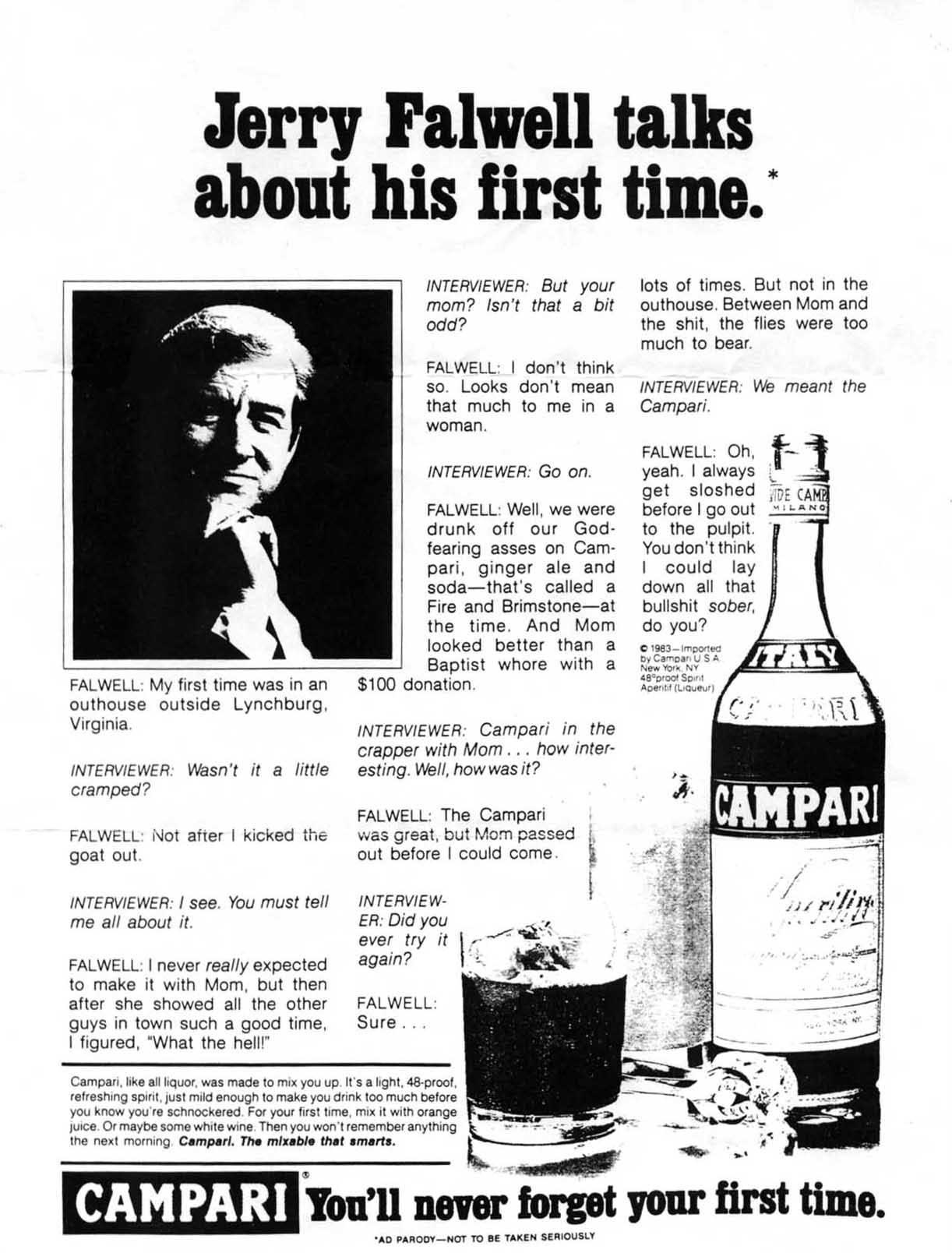
Televangelist Jerry Falwell once confessed in an interview to drunken sex with his unconscious mother in an outhouse. Except it wasn’t a real interview. It was a fake Campari ad in a 1983 issue of adult magazine Hustler.
Falwell sued the magazine and its publisher Larry Flynt for emotional distress, libel, and invasion of privacy. Flynt defended the ad’s publication as protected by the First Amendment. What came next remains one of the most famous free speech cases in American jurisprudence.
Flynt won the case, Hustler Magazine v. Falwell (1988), because parody is not a statement of fact made with “actual malice” and because print media, shows, or any other publications can generally criticize public figures under the First Amendment.
Yet such critical speech is under fire today more than ever before. And these modern efforts to silence critics risk blunting Americans of the cultural institution of satire. Late-night shows like The Tonight Show Starring Jimmy Fallon and Saturday Night Live routinely mimic and mock public figures, and it’s important they be able to do so. Because humor isn’t merely entertaining — it’s also one of the most powerful forms of political commentary.
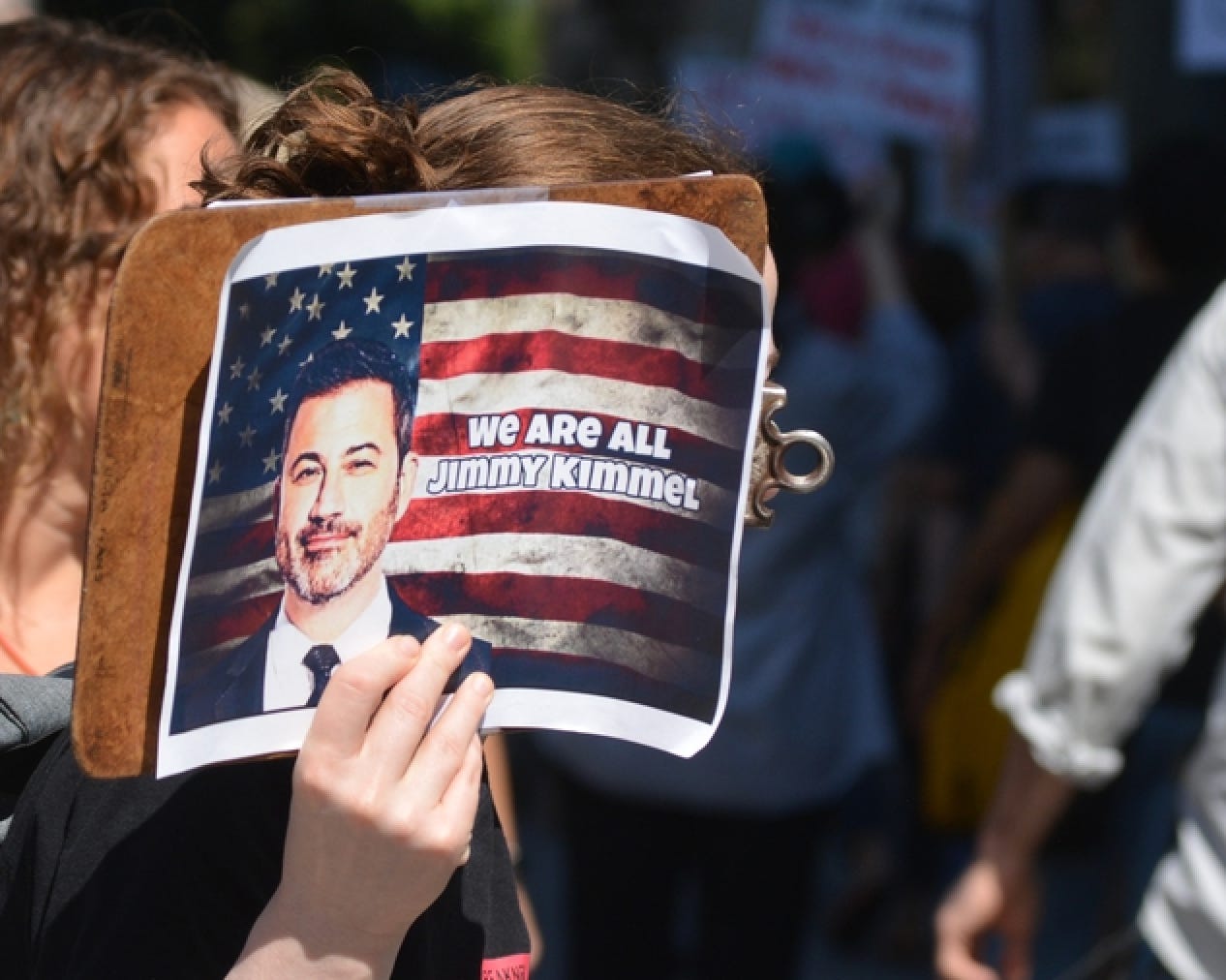
Late-night host Jimmy Kimmel speaks about political issues in his opening monologues. When his show airs, that is. A notable exception occurred when the FCC pressured ABC to suspend his show in September 2025 over anti-MAGA commentary about Charlie Kirk’s murder. Without resistance, this incident may not be the last of its kind. “Unless we resist each attempt at government-driven censorship,” says Garrett Gravley, FIRE’s program counsel, “the next suspension may not be so brief.”
Despite how significantly FCC jawboning can threaten the flow of information, the legal response to date has been scarce. The unique rise in First Amendment violations within the last year that specifically target this niche of entertainment make it even more necessary to find an effective corrective measure.
Looking back to the 1950s provides some insight. The House Un-American Activities Committee, following McCarthyism and the Second Red Scare, encouraged the denial of screenwriting and acting jobs to supposed communists through repeated investigations and contempt citations. Though the recommendation in and of itself was problematic, a primary reason the problem persisted and grew was that studio heads refused to ignore or deny unconstitutional calls for blacklisting by the government.
Indeed, cultural change occurred only when Universal Studios allowed a blacklisted producer to receive credit at the end of a movie in 1960. At the very least, cultural response, indignation, or desire to change is a prerequisite to stopping sanctions on entertainment.
Falwell lost because the Court understood an essential truth: a democracy confident enough to laugh at its leaders and other powerful figures is stronger, not weaker. If that principle no longer holds, satire won’t be the last casualty of censorship.
We should heed what SCOTUS said unanimously in New York Times Co. v. Sullivan (1964) about our need to re-learn "the lesson[s] to be drawn from the great controversy over the Sedition Act of 1798." We should re-learn those lessons today, in part, because that "great controversy" was almost as great as the controversy over the ratification of the original Constitution and the controversy over the subsequent ratification of the first 10 amendments. At least as important, the "great controversy over the Sedition Act of 1798" precisely "crystallized a national awareness of the central meaning of the First Amendment." Crucially, it did so only a mere decade after the original Constitution was ratified (in 1788) and less than a decade after the first 10 amendments were ratified (in 1791). So the vast majority of the people who wrote, debated and ratified all the relevant parts of our Constitution were still alive and able to judge for themselves the power of the people to criticize our public servants and other particularly powerful people.
As SCOTUS in Sullivan highlighted, perhaps the first lesson to be learned is from the plain text of the Sedition Act, itself. Even if criticism brought even the highest national officials “into contempt or disrepute” and even “excite[d] against them” the “hatred” of the “people,” the Act expressly precluded punishing such expression or communication until the government had proved (beyond a reasonable doubt) material facts establishing how it was, first, “false," and then also proved facts establishing how it was "scandalous, and malicious." Those standards--in the Act--prompted SCOTUS in Sullivan to conclude that our Constitution protects our criticism of any purported public service of any purported public servant unless and until the government has proved material facts establishing how it was, first, a “falsehood" and then how it was "made" with "actual malice," i.e., actual "knowledge that it was false" or constructive knowledge, i.e., "reckless disregard of whether it was false or not."
Our Constitution precludes "any test of truth" that "puts the burden of proving truth on the speaker." Any "rule compelling the critic of official conduct to guarantee the truth of all his factual assertions" violates our Constitution. "The constitutional guarantees require" a "federal rule that prohibits a public official from" punishing or penalizing a speaker for the content of criticism "relating to [any] official conduct" unless and until someone "proves [how] the statement" was a "falsehood" and how it "was made with ‘actual malice’—that is, with knowledge that it was false or with reckless disregard of whether it was false or not." Under our Constitution, "neither factual error nor defamatory content suffices to remove the constitutional shield from criticism of official conduct," and even "the combination of the two elements is no less inadequate."
SCOTUS also clarified why the foregoing rule could not be limited to any particular category of expression, e.g., defamation (or parody or satire). SCOTUS (quoting James Madison) emphasized profound and overarching truths about our Constitution that are the foundation of our First Amendment rights and freedoms. Our "Constitution created a form of government under which ‘The people, not the government, possess the absolute sovereignty,’ so in our "Republican Government," in general, "the censorial power is in the people over the Government, and not in the Government over the people."
SCOTUS emphasized a crucial truth, i.e., about the essence of the entire Constitution: "[t]he structure of the government dispersed power in reflection of the people’s distrust of concentrated power, and of power itself at all levels." As a consequence of such distrust, "the people of this nation have ordained in the light of history” that “these liberties” (our First Amendment rights and freedoms) are “essential to enlightened opinion and right conduct on the part of” all American “citizens” and our public servants. "Criticism of their official conduct" (regardless of the category of criticism (e.g., parody or satire) or the category of a claim against a critic (e.g., for defamation)) enjoys "constitutional protection," and it "does not lose its constitutional protection merely because it is effective criticism and hence diminishes their official reputations."
For very good reason, James Madison was long and often lauded as the "Father of the Constitution" and then the "Father of the Bill of Rights." Some of the best writing about our freedom of expression, communication and association and the right to petition and assemble was written by Madison.
One of the most pernicious practices of opponents (and proponents) of our freedom of expression and communication is trying to cram expression and communication into a particular category. SCOTUS repeatedly has highlighted the impropriety of this practice.
In N.A.A.C.P. v. Button (1963) SCOTUS emphasized that our public servants “cannot foreclose the exercise of constitutional rights by mere labels.” No “regulatory measures” (including any court rule or ruling) “no matter how sophisticated,” can “be employed in purpose or in effect to stifle, penalize, or curb” our “exercise of First Amendment rights.”
The following year in New York Times Co. v. Sullivan (1964), SCOTUS unanimously re-emphasized that no "mere labels” can justify (or prevent) “repression of expression.” “The test is not the [mere] form in” (or the label under) which government “power” was “applied but” whether “such power” was “exercised” consistent with our Constitution.
Here, the categories/labels are "parody," "satire" and "defamation." In Hustler, the protections in our Constitution were not limited to satire, parody or claims of defamation (and in Sullivan, the protections in our Constitution were not limited to defamation claims). In Hustler, SCOTUS expressly focused on speech about "public affairs," "public issues," "public office" and "public figures" i.e., people with the power to "shape events in areas of concern to society at large." Our Constitution protects our criticism of particularly powerful people, i.e., public officials and public figures. SCOTUS in Hustler even highlighted Garrison v. Louisiana, which did not pertain to satire, parody or defamation. SCOTUS in Garrison addressed our right to criticize the purported public service of any purported public servant (a lawyer publicly criticized 8 judges for being inexcusably lazy, if not criminally corrupt).