


“Censorship is the strongest drive in human nature,” said the late Pulitzer Prize-winning editorial writer Philip Kerby. “Sex is a weak second.”
The data say Kerby was right.
FIRE’s Campus Deplatforming Database has now documented 2,057 attempts to prevent or punish campus expression since 1998, and one fact immediately stands out: censorship campaigns are remarkably bipartisan.
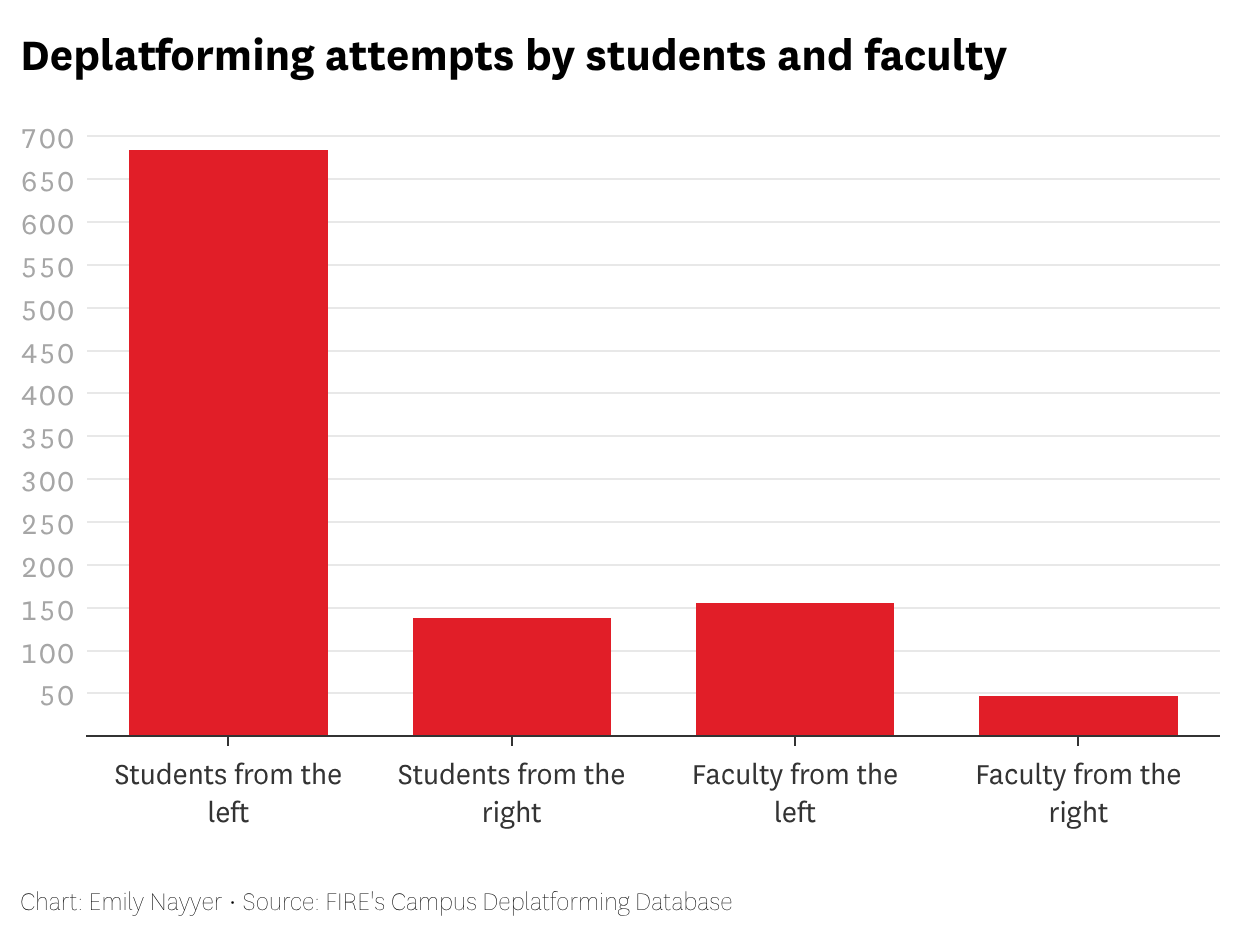
Of the total, 985 attempts came from the right of the expression while 952 came from the left. The rest came from both, from actors whose ideology could not be identified, or they involved non-ideological disputes.
But while censorship efforts from the left and the right occur with similar frequency, they take fundamentally different forms.
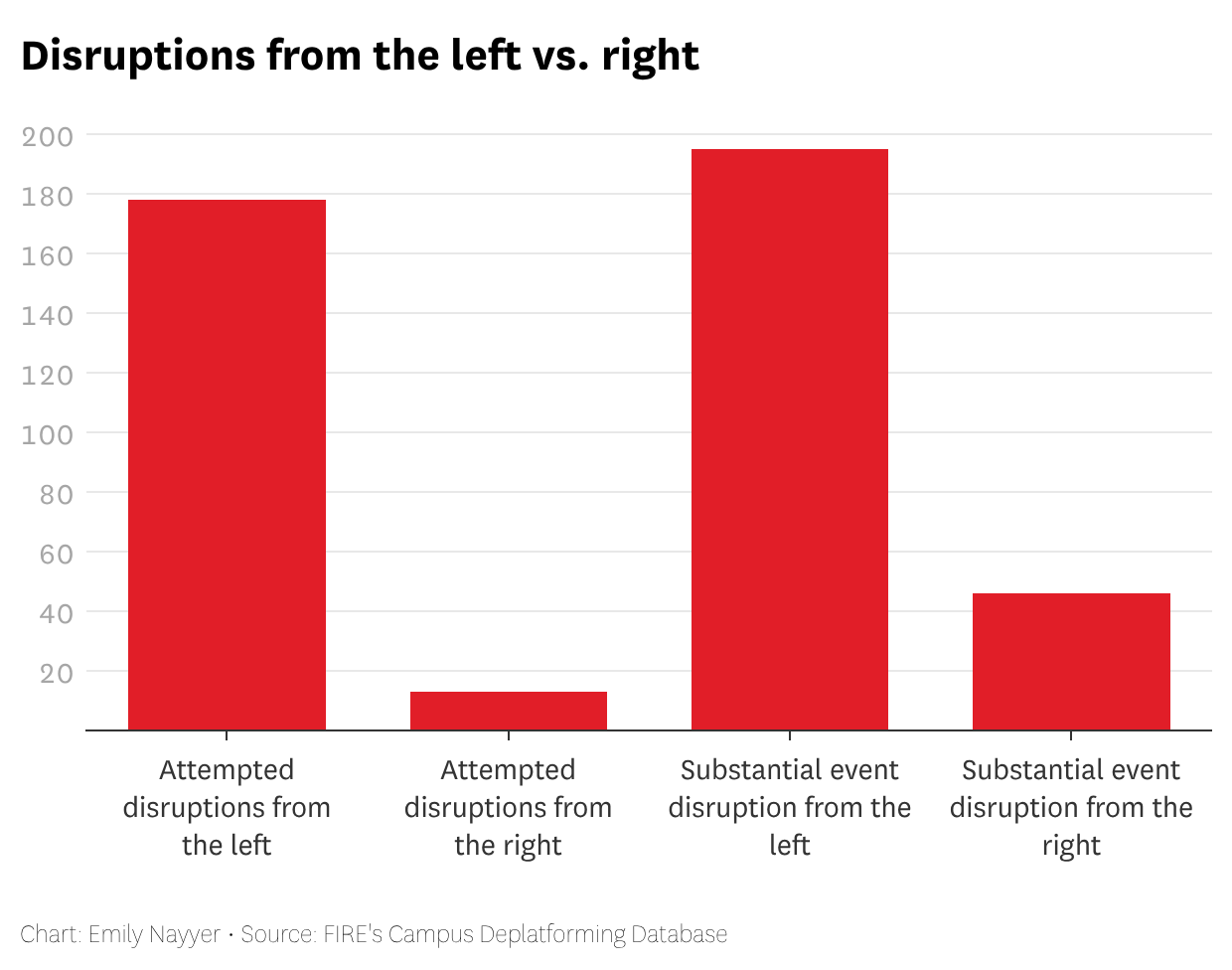
Efforts from the left typically originate on campus and are usually led by students, while efforts from the right typically originate off campus and are usually led by activist groups, public officials, or wealthy donors. Efforts from the left tend to use op-eds, social media, and online petitions to get their message across while efforts from the right threaten budgets, launch investigations, and demand resignations.
Another major difference is that efforts from the left tend to be more successful — about 50% succeed, compared to only about 40% from the right.
The purpose of FIRE’s Campus Deplatforming Database is not to determine which political faction is “worse.” Nor does documenting these trends imply that every campaign is morally equivalent or that every target of criticism deserves a platform. Members of any community are free to criticize speakers, organize protests, and express disagreement. But when criticism crosses into preventing others from speaking, or when institutions punish protected expression because of political pressure, that’s a problem.
If anything, the database demonstrates that threats to free expression are less about ideology than incentives. When people acquire the ability to suppress speech they dislike — whether through administrative influence, political office, financial leverage, or organized disruption — they often prove willing to use it.
That is precisely why viewpoint neutrality matters. Principles protecting expression cannot depend on who currently holds power. The political coalition capable of censoring today may find itself vulnerable tomorrow. Campus politics changes. Administrations change. Legislatures change. Student movements evolve. But the temptation to silence opponents remains remarkably constant.
The data remind us that censorship is not a problem of the left or the right. It is a recurring temptation that follows power wherever power resides. For anyone committed to free expression, that conclusion should be both sobering and clarifying.

I cannot help but cynically wonder how FIRE is defining "left" and "right". The cynicism comes from how often "statistics" show violence "equally" coming from left and right, but when you look at the individual cases, it turns out that to get that conclusion, they classify a lot of neutral people, and even strain to consider some left cases as "right".
And this is even before considering whether "NeoNazis" are right -- they are not, they have far more in common in every dimension with what everyone considers left -- but are still considered left nonetheless.
Pity I don't have time to go through every entry given in this database, because that's what it would take to either alleviate
or confirm my cynicism.
This is a place where schools should step up to prevent both cancelling and disruption of speakers and/or events. Should be part of a schools code of conduct with consequences for preventing free speech. It may necessitate review of school funding by government for failure to provide for what should be an educational experience of differing views ; education as opposed to indoctrination. If they are not capable of providing that at tax payer expense , then that should be a factor in funding.