


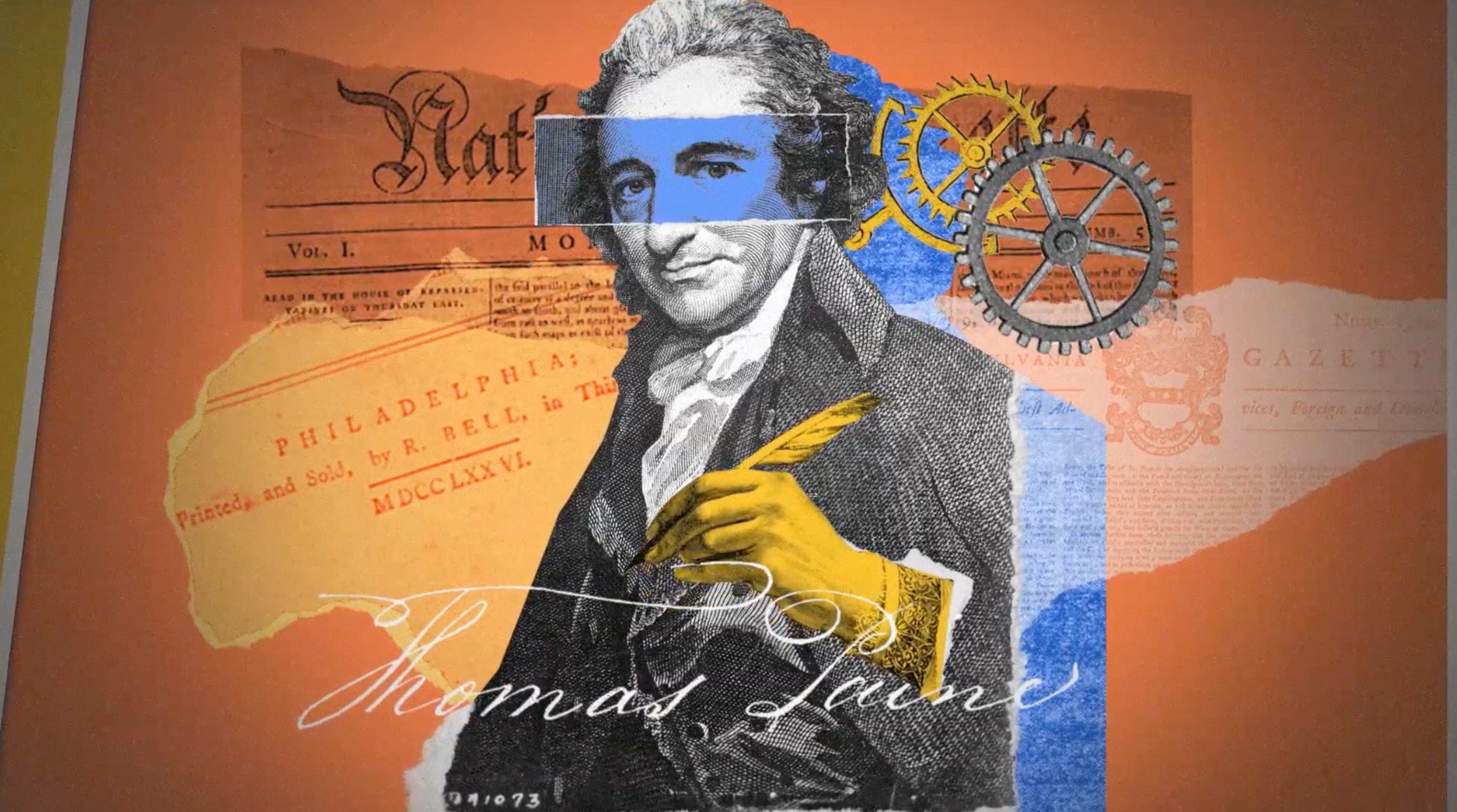
This year, the United States celebrates its 250th anniversary. To commemorate the occasion, FIRE is proud to present the limited series “Figures of Speech,” looking at the heroes and villains of free speech in American history. We began with Joseph McCarthy, the senator who became our censor-in-chief and gave us a new term for political oppression. This week, we turn to Thomas Paine, the revolutionary pamphleteer who made independence imaginable.
On June 8, 1809, 72-year-old Thomas Paine took his last breath inside a small house in Greenwich Village. The next day the pamphleteer and revolutionary’s body was loaded onto a cart and taken to his farm in New Rochelle, about 22 miles north of New York City, for burial. There was no procession, no national moment of silence, no celebration of a life fully lived. Only six people attended his funeral, including his caretaker, Madame Marguerite Bonneville, a friend from his many years in Revolutionary France, and her son, Benjamin.
As the dirt hit the mahogany coffin, Mme. Bonneville exclaimed, “Oh! Mr. Paine! My son stands here as testimony of the gratitude of America, and I, for France!” A decade later, William Cobbett, a British admirer of Paine, dug up his bones to repatriate them to England and give Paine a hero’s burial. But Cobbett failed, and portions of Paine’s remains fell into multiple hands, scattered across the globe in the decades after his death — a fitting, if macabre, ending to someone who declared himself “a citizen of the world.”
By the time of his death and subsequent desecration, Paine had fallen out of the American pantheon of Founding Fathers, reviled as an alcoholic infidel. But as we celebrate the 250th anniversary of both Common Sense and the American independence his pen sparked, Paine deserves his due and our gratitude. Without the words of Paine, the most modern of the Founding Fathers, there may be no United States of America to even celebrate today.
In January 1776, Paine’s Common Sense hit the streets of Philadelphia like a cannonball. The 47-page pamphlet was an immediate sensation and improbable debut. Paine had only washed up on American shores about 13 months before, flotsam and jetsam from the Old World. Yet in little more than a year, the 37-year-old failure reinvented himself as a successful journalist and editor in colonial Philadelphia. After Common Sense’s publication, Paine became something more: the 18th century’s greatest propagandist for revolution.
The pamphlet — penned in prose the colonies’ artisans, farmers, and mechanics could understand — argued that there could be no reconciliation with Great Britain. Instead, Paine argued that the 13 colonies could rule themselves. But Common Sense also did something truly revolutionary. It sought to tear down the edifice of oppression, hereditary monarchy, and replace it with a democratic republic that protected individual liberty. For Paine, the United States of America had the potential to be a superpower for freedom and an “asylum for mankind.”
The popular reaction to Common Sense remains legendary. The first run of 1,000 copies sold out in days. Printers all across the colonies reprinted it. Within three months, 120,000 copies were sold — a blockbuster in a population of 2.5 million colonists. To put it in modern terms, Thomas Paine was the Stephen King of the early American republic of letters. Less than six months later, the pamphlet achieved its improbable goal. The Second Continental Congress declared on July 4, 1776, that “these United Colonies are, and of Right ought to be Free and Independent States.”
In his Tom Paine and Revolutionary America, historian Eric Foner explained why Common Sense and its author were so special:
What made Paine unique was that he forged a new political language. He did not simply change the meanings of words, he created a literary style designed to bring his message to the widest possible audience. His rhetoric was clear, simple and straightforward; his arguments rooted in the common experiences of a mass readership . . . Through this new language, he communicated a new vision — a utopian image of an egalitarian republican society.
But Paine’s contribution to American independence didn’t end with Common Sense. Throughout the Revolutionary War, Paine lent his talents to the war effort. Across 13 essays called The American Crisis, Paine rallied the troops and the American populace to the Cause during its darkest days.
The first American Crisis appeared just in the nick of time — a week before Christmas 1776. Paine’s prose was so bracing that Gen. George Washington ordered it read to the troops before they crossed the icy Delaware River on Christmas night to assault Trenton the next morning. It isn’t hard to see why after reading the first essay’s immortal opening:
These are the times that try men’s souls. The summer soldier and the sunshine patriot will, in this crisis, shrink from the service of their country; but he that stands by it now, deserves the love and thanks of man and woman. Tyranny, like hell, is not easily conquered; yet we have this consolation with us, that the harder the conflict, the more glorious the triumph. What we obtain too cheap, we esteem too lightly: it is dearness only that gives every thing its value.
The Americans routed the Hessian mercenaries camping on the other side of the river during the Battle of Trenton. Hope returned to a cause that had looked all but lost. Paine once again proved that the pen can be just as mighty as the sword.
How McCarthy scared America silent

This year, the United States celebrates its 250th anniversary. To commemorate the occasion, FIRE is proud to present the limited series “Figures of Speech,” looking at the heroes and villains of free speech in American history. We begin with Joseph McCarthy, the senator who became our censor-in-chief and gave us a new term for political oppression: McCa…
If Paine’s literary and revolutionary career had ended after America won the Revolutionary War, he no doubt would be considered a Founding Father today. His archnemesis, John Adams, worried that “History is to ascribe the American Revolution to Thomas Pain.” But it wasn’t to be. Paine soon plunged into the revolutionary politics engulfing France.
As the French Revolution descended into the Reign of Terror, Paine found himself imprisoned for arguing against King Louis XVI’s execution and completed what became his most infamous work: The Age of Reason. A deist, Paine provided a rationalist argument against revealed religion in his trademark style: plainspoken, ferocious, free-thinking. As usual, Paine pulled no punches, reserving his worst for the Bible and Christianity. “It is from the Bible that man has learned cruelty, rapine, and murder,” Paine wrote, “for the belief of a cruel God makes a cruel man.”
Paine saw his critique of revealed religion as all a piece with his critique of hereditary monarchy. “My motive and object in all my political works, beginning with Common Sense, the first work I ever published,” wrote Paine in 1806, “have been to rescue man from tyranny and false systems and false principles of government, and enable him to be free.” With The Age of Reason, Paine learned the hard way that there are some things that people do not want to be free from.
The work destroyed his reputation as the evangelicalism of the Second Great Awakening gathered force in the early republic. Longtime friends and former revolutionaries like Samuel Adams and Benjamin Rush abandoned him. Many of his contemporaries would have agreed with Benjamin Franklin’s daughter Sarah Bache, who wrote presciently to her father in a 1781 letter that “the most rational thing” Paine “could have done would have been to have died the instant he had finished his Common Sense.” Instead, Paine, ever the iconoclast, continued to express himself freely — and paid the price for his principles.
Two hundred and fifty years after his ink and quill ignited a revolution, Paine’s life and legacy are a reminder that what makes someone an American isn’t blood or soil. What makes an American is a sincere belief in the nation’s ideals: that we are a creedal nation defined by our belief in limited government, individual rights, and the consent of the governed.
And most importantly, that freedom is common sense.
Fantastic article — I had little knowledge of Paine's complicated history. It speaks to how difficult it is for people to see nuance and separate the good from the (seemingly) bad.