


Max Friedman is a rising third-year law student at the University of Memphis. This is the second entry in a series on antisemitism and speech-restrictive policies. See also the first entry about a play about Jewish lesbians.
Universities don’t have to choose between protecting Jewish students and championing freedom of speech. In fact, federal law requires them to do both. Yet when my alma mater, Brown University, resolved a federal civil rights investigation during the Biden administration in July 2024, the line between protected speech and unprotected conduct was unnecessarily blurred.
The Department of Education’s Office for Civil Rights had been investigating Brown’s handling of alleged antisemitism on campus after the October 7 attacks on Israel in 2023. Brown maintained it had complied with Title VI of the Civil Rights Act of 1964. Had OCR found Brown in violation, it could have pulled federal funding from the university. The voluntary resolution agreement let Brown end the investigation while claiming to uphold its commitments to academic freedom.
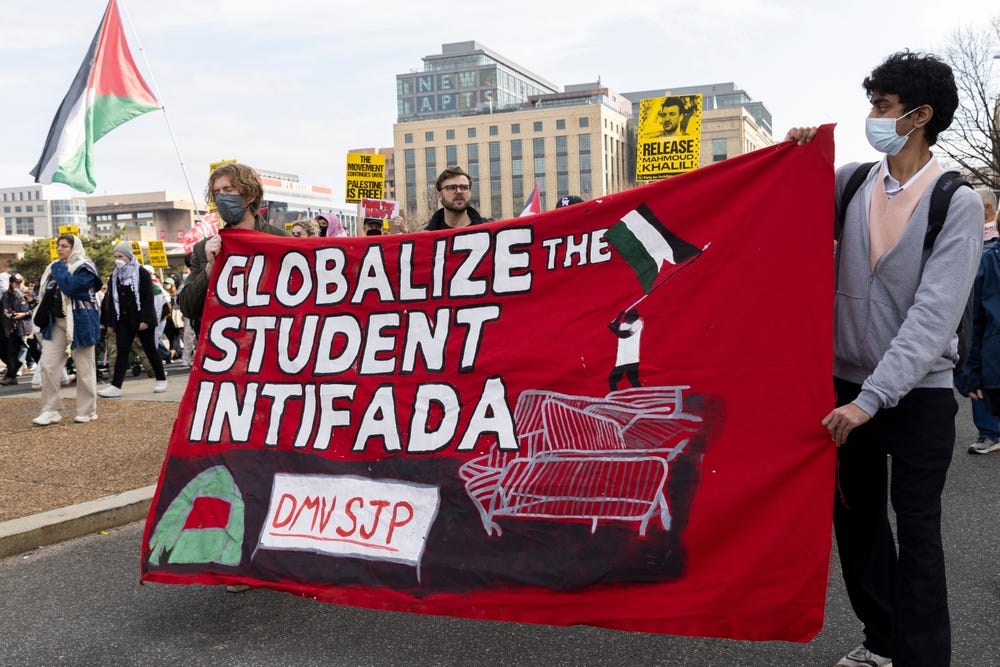
Yet OCR’s outcome letter provided “illustrative examples” of reported discrimination that include both serious allegations of peer harassment against Jewish students and speech protected by the First Amendment. Some students, for example, reported receiving threats and being blocked from accessing rallies on campus. Such conduct is clearly unprotected by the First Amendment, and could create a hostile environment for Jewish students on campus. But other allegations — students chanting “from the river to the sea,” inviting controversial anti-Israel speakers to campus, and displaying posters with anti-Israel messages — would raise serious First Amendment issues if used to subject the university to civil rights liability.
FIRE takes no position on the Israeli-Palestinian conflict, nor does it endorse or condemn any of the constitutionally protected expression listed above. Universities may well have failed in some cases to properly address actionable misconduct. But institutions have too often responded to federal scrutiny by conceding more than civil rights law requires.
Columbia University and Reed College, for example, resolved similar investigations in 2025 and 2026 by incorporating the International Holocaust Remembrance Alliance’s working definition of antisemitism into university policy and agreeing to consider the definition and its examples as evidence of discriminatory intent. This usage of the IHRA definition creates confusion about what speech is and is not allowed regarding the Israeli-Palestinian conflict and risks stifling expression on an important matter of public concern.
Of course, it is not unusual for civil rights settlements to include provisions that reform institutional policies. What is unusual is the extent to which these settlements bypass First Amendment limitations on Title VI. Federal courts have grown increasingly clear on two key principles.
First, the standard articulated by the Supreme Court in Davis v. Monroe County Board of Education is the appropriate means of assessing whether a university failed to adequately respond to reports of discriminatory peer harassment on campus. FIRE has long supported the Davis standard, which defines actionable discriminatory peer harassment as conduct that is “so severe, pervasive, and objectively offensive, and that so undermines and detracts from the victims’ educational experience, that the victim-students are effectively denied equal access to an institution’s resources and opportunities.”
This standard effectively balances the government’s interest in protecting students from discriminatory conduct against the risks of suppressing protected student speech and subjecting universities to endless liability. And although the Davis standard was first articulated in the Title IX sexual harassment context, courts have readily extended it to Title VI hostile environment claims based on race, color, or national origin — including claims of antisemitism.
Second, the First Amendment limits harassment law’s reach. In the landmark case Saxe v. State College Area School District, then-Judge Samuel Alito wrote for the U.S. Court of Appeals for the Third Circuit, “There is no categorical harassment exception to the First Amendment’s free speech clause.” The Supreme Court and lower courts have since warned against transforming harassment law into a “general civility code.”
Numerous federal courts have agreed when considering Title VI hostile environment claims against universities for their handling of pro-Palestinian protests. For example, a federal district judge in Gartenberg v. Cooper Union Center for the Advancement of Science and Art concluded that Title VI does not allow for liability based on protected speech on a matter of public concern. The First Circuit in a similar case, StandWithUS Center for Legal Justice v. Massachusetts Institute of Technology, found that the complaint largely rested on allegations that the university declined to censor core political speech.
Colleges are sophisticated actors. They are well-equipped to enforce their conduct rules, litigate cases, negotiate settlement terms, and craft nuanced responses to complaints. They should act like it.
Notably, the complaint in Gartenberg survived a motion to dismiss because it alleged significant discriminatory conduct; for example, demonstrators allegedly surrounded and banged on the windows of a library while identifiably Jewish students were inside studying. But in both cases — and others at the University of California at Berkeley, Haverford College, and the School of the Art Institute of Chicago — courts recognized that Davis and the First Amendment do not permit Title VI liability premised solely on students’ subjectively offensive political speech.
Accordingly, Title VI does not obligate universities to respond to protected speech or settle investigations by adopting speech-restrictive policies. Instead, universities must respond to allegations of discriminatory hostile environment harassment by enforcing their conduct policies and applying the Davis standard. This approach gives universities the tools they need to respond to actionable discriminatory harassment — for example, when students directly target their peers with true threats, block others from parts of campus, or damage property — without chilling free speech.
Unfortunately, as we’ve seen, too many universities have taken a different path. Some have failed to enforce their conduct policies and, when faced with subsequent scrutiny, agreed to settlements that fail to distinguish between protected speech and unprotected discriminatory conduct. But with this approach, institutions commit a double wrong. They fail the students who were victims of actionable discriminatory harassment, and they betray their commitments to the students whose speech is suppressed by flawed policies.
Colleges are sophisticated actors. They are well-equipped to enforce their conduct rules, litigate cases, negotiate settlement terms, and craft nuanced responses to complaints. They should act like it, rather than making unnecessary concessions that will chill the very free expression that they claim to support.
But free speech cannot support/promote crimes and terrorism or any form of individual rights violations.
Nice article. In part, it's helpful because it serves as a reminder that some common distinctions (e.g., "protected speech" versus "unprotected conduct") serve more to confuse than to illuminate. The statement about "threats" followed by the assertion that "[s]uch conduct is clearly unprotected by the First Amendment" is illustrative.
Not all so-called threats are unprotected. As Trump will learn (regarding Comey's mere photo of the mere numbers 86 47), not everything that a snowflake claims is a "threat" can be punished. As SCOTUS emphasized in Counterman v. Colorado in 2023, "the First Amendment" necessarily "requires proof that the defendant had some subjective understanding of the threatening nature of his statements." At the very least, the government must prove "that the defendant consciously disregarded a substantial risk that his communications would be viewed as threatening [actual physical] violence."
In addition, although a threat always is conduct, it also very often is speech. Moreover, a threat always is conduct even if it is mere speech. All forms of expression and communication necessarily constitute conduct. "Speech" necessarily means expressive conduct. Even in the most narrow sense of the word "speech" is the verbal expression of words. Words not expressed are mere thoughts.
Everyone would better understand what the First Amendment protects if we would use the words that our Constitution uses and if we understand their purpose. Our Constitution expressly protects "the freedom of speech" or "the freedom of the press," not mere "speech" and not merely "the press."
The expressions "the freedom of speech" and "the freedom of the [printing] press" (aka "the liberty of the [printing] press") were not meant to be taken literally. They are idiomatic expressions that symbolize our right to express ourselves and communicate.
Copious conduct counts as "speech." Wearing expressive attire (including uniforms and costumes), flying flags, making gestures, erecting structures (Liberty Poles), decorating trees (including Liberty Trees) and even hanging effigies or burning effigies (or crosses) has been considered protected expression and communication since before the U.S. became a nation.
The "freedom of the press" even more obviously cannot be taken literally. In the 1780's and 1790's, the press didn't mean any speech or conduct. "The press" meant an inanimate object, a printing press, which, alone, did nothing. It did nothing relevant without a person arranging lead letters on it, applying ink and physically pressing paper (or fabric) against the lead. See, e.g., https://youtu.be/SsdvcuDApdU?si=-Mk488gkrKdO5hrI.
Moreover, copious expression and communication is prohibited or restricted (e.g., in any limited public forum) or penalized (e.g., defamation) or punished (e.g., true threats, perjury, exposing certain national secrets). Our Constitution even expressly compels some speech. See, e.g., the two oath clauses and the Sixth Amendment requiring a "public trial" and that a defendant "be confronted with the witnesses against him" and "have compulsory process for obtaining witnesses in his favor."