


The battle for free speech on American campuses isn’t just a string of legal skirmishes to protect students and faculty from backlash when they speak their minds. It also means creating a climate in which they feel comfortable speaking up in the first place. That’s why this week, we decided to look into the data behind student self-censorship.
We began by asking students whether they would allow six hypothetical controversial speakers on campus, three from the right and three from the left. Some students, let’s call them “Saints,” said they would definitely allow all six speakers. But this was only 4% of students. Then you’ve got “Demons,” who would definitely not allow any of the speakers. Finally, there are “Witches” who would only allow speakers whose views they support.
For each of those groups, we then did sentiment analysis of their own descriptions of moments when they censored themselves on campus. The results were fascinating.
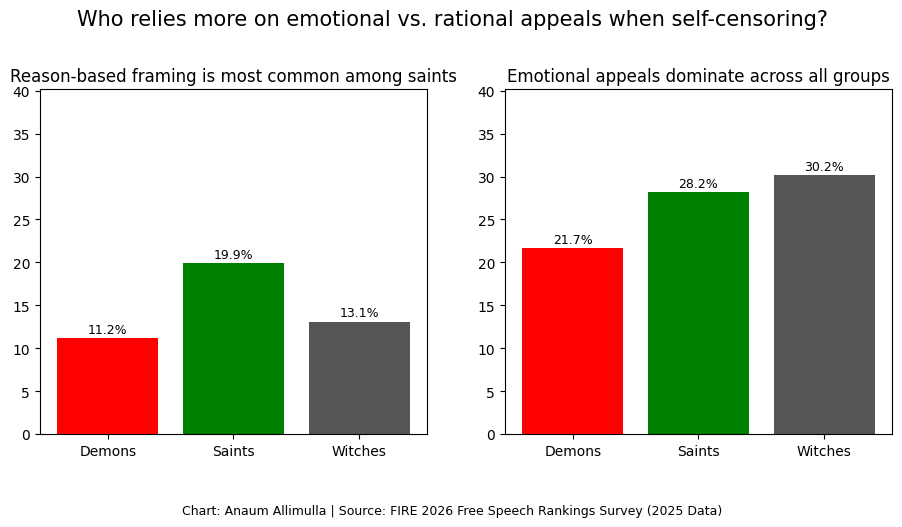
One thing that immediately jumped out was that across all three groups, emotional reasoning is more common than rational thinking. On today’s campuses, the divide over free speech isn’t just about who gets to speak but about whether students are thinking or feeling their way to that answer, and the data isn’t good.
The selectively censorial Witches show the most emotional reasoning. If a particular viewpoint makes them feel bad, they don’t want that speaker platformed. By contrast, rational arguments are most common among Saints. As one student said, “I did not agree with the speaker, but everyone should be allowed to speak to create a diverse environment.” But Saints also lean more on emotional appeals than rational ones. In other words, even the most principled group operates less on principle than on how situations feel.
Things get bleaker still when you ask why students censor themselves.
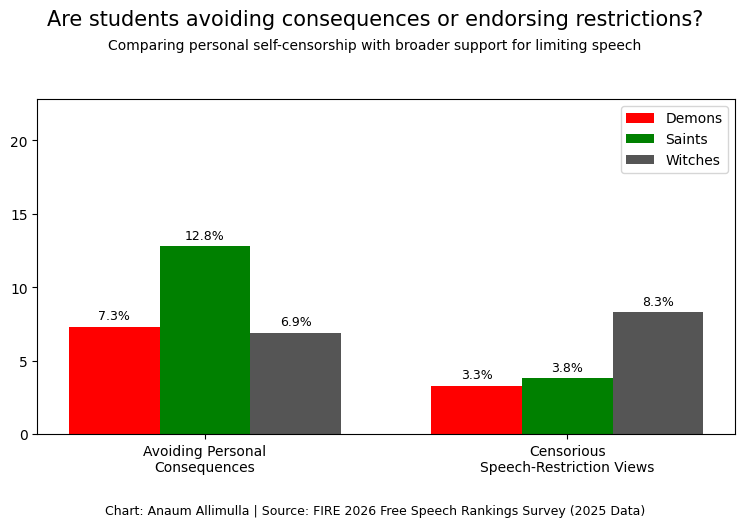
Across all three groups, a common reason students self-censor is to avoid personal consequences, such as judgment from peers, especially the Saints. Another sentiment expressed in the self-censorship responses is a belief that certain viewpoints should not be openly expressed. Interestingly, more Witches mentioned this than avoiding personal risk. As one student said, “When they were talking about transgenders . . . I do not think that should be allowed.”
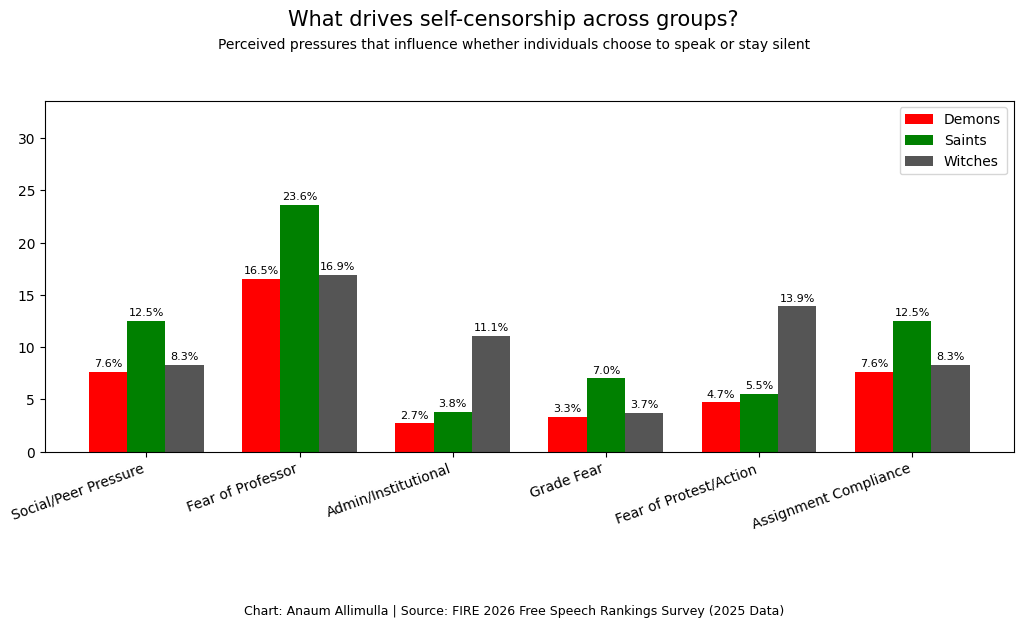
We then drilled down on more specific reasons for self-censorship. Fear of professors stands out as the top reason given by all groups, especially Saints. Saints also generally report higher sensitivity overall. This makes sense since they oppose censorship and are therefore more sensitive to factors that might cause it. Meanwhile, Witches are more worried about administrative pressure and protests compared to other groups. It’s also worth noting that grade fear is relatively low across the board, suggesting academic penalties usually matter less than social dynamics or pressure from authority figures.
What emerges from all this is a picture of a campus climate in which student self-censorship is less about formal punishment and more about perceived pressure, where even the students who are most committed to open expression are navigating that pressure with their instincts more than their principles. This has two implications. First, policy alone won’t fix the problem. Universities can adopt strong free speech statements, but if students expect social or institutional backlash, they’ll stay quiet. Second, the case for free expression itself is eroding where it matters most: how students actually think.
This is deeply disturbing because if support for free speech rests more on how situations feel, that makes it incredibly fragile. And if students’ willingness to speak up is being throttled by fear of their own professors, the impulse is being killed before it’s even fully formed.


Big fan of your work.
I think we have known forever that emotional arguments can win over reasoned, fact-based arguments in most situations, even, in my experience, with smart people who think they are above emotional manipulation. Not really a new revelation. So, we teach people how to dress and talk and which behaviors are mostly like to win over an audience, in addition to providing data that is fact-checked for accuracy.
Decades ago, the summer before I began teaching at a state college as adjunct faculty, I dropped in at the department's office to meet the professor who would be supervising my work. I was in blue jeans and t-shirt, in my thirties; classes were not in session. Colorado is pretty casual when it comes to dress codes.
The secretary was not very nice as I asked her if the prof had time to meet with me. She handed me a form to fill out and pointed out a chair.
Sit and wait, she said. I looked at the form, which was a complaint form for students to fill out.
I had given her my name...and then I realized she did not know who I was.
My apologies, I said. I am the new substitute adjunct for the conflict management class.
Her voice and expression changed instantly. Big smile. Warm and friendly.
And then she said something that made me wish I had had a means to videotape her.
"My apologies. I was rude to you only because I thought you were a student."
After 40+ years, as a management consultant to dozens of workplaces, including academia, across the US, I can say that our species is mostly not rational.
I believe the internet cycle of praise to hatred also increases this impulse to hold your tongue out of fear of how others will respond.