


In our recent Law Faculty Survey, we asked law professors whether they believe that judges are politically neutral or politically biased, and we asked them what they teach their students.
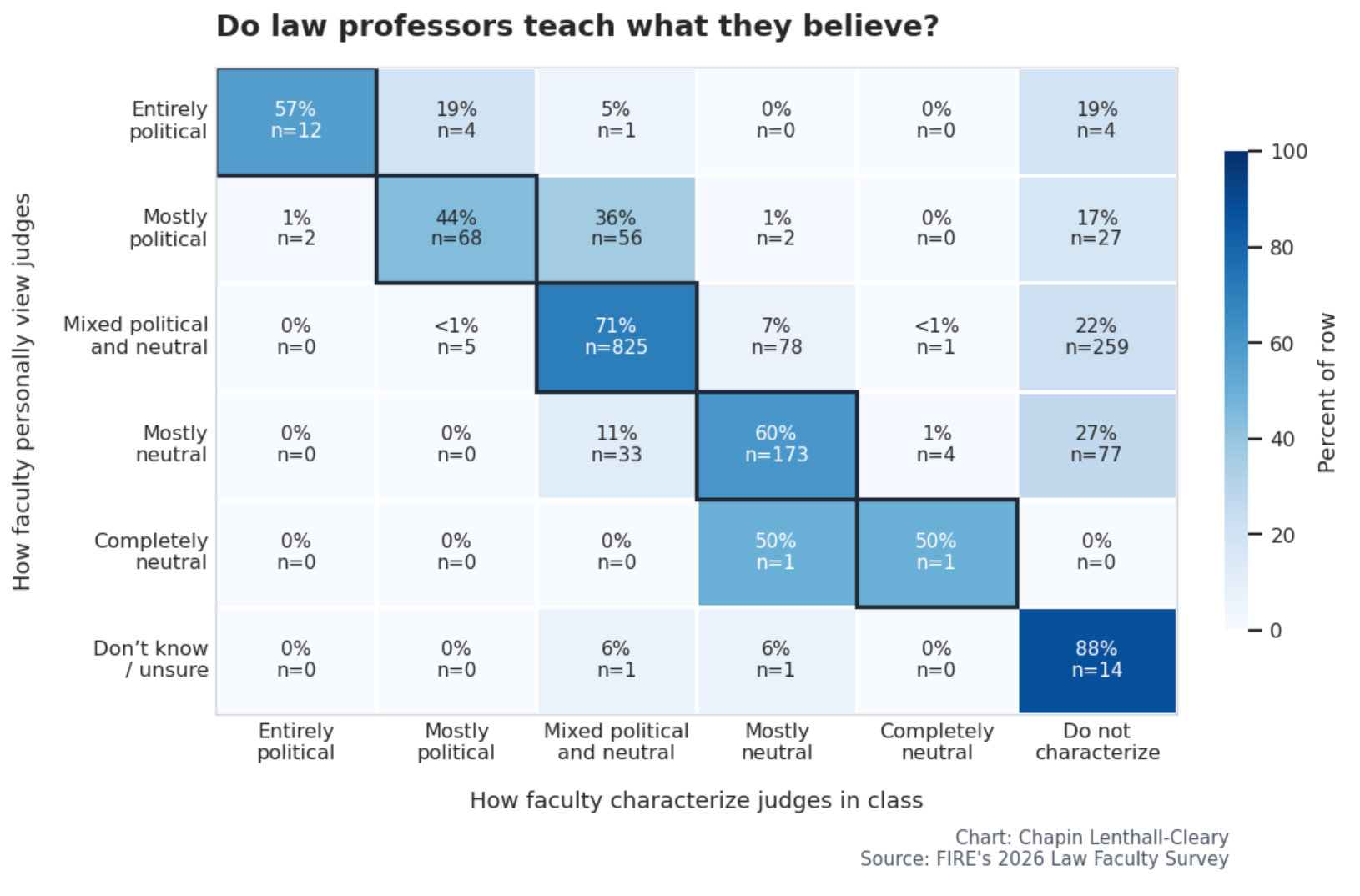
Professors’ personal views are listed on the left, with what they say they teach on the bottom. Each row adds up to 100%, showing what professors with a given opinion teach:
Ouch.
Among law professors who think the judges are mostly politically motivated, over a third say they tell their classes otherwise, usually that judges’ motivations are mixed. Unsurprisingly, there’s a concentration on the main diagonal, corresponding to those who teach what they believe. But the deviations from the main diagonal, those who don’t teach what they believe, are striking. If we exclude those who just don’t talk about the issue, over 40% of professors who believe judges are politically motivated teach their students something else.
What could cause this? Believing one thing and teaching another could signal an intent to deceive. But there are reasons professors would give different responses to the two questions that don’t involve deceiving their students. Maybe these professors are trying to teach both sides, avoiding presenting their views on the matter as fact. Indeed, that seems much more responsible than teaching what you earnestly believe on a contentious issue as fact, in favor of letting students form their own conclusions. If I were teaching the debate (which I presumably would be), I’d probably respond, “I don’t characterize judges’ decision-making as either politically motivated or neutral.”
But I’d do that because it’s the technically-correct answer if I’m teaching the debate. Maybe some law professors who mean that they teach the debate, rather than a particular view, respond that “Judges are a mix of politically motivated and neutral” (the “mixed” option on the plot). If that’s what’s going on, there’s a puzzling asymmetry: professors who think the judges are mostly neutral don’t say “mixed” nearly as frequently as their less-cynical counterparts, those who think judges are mostly political.
Even if the motive is to deceive, it could be for pragmatic/pedagogical purposes — if one teaches students that judges are entirely political and will simply rule in favor of their biases, that discourages putting the effort into learning how to become an effective advocate when that won’t influence the result in the end. While I’d argue that the first obligation of professors is to the truth, even when unpleasant, this line of reasoning may account for many of the people who teach something they don’t believe.
That asymmetry, where many professors who believe judges are mostly political, but few who believe they’re mostly neutral, teach “mixed”, is notable: Whether the “judges are mixed” responses from those who think judges are mostly political (or mostly neutral) are due to dishonesty, teaching both sides the debate, something else, or all three, and whether they’re a sign of something good or bad, this asymmetry still means that the views of cynical professors are less likely to make it into the classroom.
The code, data, and codebook used to generate the plot above can be found on Github.

Broadening the scope of the discussion to other disciplines–my experience was in the social sciences–I believe, based on first-hand observations and understanding my own failings:
1. Some educators are cause-driven and will present (meaning promote) only their one version of the truth. And students who know better keep their mouths shut in class to protect their grades.
2. Some believe they are being fair-minded, but because they don't walk the talk in terms of their actions, students will judge them as hypocrites. They preach one set of values but are seen and heard practicing a different set. For example, the professor who teaches conflict resolution behaves like a bully or a jerk. (I think those are the academic terms.)
3. Some are presenting "old" information, literally decades out of date. When citing the views of an active practitioner such as a judge, they haven't checked in to see if that person still is behaving that way.
I tried to present a diversity of theories and be honest about my own biases, while telling students that, while I expected them to know the material on tests and papers, I didn't expect them to always agree with my preferences, just show they understood. Make your case for your position, I would tell them. The result was that students with different opinions tended not to be defensive in class and were more open to considering new ideas. As long as they were respectful of others, they could present their ideas and not have to pretend to agree with me.
My opening statement the first day of class: There are over 50 major theories regarding how humans communicate and learn. I can direct you to the resources to further study all of them, however, in the time we have in this class, you are going to be stuck with my four favorites.
I also had to be the best version of myself in the classroom. 45+ years of this kind of work humbled me and made me a better person. Still working on that.