


In our College Free Speech Rankings survey, we ask students how often they feel they cannot express their opinions. Around one in six say they self-censor fairly often or very often. What can we say about what causes this? First, self-censorship is more common on the right:
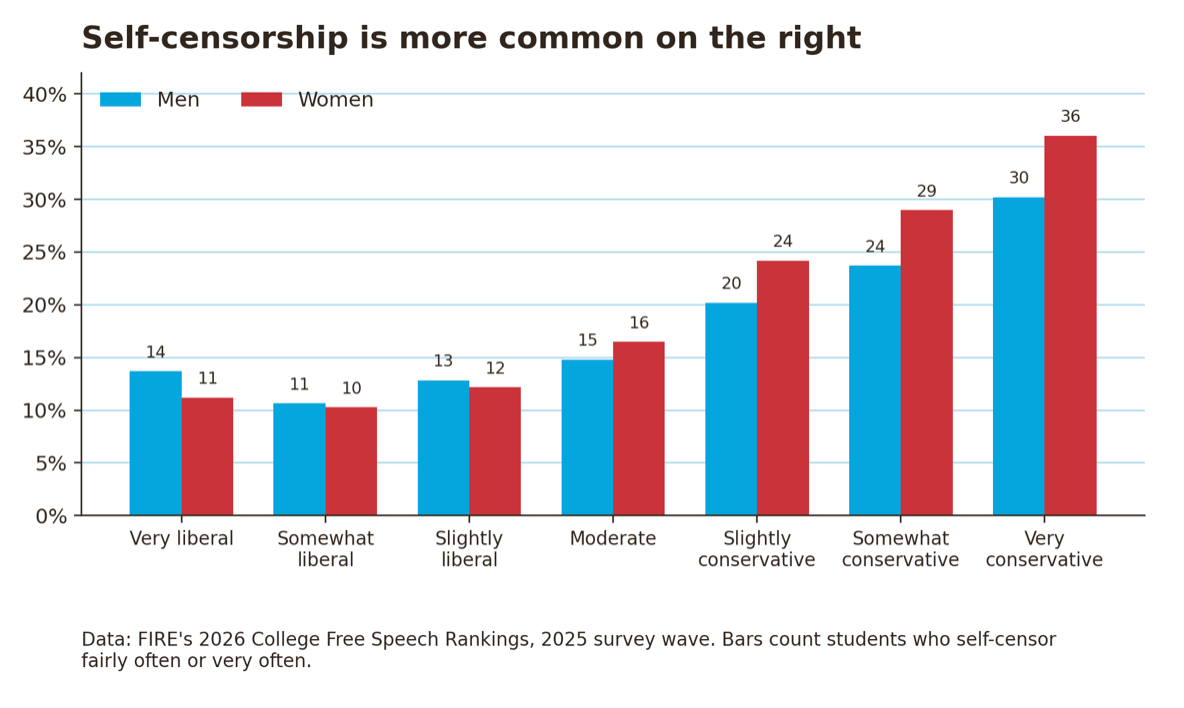
Why are conservatives, and especially conservative women, more likely to self-censor? One reason might be to hide their political beliefs from professors (who skew heavily liberal) in order to get a better grade in class:
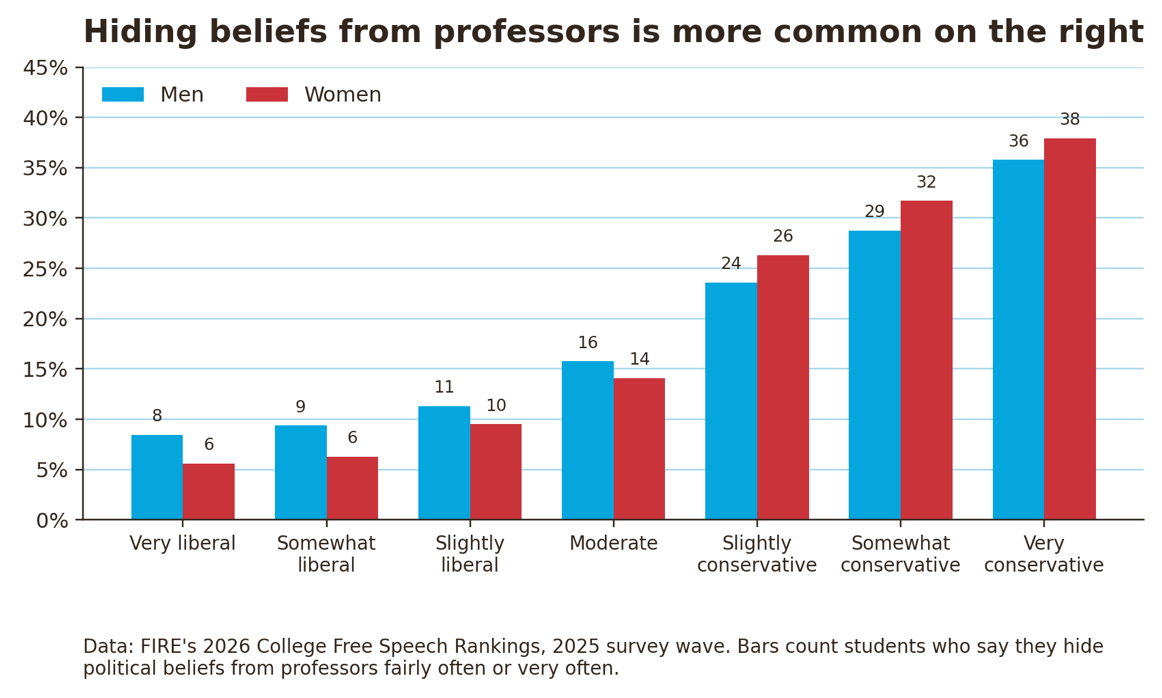
Only 6.5% of very liberal students say they hide beliefs from professors for a better grade fairly often or very often, compared to 37% of very conservative students, suggesting a fairly widespread fear of bias in professors among students on the right.
Another potential factor is peer pressure. Are students possibly censoring themselves because they are afraid of what their classmates might say? It turns out that, yes, students censor themselves more often as the likelihood of a classmate reporting them increases, and more than they do to avoid being reported by a professor:
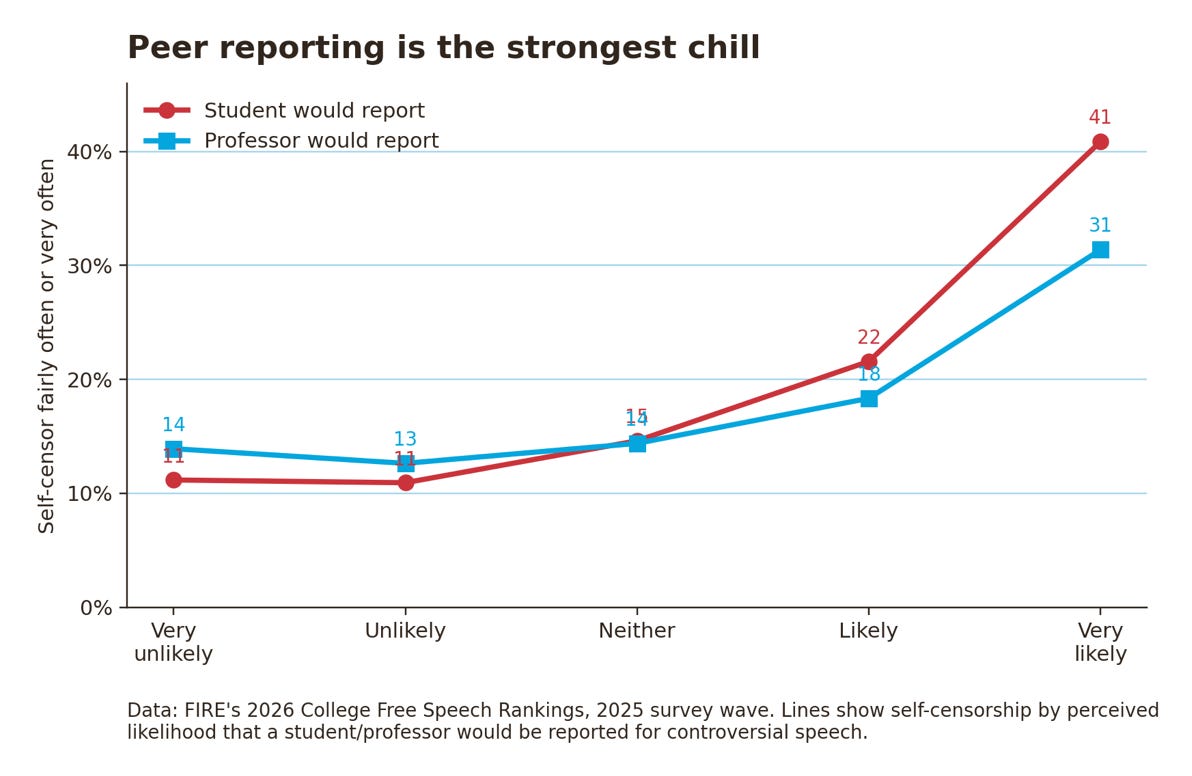
Students who believe another student won’t report controversial comments only self-censor about 11% of the time. Students who think another student is very likely to report speech will censor themselves about 41% of the time, or nearly four times as often. That’s larger than the gap between most broad demographic or ideological groups.
When students think a professor is very likely to report speech, they only censor themselves about 31% of the time, which suggests that fear of being reported by other students is a much bigger concern.
But now let’s consider where students are most afraid to say what’s truly on their minds. On a written assignment? In a class discussion? In a public disagreement with a professor? On a social media account tied to their real name? It turns out, it’s the social media account:
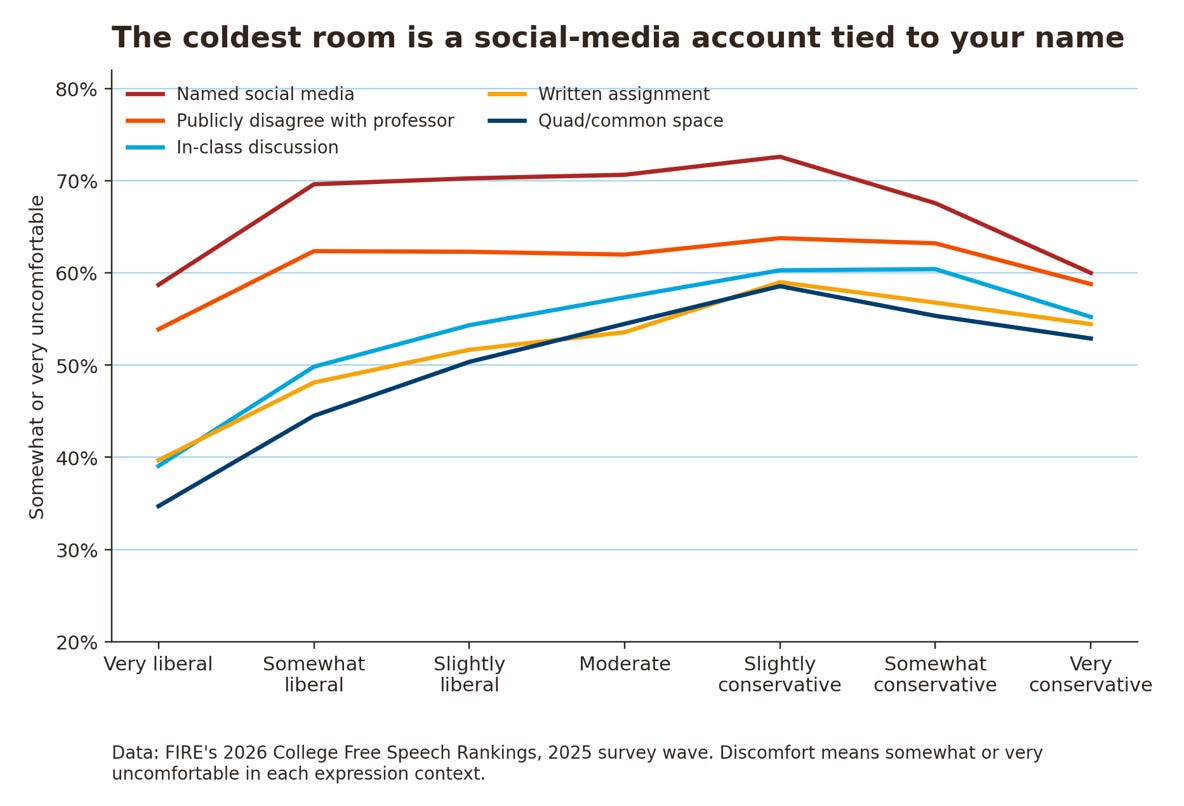
Nearly two-thirds of all students total say they would be somewhat or very uncomfortable expressing an unpopular political opinion on a social media account tied to their name. That’s more than any other setting we asked about. The survey doesn’t ask why, but the obvious difference is exposure: a named account expands the potential audience and preserves the record.
This is not only a conservative problem. Anxiety over social media is common. But in all contexts, conservative students feel the pressure more than their liberal counterparts: in class, in written assignments, and in campus common spaces.
There’s also a striking effect regarding what topics students find difficult to discuss:
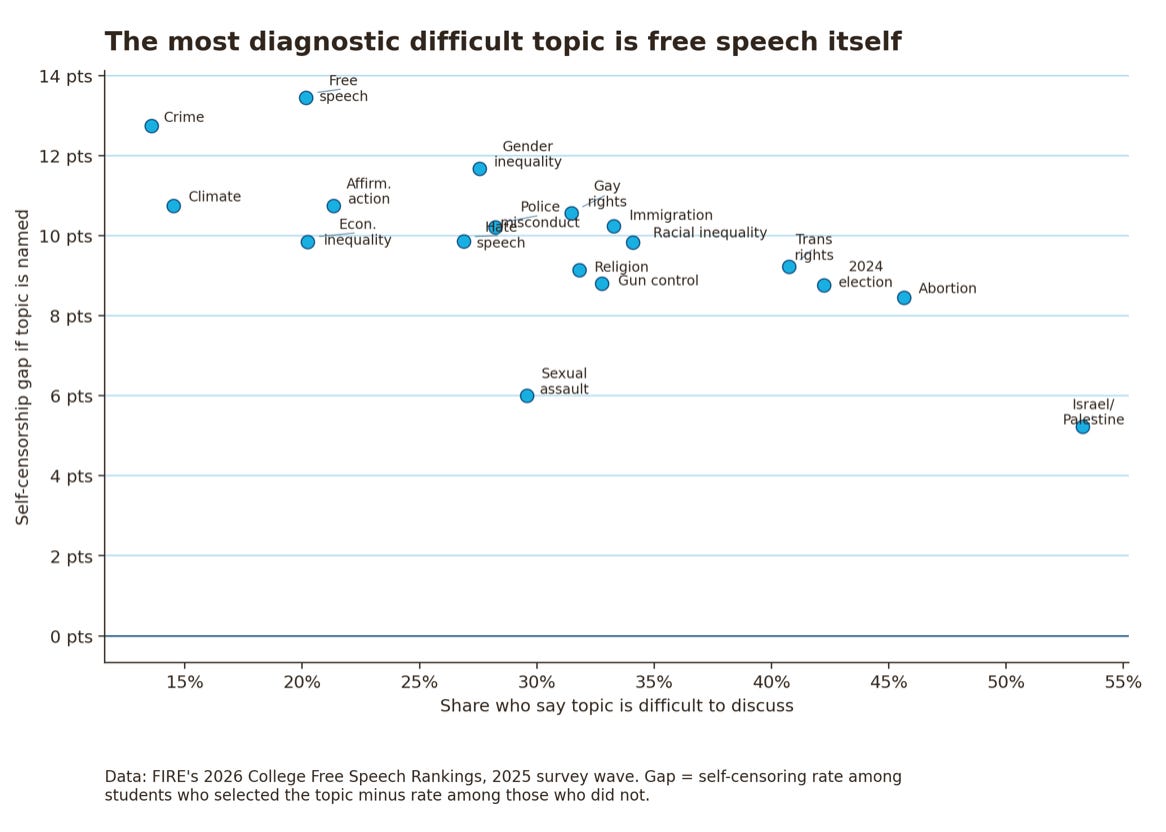
Students who find free speech easy to discuss on campus are significantly less likely to self-censor. It’s not a difficult topic to discuss for most students, but the students who do find it difficult to discuss are also generally prone to self-censor.
Taken together, these patterns suggest a variety of factors driving self-censorship on campus, especially peer pressure. If colleges want to stop students biting their tongues, they might do well to build a culture where students aren’t afraid of each other.

Don't overlook or ignore criminalization and fear of retributionary government surveillance.
I’ll answer this question from my own introspection. Like many survey respondents, I’m reluctant to comment online with my real name. I know that other people will judge my morality and goodness based on my political opinions. As someone who is generally liberal, I’m sad to say that liberals are especially guilty of this. I am vulnerable to this even though I’m liberal because I don’t toe the line when it comes to liberal sacred cows, especially around identity politics, which I despise, and the supposed evil of capitalism