


At moderate schools, those where the average student is close to the middle politically, a lot of issues are difficult for both sides to discuss. At hyper-liberal schools, those where the average student is strongly liberal, every issue is easy for liberal students to discuss — except for one:
The Israeli-Palestinian conflict.
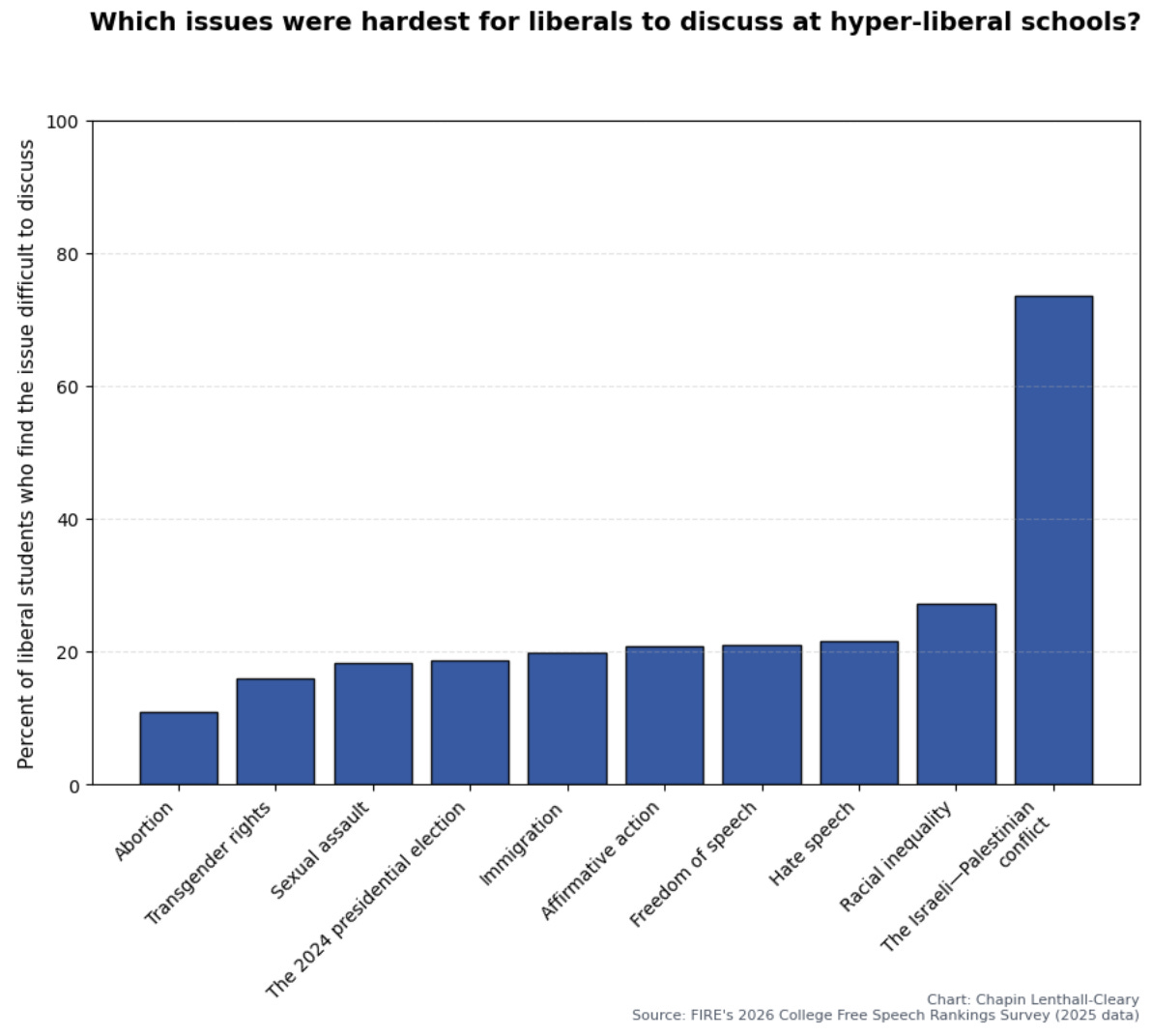
At these hyper-liberal schools, the topic is more than twice as difficult for liberals to discuss as any other issue.
Remember, the hyper-liberal schools discussed here are only a small group of schools, and don’t include any Ivies or other large schools, such as Columbia University. At those other schools, there are of course many examples of administrations going after students for protected pro-Palestinian speech.
While this phenomenon got worse after Oct. 7, the issue has been uniquely thorny for these students as far back as our data goes. In addition, disagreements among liberals or fear of social stigma may make the issue harder to discuss in general, but they do not explain why it is especially difficult at very liberal schools.
Students who don’t trust their administrations are significantly more likely to find it difficult to discuss the conflict. Liberal students at hyper-liberal schools are less trusting of their administration and more worried about discussing the Israeli-Palestinian conflict, even though they’re seemingly less likely to face punishment for pro-Palestinian protests there.
One generally assumes people are more comfortable sharing their views when surrounded by others who think the same way. So then why are liberal students at very liberal schools scared to talk about the Israeli-Palestinian conflict?
In FIRE’s College Free Speech Rankings survey, we ask students whether they’re comfortable discussing a variety of political issues.1 Which issues do they find difficult to discuss? Let’s begin by looking at students at moderate schools.2 In the scatterplot below, issues that conservatives find hard to discuss are closer to the top (measured on the vertical axis) while issues that liberals find hard to discuss are more to the right (measured on the horizontal axis):
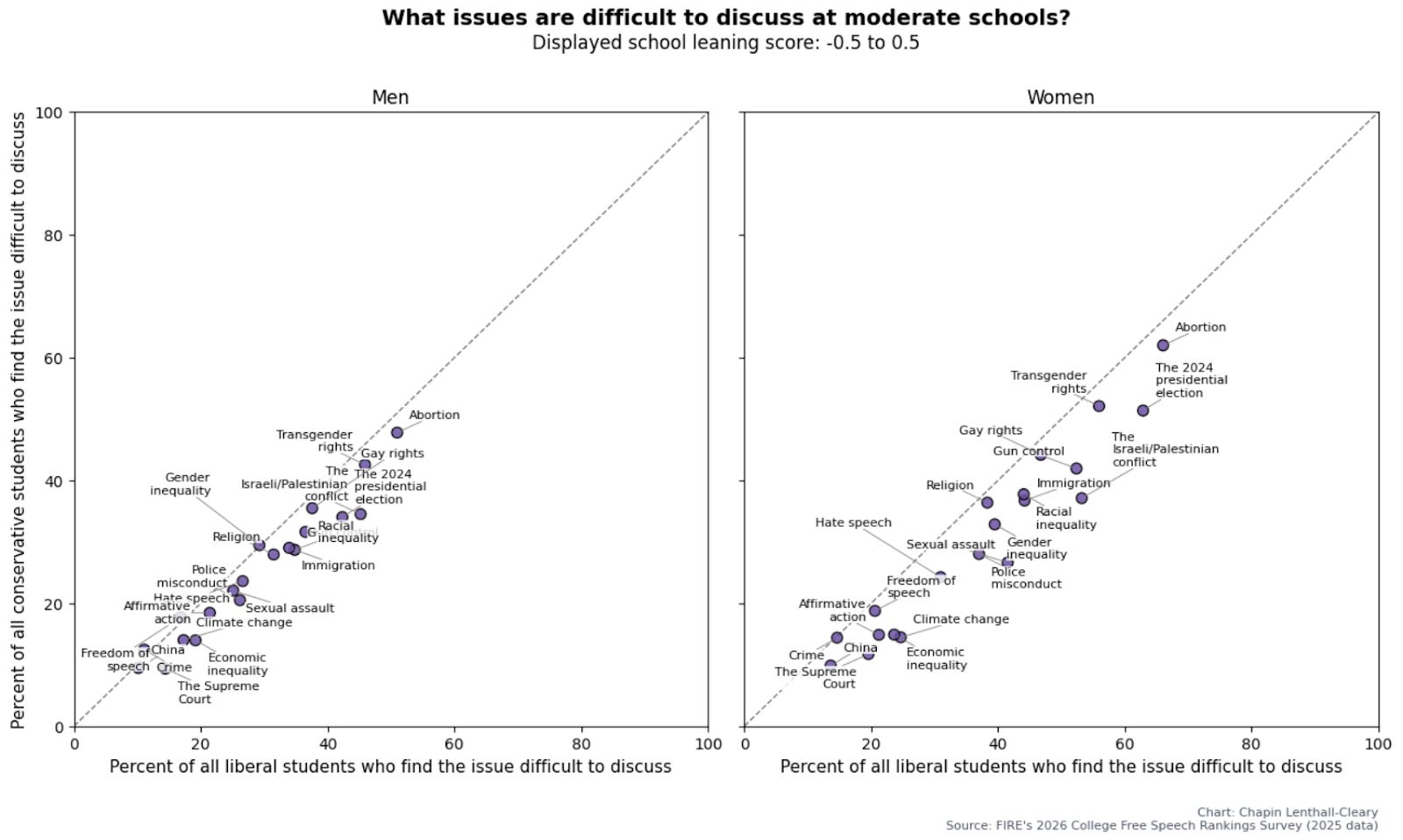
This is about what I’d expect. The points fall along a diagonal line with a slope of roughly one, meaning conservatives and liberals roughly agree on which topics are difficult to discuss. Abortion and transgender rights are the thorniest. For women, the presidential election is also very difficult. China, crime, and SCOTUS are the easiest.
The offset from the center diagonal is interesting. At schools with close to perfectly moderate student bodies, liberal students still report greater difficulty discussing most topics. Given that most schools don’t exactly have administrations or environments that are disproportionately hostile to liberal students, it seems most plausible that this reflects a psychological difference between liberals and conservatives, perhaps greater neuroticism3 or anxiousness, a greater tendency to view one’s environment as oppressive, or something else. The fact that this gap is larger in women than men supports the notion that we’re seeing a psychological effect. That said, it’s not a massive effect.
But what about students at extremely liberal schools?

That’s a result.
For the most part, liberals at liberal schools are comfortable talking about every issue. We might’ve expected a diagonal with a larger offset or steeper slope, but instead we see a vertical blob. It’s not just that liberals have an easier time talking about most issues: the difficulty for the two sides becomes decoupled. Conservatives still have a difficult time talking about the normally difficult issues — abortion, transgender rights, and the 2024 Presidential Election — and an easy time with the normally easy ones — the Supreme Court, China, climate change — but liberals have an easy time with every issue. But these dynamics disappear for liberals at very liberal schools — echo chambers can seemingly make people more comfortable talking. To the small extent that some issues are tougher for liberals, it’s things like economic inequality, which aren’t normally thorny.
Until we get to the Israeli-Palestinian conflict. At moderate schools, it’s a normal political issue. For liberal students at liberal schools, it’s the difficult issue, with more than twice as many students finding it difficult to talk about than any other issue, even though they are surrounded by more like-minded peers than any other students.
So what’s going on here? Why is this issue so thorny? To understand why this happens, we look at four possibilities: the impact of Oct. 7, ideological divisions among liberals, fear of social stigma, and fear of administrative punishment.
October 7
First, the obvious: Presumably, this is a response to Oct. 7, the subsequent war, and the encampments. We can check that by making the scatterplot with (early) 2023 data:
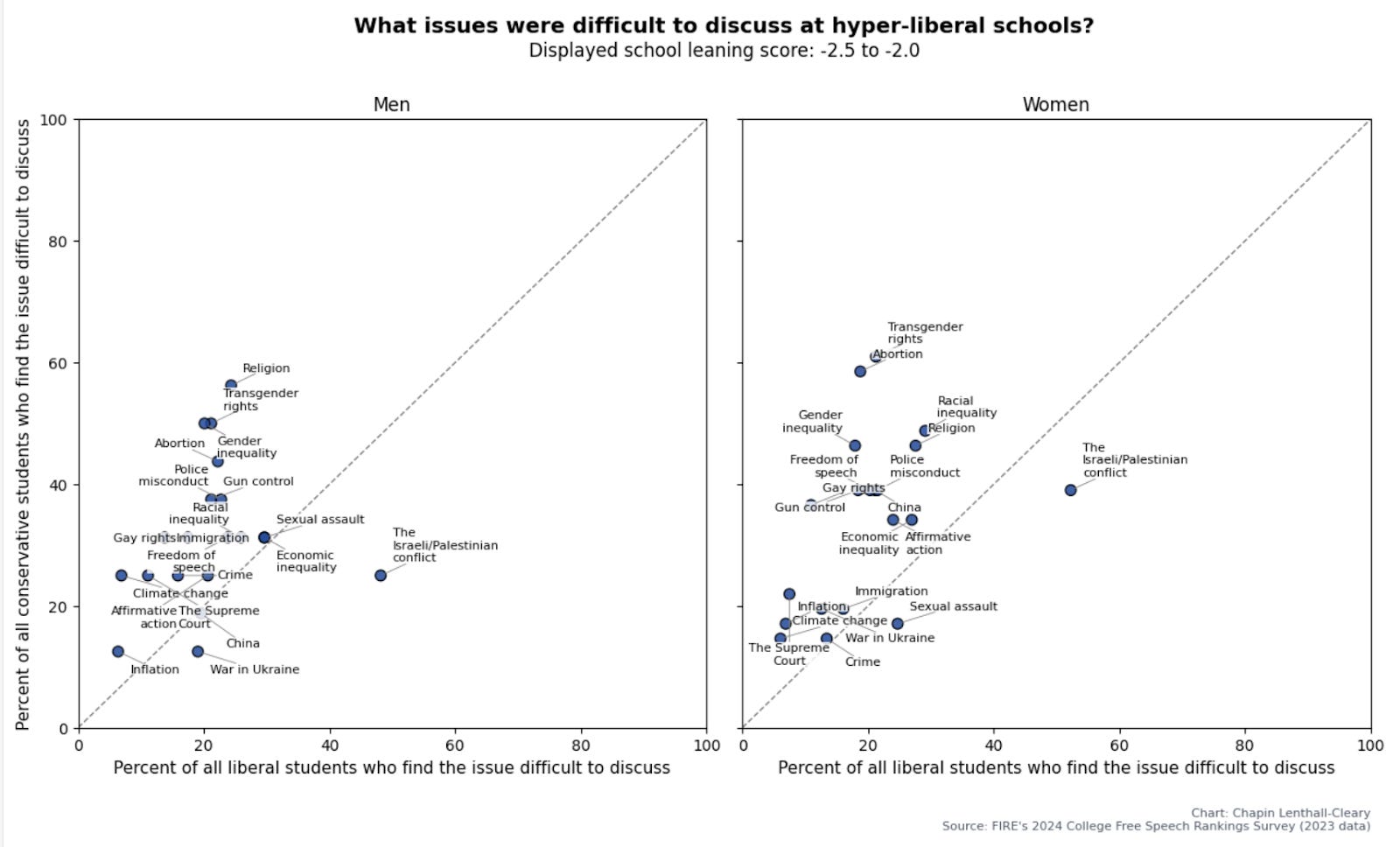
Erm, what?
Oct. 7 and its aftermath coincided with the Israeli-Palestinian conflict becoming more difficult to discuss, but it’s been a uniquely difficult issue for liberal students at liberal schools for longer than that — in fact, since at least 2020, the first year we have data on this.
What’s so special about this particular issue?
Divisions among liberals
Well, there’s an unusual amount of disagreement amongst liberals of various shades. And the scatterplots binned together students who were anywhere from slightly to very liberal. At moderate schools, liberals tend to be more moderate. But at hyper-liberal schools, you tend to have more left-wing extremists. Maybe very pro-Palestinian students are uncomfortable discussing the conflict more often, and the difference between liberal students at various schools is just a question of how far to the left they are. To check this, let’s bin individuals by ideology (in addition to school leaning):
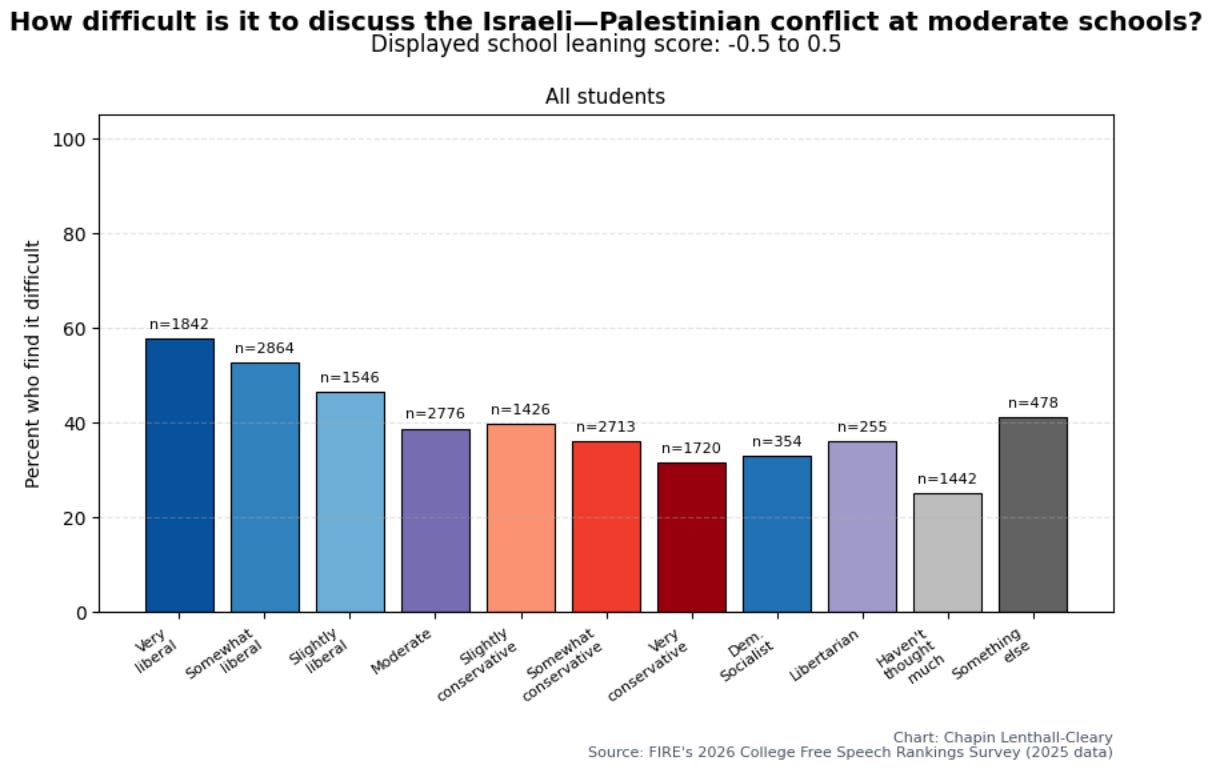
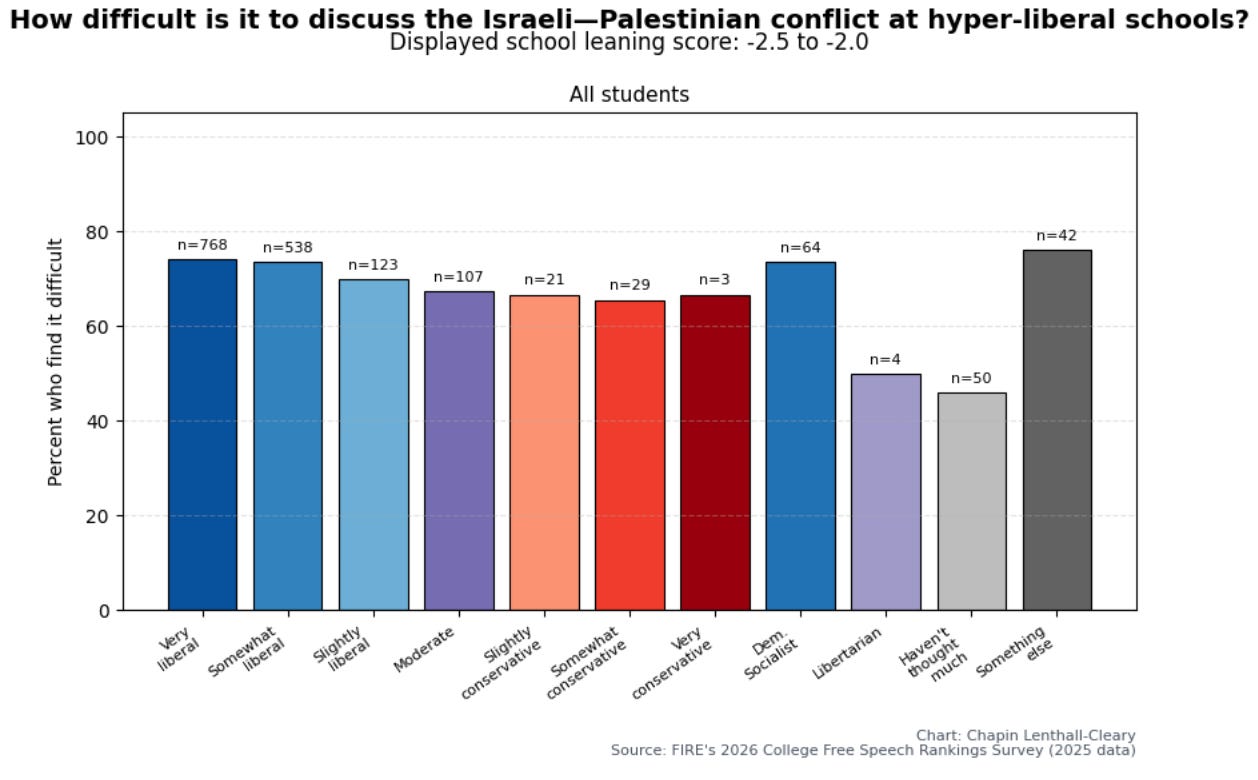
That’s part of the explanation. Very liberal students do have a tougher time discussing the conflict than moderately liberal students. But students at more liberal schools also have a harder time discussing it, regardless of ideology. A very liberal student at a far-left school is nearly 20 percentage points more likely to have difficulty than a very liberal student at a moderate school. For moderately liberal students, the gap is even larger. More liberal schools genuinely seem to be tougher places to discuss this issue.
But while I do suspect that liberal infighting contributes to the issue being difficult to discuss in general, I don’t think it’s the primary reason that it’s especially difficult at very liberal schools. At moderate schools, there are roughly even numbers of very and slightly liberal students. At hyper-liberal schools, very liberal students outnumber slightly liberal ones by roughly 6 to 1. While our ideology measurements are an imperfect proxy for opinion on this issue, I’d bet against numbers like that causing more liberal infighting.
Fear of social stigma
Okay, there’s research suggesting that college students often fear social sanction for speaking their minds. Even if hyper-liberal schools, which are all small liberal arts schools and half of which are all-women, have less disagreement of opinion, maybe what disagreement exists is met with more social stigma there. I don’t have any data that proves this isn’t a factor, and I suspect this has some effect, particularly on creating a baseline difficulty across a range of schools and contentious political issues.
But it’s probably not the whole story, or anywhere close to it. It can’t explain why conservative women report having an easier time discussing abortion or the 2024 presidential election at hyper-liberal schools than they do at moderate schools. It can’t explain why the presumably-apathetic students who haven’t thought much about their ideology have an easier time discussing the Israeli-Palestinian conflict. And it can’t explain a relationship between administrative distrust and difficulty, which we’ll discuss momentarily. There seems to be a larger factor here.
Fear of administrative punishment
Another obvious possibility is that fear of administrative ire is silencing students. After all, there were more than a couple heavy-handed administrative crackdowns in response to the encampments. We have data on a question similar to this: In our survey, we ask how clear it is that an administration protects free speech on campus. Are students who distrust their administrations more likely to be uncomfortable discussing such a charged issue?
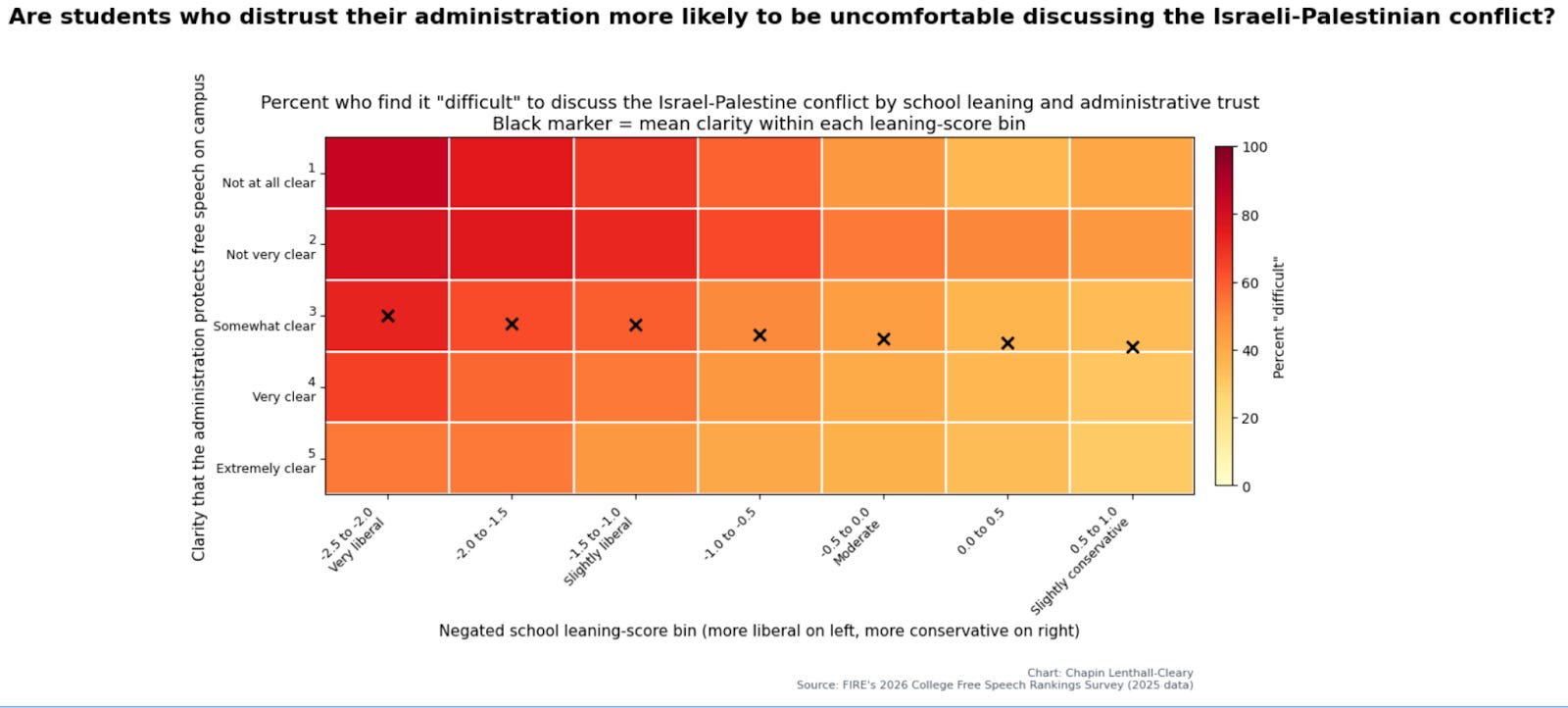
That’s very information-rich, but also busy. Here’s a simpler plot showing the same core trend:

Yes, emphatically. At the most liberal schools, students who think it’s not at all clear that their administration protects free speech on campus are 30 percentage points more likely to find the conflict difficult to discuss than those who think it’s extremely clear. (Looking just at liberal students at hyper-liberal schools, we see a similar result.) On the plot above, notice how the higher rows (where students trust the administration less) are darker (more difficulty): there’s a very strong relationship between distrust of one’s administration and difficulty discussing the conflict, especially at liberal schools. While we can’t prove that it’s causal, that result suggests that fear of the administration is a significant force in deterring discussion on this issue.
So what do students at hyper-liberal schools say about the topic? We ask students to share a moment where they felt they could not express their opinions on campus. When they feel they’re unable to talk about the Israeli-Palestinian conflict, do they talk about the administration?
“Whenever we discuss the ongoing conflict in Gaza, it’s under the assumption that if we go against administration, we are kicked out of the college.” (Barnard College)
“Administration just expelled two students over speaking out about the Israel-Palestine conflict.” (Seemingly for disrupting an Israeli history class, which, regardless of whether it justifies expulsion, isn’t protected speech.) (Barnard College)
“Not being able to say from the river to the sea without risk of being honor coded” (Wellesley College)
“The college has been very pro-Israel, this has led to a lot of censorship away from pro-Palestinian conversations” (Mount Holyoke College)
“The admin here is pretty pro-Israel so sometimes I’m worried about expressing my pro-Palestine opinions” (Smith College)
These should be treated as an illustration, not a representative sample or strong evidence: there are students who give other reasons for silence on the conflict, including fear of social repercussions, or no reason at all. That said, sentiments like the ones above are quite common.
So is this fear actually justified? Are administrations actually cracking down on liberal students or pro-Palestinian protestors especially aggressively at hyper-liberal schools? We don’t have data on that exact question in its entirety, but we do have data on the responses to the encampments, which seems like a reasonable proxy. Were they shut down more often at very liberal schools?
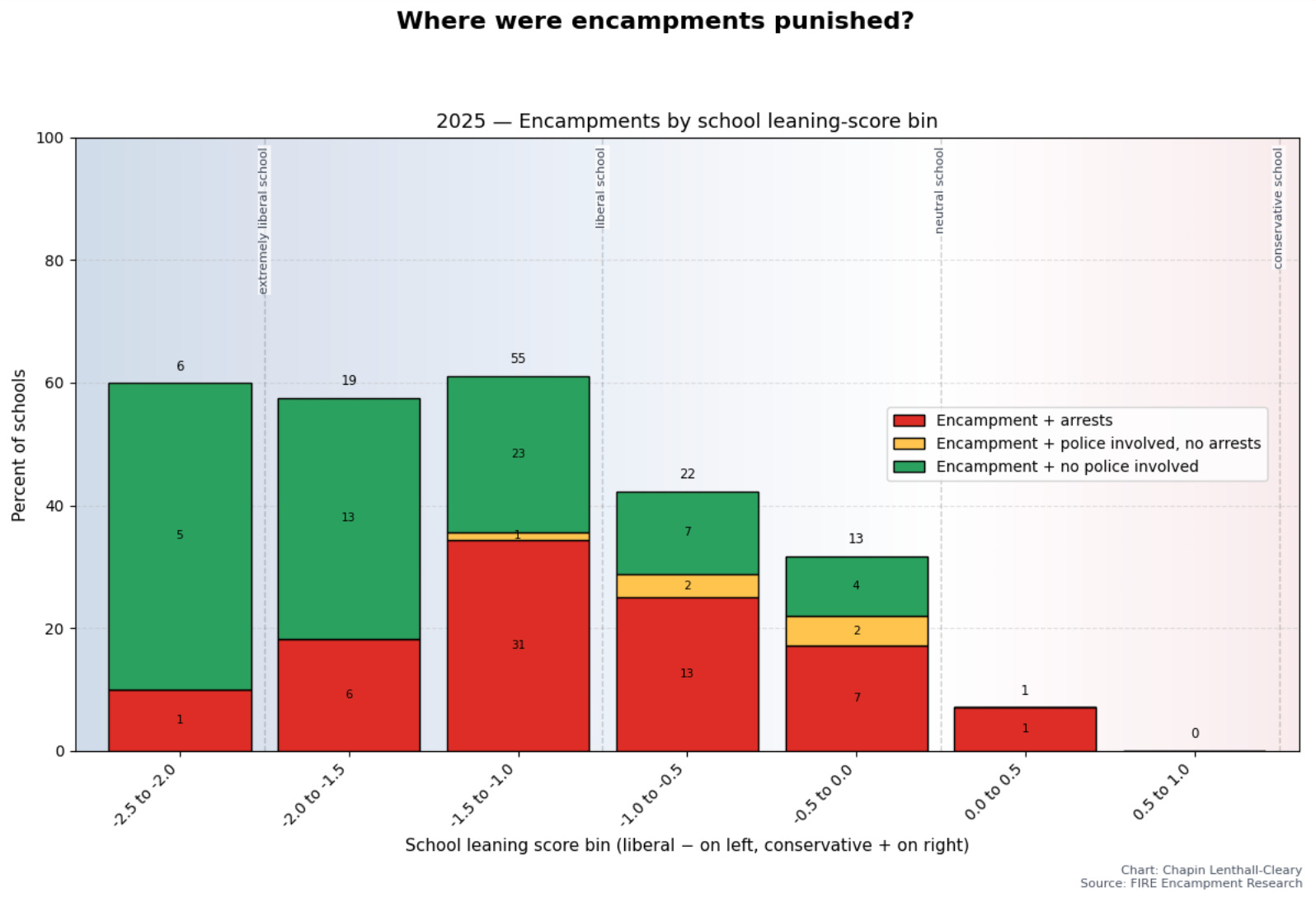
No. Encampments were more common at more liberal schools, but, when they happened, they were less likely to result in arrests or other police action. (This is the size of the red/yellow bar as a fraction of the whole bar.) Administrations at more liberal schools were less likely to punish students for encampments.
But what about punishment for speech generally? We also ask students whether they’ve been punished or threatened with punishment for expression on campus:

Generally, the more liberal the school, the less likely the students were to be disciplined or threatened for expression. Yes, college administrators are famously unkind towards student speech, but the administrations at hyper-liberal schools seem more lenient towards pro-Palestinian protestors than their counterparts at other schools. Liberal students at hyper-liberal schools are less trusting of their administration and more worried about discussing the Israeli-Palestinian conflict, even though they’re seemingly less likely to face punishment for pro-Palestinian protests there. While I certainly agree with their general distrust of college administrations, in this specific regard, it looks like this might be a case of many pro-Palestinian students at hyper-liberal schools being scared of their own shadows or having deeply distorted views of what free speech means. We should of course be appropriately cautious when reading into the data something very related to what it says, but that seems the most reasonable conclusion from the available evidence.
Conclusion
I see two useful warnings here. The first is the danger of scaring yourself into silence with an invented or exaggerated fear. Yes, the administrative onslaught against student expression is often real, fierce, and brutal. Yes, even when not officially punished, speaking your mind can have social repercussions. But, if you’re lucky enough to be in neither of those situations (or neither particularly severely), it’s easy to overestimate the danger you actually face. If you’re an ardently pro-Palestinian student at an overwhelmingly liberal school, you probably shouldn’t be more afraid to talk about the conflict than someone who holds the same opinion at a school with a slightly liberal student body and an administration possibly deeply hostile to your cause.
The second is more obvious: the general state of discourse on campuses is bad. At moderate schools, over half of students find it difficult to discuss many important issues. At very liberal schools, those with minority viewpoints face a similar situation. Part of the problem here is censorship, but not all of it. If we want to make progress on issues vital to our nation, we need to be willing to discuss them honestly even when doing so is difficult, uncomfortable, or worse.
The code, data, and codebook used to generate these plots can be found here.
The question is worded as: “Some students say it can be difficult to have conversations about certain issues on campus. Which of the following issues, if any, would you say are difficult to have an open and honest conversation about on your campus?”
Calculated as a weighted average of the student body’s ideologies, with very liberal students counting as -3 and very conservative as 3. By “moderate schools”, I mean those with leanings between -.5 and .5. By “hyper-liberal schools”, I mean those with a leaning below -2, i.e. those with an average student ideology more than somewhat liberal. These 10 schools qualify: Smith College, Mount Holyoke College, Bard College, Scripps College, Pitzer College, Wellesley College, Barnard College, Vassar College, Clark University, and Oberlin College.
Existing literature is divided on the question of whether liberals tend to be more neurotic after controlling for gender. This study found that to be true, but only in young people.

This is interesting! I wonder how much of this has to do with the vast majority of liberal students having mixed or "softer" but still critical anti-Israel views than the further left vocal minority that has a more maximalist "Israel must be destroyed" POV. Perhaps those more moderate liberals simply don't want to be forced to pretend they agree with those more hateful, taboo views, or face social backlash from their peers if they draw that moral line.
Show me a college liberal who says "Israel is bad but they shouldn't all be genocided" that hasn't been labeled a Zionist and excommunicated from their lefty friend groups.
I think we make a mistake by combining "speech critical of Israel" with "speech that clearly violates moral taboos expressing overt hateful bigotry and calls for violence". If kids are only worried about the former, that's a problem. But if the examples they share are students facing consequences for egregiously violating these taboos and policies, then this is not a censorship problem. This is society doing exactly what it's supposed to to maintain a stigma around overt hateful bigotry, ensuring it remains unacceptable in polite society.
I think the answer is violent rhetoric. Far-left pro Palestine discussions tend to show overt approval towards anti-Western and anti-Jewish violence and terrorism. This can make less militant far leftists uncomfortable and also make any kind of discussion on the topic
impossible.