


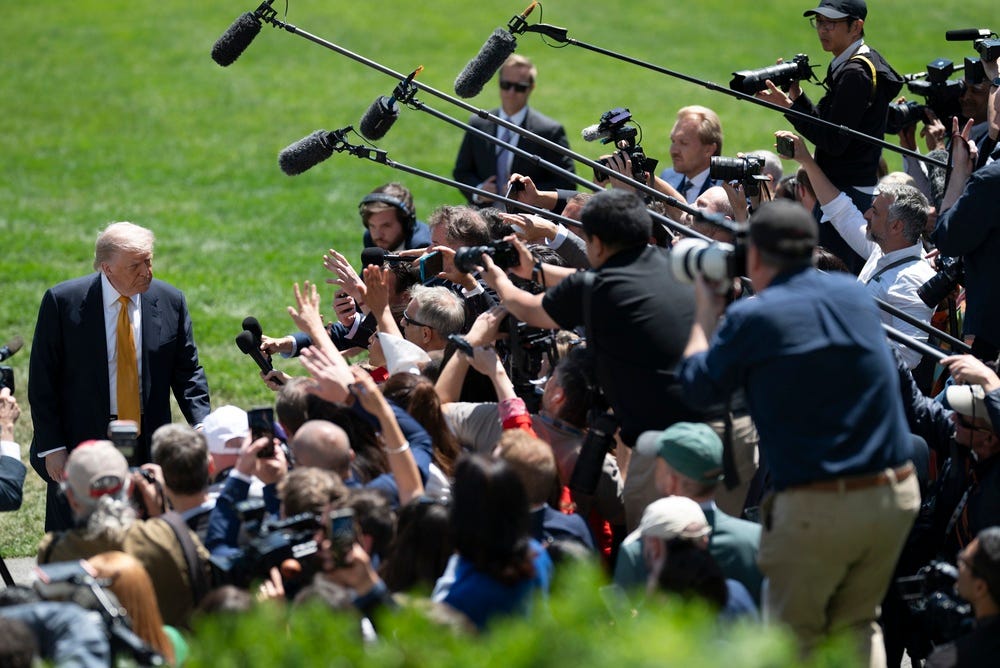
President Trump’s decision to ban CNN, MS NOW, and Politico from the White House has sparked intense debate online — and a court order to reinstate the journalists’ access to the White House immediately. Read our latest essay to see what the law, and history, have to say about that. As for the online debate, whataboutism and red herrings reign supreme, with people saying these outlets aren’t really press, that access isn’t really a right, that the other guys did it first.

Let’s take a look at each of the main criticisms, what they get right, and where each one runs out of road.
1. They’re propaganda, not press, so they’re unprotected.
Someone at the White House does have to decide who gets a press pass, and it’s fine for them to ask neutral questions, like whether an applicant regularly publishes news. What the government cannot do is decide who counts as “the real press” based on whether it likes the coverage. When the official making that call is the subject of the reporting, and the test is whether the reporting is fair to him, that’s the precise abuse of power the Press Clause of the First Amendment exists to prevent.
The First Amendment protects journalism, regardless of whether those in power view the reporting or commentary as sufficiently fair or adequately favorable. As far as the First Amendment is concerned, anyone gathering and reporting the news, with or without a government credential, is part of the press. A White House press pass can come with added requirements, but those requirements have to be objective and viewpoint-neutral. “Make the president look good” can’t be one of them.
This argument is based upon the notion that presidents should be able to handpick the reporters who get access. None of us are better off when press passes become de facto loyalty oaths.
2. White House access is a privilege, not a right.
This is true as far as it goes, but also irrelevant. Places the White House opens up for expression are, at a minimum, considered “nonpublic forums.” This includes the James S. Brady Press Briefing Room, the press workspaces in the West Wing, and the North Lawn. The White House has no obligation to open them up. But once it does, the First Amendment analysis changes.
You don’t necessarily have a right to borrow books from the public library, but the city cannot revoke your library card because you insult the library board at a public meeting. You don’t necessarily have a right to a fishing license, but the state can’t take yours away for writing a letter to the editor of a local paper attacking the governor.
In a nonpublic forum, the First Amendment lets the government set reasonable restrictions based on the purpose of the forum itself. But in Perry Education Association (1983), the Supreme Court said these restrictions cannot be put in place “merely because public officials oppose the speaker’s view.” And in Sherrill v. Knight (1977), the D.C. Circuit said White House officials cannot use “arbitrary or content-based criteria” in issuing press passes.
But that’s exactly what the president did here. The White House has granted access to reporters for decades, and the Trump administration continued this access for almost six years. Sure, no outlet has an affirmative right to a desk in the briefing room and the White House is under no obligation to let reporters into its facilities in the first place. But it has already let reporters in. It can’t shut specific reporters out simply because it dislikes what they have to say.
3. Where were you when Biden did it?
Okay, but “they started it” only asserts that the practice is bipartisan, not that it’s lawful. And the Trump administration’s action of indefinitely banning news outlets from the entire White House grounds based on disapproval of their reporting is particularly extreme. By the way, FIRE was critical of the Biden administration’s jawboning and filed an amicus brief in Murthy v. Missouri, arguing that pressuring platforms to remove COVID content violated the First Amendment. But also, if the concern is that the other side does it too, then that’s all the more reason not to allow it when it’s your side — because they’ll be back in office soon enough. As SusanK1717 notes:

4. Nothing really changed because they can still report.
Constitutional injury doesn’t depend on whether you can still exercise your First Amendment rights somewhere. The location matters. A concerned citizen speaking out against their city council still gets her rights violated when she’s tossed to the sidewalk, even though she can keep speaking elsewhere. The harm here is viewpoint-based retaliation: As discussed earlier, the White House opened up its halls for reporters, so the president can’t just revoke their access because he doesn’t like their reporting. That’s unconstitutional, which Judge Timothy Kelly recognized in his Thursday order to reinstate access.
Moreover, practically speaking for a White House reporter, the location is the job, and it comes with briefings, gaggles, pool rotations, and travel. Only reporters on the scene can observe events firsthand and ask officials questions in real time. Even more concerning, if an outlet can lose access because, as Trump later told reporters, they “purposely write negative news,” then every newsroom will quickly learn the price of reporting a tough story, and not all of them can afford the cost of a First Amendment lawsuit (which is part of the point).
What ties these four genres of commentary together is that each one asks you to trust that the government, free from the First Amendment’s constraints, will draw the line somewhere reasonable — that it will correctly identify who’s really press, revoke access only from the deserving, and so on.
Thankfully, the First Amendment does apply. The genius of our Constitution is that it assumes the person drawing the line will eventually be someone you don’t like, so it forbids all of them from drawing it based on whether they like what you say. It might feel justified when it’s happening to the other guys, but it helps to remember that soon enough, we all end up as the other guys.
We should recall how past SCOTUS justices who cared to inform Americans about the crucial truth about and vital purposes of our freedom of expression and communication kindly and conscientiously quoted a crucial clarification by the First Continental Congress in 1774. SCOTUS justices did so in majority opinions in Near v. Minnesota, 283 U.S. 697 (1931) and Roth v. United States, 354 U.S. 476 (1957).
On October 26, 1774, the First Continental Congress penned its Letter to the Inhabitants of Quebec and declared “five great rights” of all American citizens. That august assemblage included some of the brightest stars, not only of the American Revolution, but also of the future new government under our Constitution starting in 1789. It included the commander in chief of the Continental Army (George Washington) and our first two presidents, Washington and John Adams, and our first SCOTUS Chief Justice, John Jay (each of whom also was a member of the Second Continental Congress).
One of the “great rights” they declared was “the freedom of the press.” Fortunately, the 1774 Congress did more than merely write that right. They emphasized its meaning and power:
"The importance of this consists," in part, in "the advancement of truth" and the "diffusion of liberal sentiments on the administration of Government," by "ready communication of thoughts between [citizens], and its consequential promotion of union among [citizens], whereby oppressive officers are shamed or intimidated, into more honourable and just modes of conducting affairs."
SCOTUS also quoted the same language from 1774 in Thornhill v. Alabama, 310 U.S. 88 (1940), but SCOTUS substituted “ashamed” for “shamed.” Thornhill is a profoundly important opinion that is almost unknown to Americans. The Thornhill SCOTUS justices faithfully supported our Constitution with the following crucial elaboration:
"The freedom of speech and of the press" (the freedom of expression and communication) that the People "guaranteed by the Constitution embraces at the least the liberty to discuss publicly and truthfully all matters of public concern without previous restraint or fear of subsequent punishment. The exigencies of the colonial period and the efforts to secure freedom from oppressive administration developed a broadened conception of these liberties as adequate to supply the public need for information and education with respect to the significant issues of the times. . . . Freedom of discussion, if it would fulfill its historic function in this nation, must embrace all issues about which information is needed or appropriate to enable the members of society to cope with the exigencies of their period."
The right at issue here isn't merely a right of access. It is the right of the people to criticize all our public servants.
It is well worth recalling the wisdom of the unanimous SCOTUS that carefully considered this issue in New York Times Co. v. Sullivan. Retaliating against speakers for criticizing any public servant's purported public service "reflect[s] the obsolete doctrine that the governed must not criticize their governors," i.e., the doctrine of so-called seditious libel.
Absolutely all "‘public men, are, as it were, public property," and "discussion cannot be denied and the right, as well as the duty, of criticism must not be stifled." "Those who won our independence believed . . . that public discussion is a political duty; and that this should be a fundamental principle of the American government." "Analogous considerations support the privilege for the citizen-critic of government. It is as much his duty to criticize as it is the official’s duty to administer."
SCOTUS in Sullivan highlighted that James Madison in 1800 highlighted that "the Constitution created a form of government under which ‘The people, not the government, possess the absolute [actual] sovereignty.’ The structure of the government dispersed power in reflection of the people’s distrust of concentrated power, and of power itself at all levels." So "the nature of [our] Republican Government" (see Article IV requiring the U.S. to "guarantee" a "Republican Form of Government") is that, in general, "the censorial power is in the people over the Government, and not in the Government over the people."