


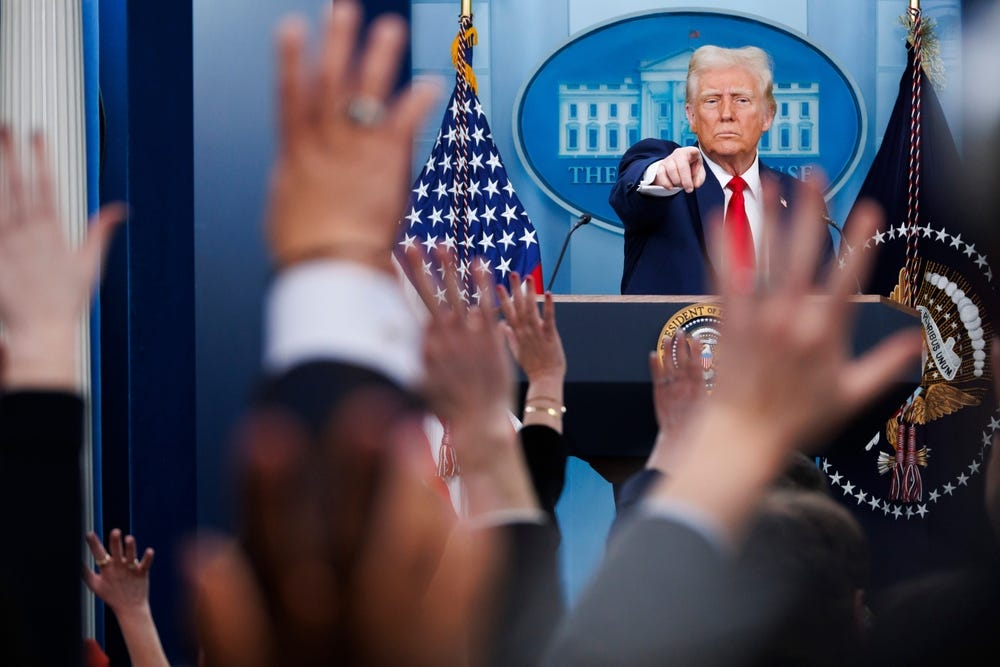
“Fake News” — that’s why President Trump says he banned CNN, MS NOW, and Politico from the White House. Since our country’s founding, presidents have bristled at the press. What’s different here is barring entire news organizations from the White House grounds because the president dislikes their reporting.
Now the three outlets have sued. “This ban could not be a more direct assault on the First Amendment nor a more blatant violation of our most fundamental constitutional principles,” they allege in their complaint.
The outlets also point to a nearly 130-year tradition of independent reporting stationed inside the White House. While an independent press can trace its roots all the way to the founding, the tradition of having reporters stationed permanently inside the White House began taking shape in the late 1890s. Most famous was the Washington Evening Star’s William “Fatty” Price, who started his tenure as a White House reporter by staking out staff and guests outside the White House’s North Portico.

Price’s column, “At the White House,” was so successful that other reporters quickly caught on. A permanent White House beat was born. In 1896, Price wrote to President Grover Cleveland’s staff thanking them for “brightening up our table” inside the White House. Price, who described himself as “dean” of the fledgling White House “newspaper gang,” chased tips and reported on what he saw and heard inside the White House.
In his words, “There is no giving out of prepared news … Sometimes it’s a question of hard digging, as the miner put it, to unravel a story.”
Cleveland’s successor, President William McKinley, continued the relationship. By early 1898, McKinley had given Price and his “gang” a table in the White House’s second-floor corridor. At the same time, McKinley’s staff asked reporters to stick to those “proper facilities.”
That original arrangement was mutually beneficial. Presidents gained a regular channel to the public, while reporters gained a means of access inside the White House that let them independently observe and report on the presidency.
But some friction was inevitable. In 1913, President Woodrow Wilson made a remark about the ongoing Mexican Revolution he understood to be off the record. When the comment appeared in a New York newspaper, Wilson was “furious” and threatened to end presidential press conferences altogether.
He didn’t. Instead, Washington correspondents proposed rules to formalize White House access, and Wilson agreed. Reporters would not quote the president without his consent, and attendance was limited to accredited journalists. Six months later, after another dispute over stock market “tipsters” crowding into Wilson’s press room, White House reporters formed their own organization to police the rules: the White House Correspondents’ Association, headed by none other than Fatty Price.
In that moment, both reporters and the president treated their inevitable tension as something to manage — not a reason to shut the press out.
By the 1920s and 1930s, the White House press corps had become more than a group of reporters the president tolerated having around. In 1926, President Calvin Coolidge told reporters that accurate reporting of the presidency was “rather necessary to the carrying on of our republican institutions.”
But Coolidge did not think that meant dictating his own account of what happened inside the White House. He preferred to leave that work to the reporters, who could draw their own conclusions and interpretations — what Coolidge called the “art of reporting.” Coolidge put it simply: “I don’t want to compete with your business.”
Three years later, at his final press conference, Coolidge emphasized that point: “I have left the work of reporting the affairs of my administration to the experts of the press. Perhaps that is the reason that the reports have been more successful than they would have been if I had undertaken myself to direct them.”
For generations, White House reporters have been expected to do things that often bother presidents.
President Franklin D. Roosevelt did more to secure the White House press corps’ independence. At his first presidential press conference in 1933, FDR scrapped the practice of requiring reporters to submit written questions in advance. He understood the political risk of that move, telling reporters they would ask questions “I do not want to discuss, or I am not ready to discuss, or I do not know anything about.”
He opened the floor anyway.
In the ensuing decades, tradition governed the relationship between press and president, though not always because presidents welcomed it. President Richard Nixon kept an enemies list and barred Washington Post reporter Judith Martin from his daughter’s 1971 White House wedding over her coverage of the family. In 2009, the Obama administration sought to marginalize Fox News, with Chief of Staff Rahm Emanuel saying the network was “not a news organization so much as it has a perspective,” and initially excluded Fox from a round of interviews with a Treasury official before backing down.
Eventually, courts had to address what happens when a president tried to take such access away.
In the 1977 case Sherrill v. Knight, the Secret Service had denied journalist Robert Sherrill a White House press pass, citing vague security concerns. The U.S. Court of Appeals for the D.C. Circuit held that “arbitrary or content-based criteria for press pass issuance are prohibited under the first amendment.”

The White House did not have to “open its doors to the press, conduct press conferences, or operate press facilities” in the first place. But once it had chosen to do so, the court said, access could not be granted arbitrarily. Nor was that protection only for reporters. “The public at large,” the court explained, also has a First Amendment interest in preventing arbitrary exclusion from sources of information.
Trump is similarly claiming CNN, MS NOW, and Politico pose a vague security risk, but that’s unlikely to stand under Sherrill and the precedent developed since.
For generations, White House reporters have been expected to do things that often bother presidents: interpret what they see at the White House and report it to the public. It’s what Fatty Price called “hard digging,” what Coolidge described as the “art of reporting,” and what FDR knew would sometimes produce questions he did “not want to discuss.”
Reporters do those things not to please the president, but to inform the public about our nation’s highest office. The entire arrangement rests on accepting and inviting the tension between reporters and politicians.
Ultimately, though, this isn’t just about CNN, MS NOW, and Politico. If Trump can ban any outlet whose reporting he dislikes from the White House halls, a future Democratic president could just as easily ban Newsmax, Fox News, or Breitbart. And it’s often the outlets a president perceives most hostile to his cause that stand to reveal the most about his administration.

Bollox. He’s clearing out the corporate liars & TDS sufferers
CNN and MSNBC unashamedly belong to the propaganda branch of the Democratic Party. They’re neither “independent” nor “news” channels although they masquerade as both.
It’s legitimate to exclude hostile propagandists from White House press briefings. Witness Jim Acosta’s flagrant disrespect towards the office of President. His promotion after frequent displays of contempt is demonstrable proof that his CNN masters approved of his conduct.
The country knew what was up. Both channels viewership ratings cratered.