


I’ve previously discussed surprising results around tolerance for hypothetical controversial speakers, including the fact that male college students are substantially more tolerant — so much so, in fact, that male students are often more tolerant of their political enemies than female students are of their own allies. One might wonder whether this is true of the general population as well.
Our data on the general population is less comprehensive than our student data. We don’t ask the same speaker-tolerance questions. But we do ask people whether they agree with the claim, “Words can be violence.” It seems likely that people who think words are violence are more likely to support censorship. The phrase is also a slogan among left-wing activists. But how widely held is this idea, and who holds it?
To figure that out, consider the scatterplot below, showing men on the left and women on the right. Each marker indicates a different political ideology, such as “conservative” or “very liberal.” The lower down each marker sits in a column, the more that group agrees with the claim, “Words can be violence.” The first thing to notice is that liberals, men and women alike, are more likely than conservatives to think words can be violence. That’s not too surprising. But take another look.
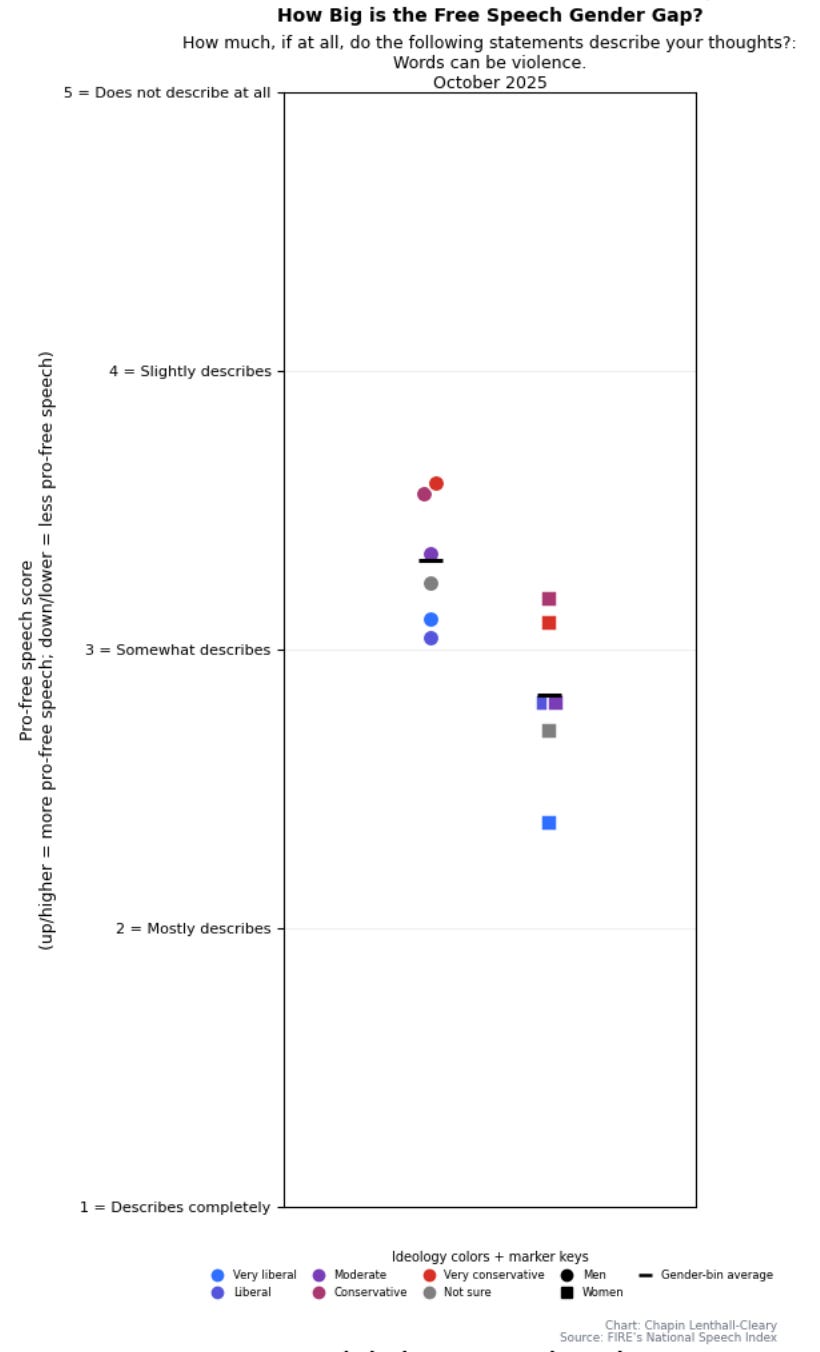
It turns out, this belief is not just a disproportionately liberal opinion — it’s also a disproportionately female one. In fact, even very conservative women are more likely to think “words can be violence” than very liberal men. Also, it seems the gender gap here is growing compared to last year, though there’s enough noise that it’s very uncertain.
Notably, the size of the gender gap varies significantly depending on what sort of question you ask, including in some ways that I wouldn’t have guessed. When we ask people whether offensive speakers should face consequences, we see a much smaller gender gap.
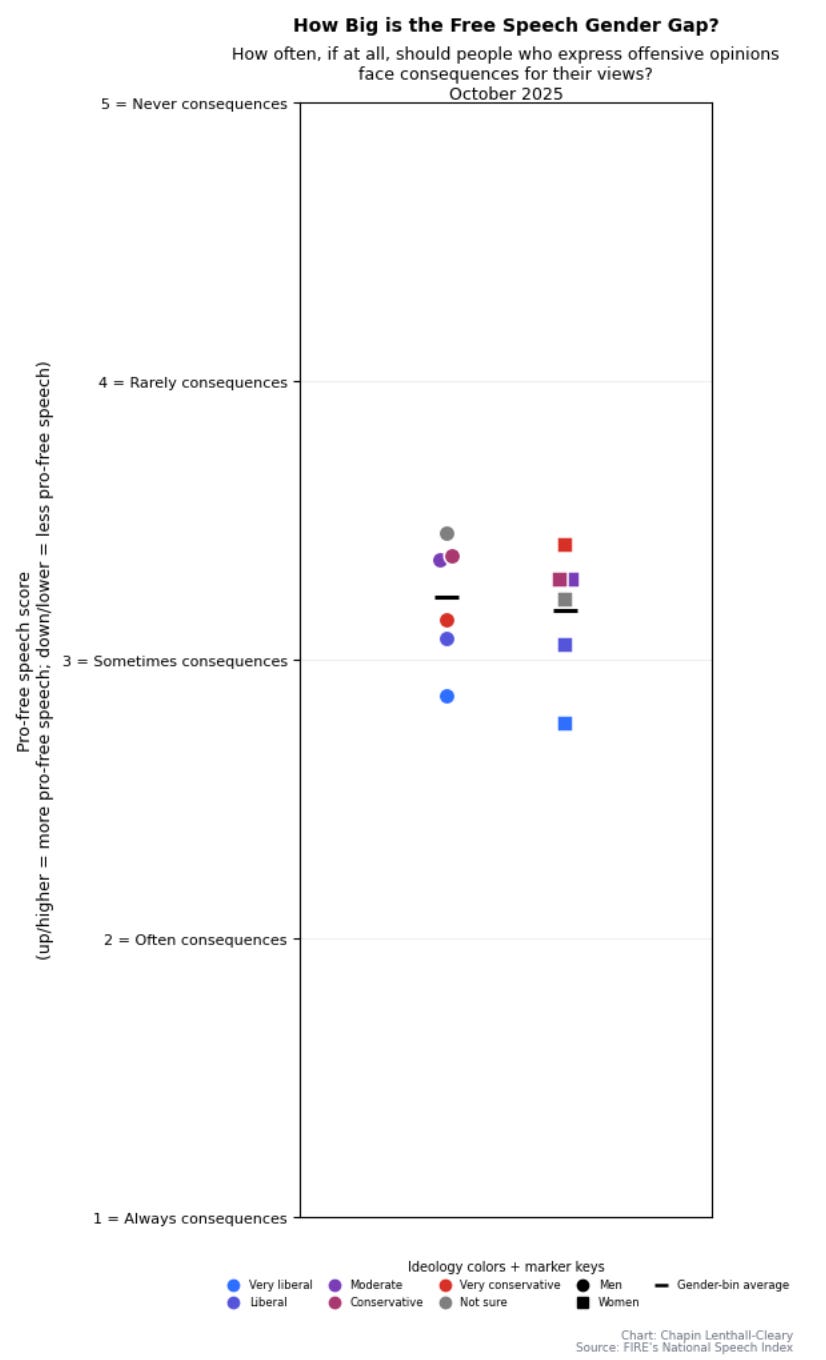
If I had to hazard a guess at why men and women are more in agreement here, I’d assume it’s because unlike with most of our questions, or public framings for that matter, there’s more emphasis here on how censorship can harm people. All you champions of free speech, take note. It might be that emphasizing the harm of censorship is a more effective way to get women engaged in the issue.
As one might expect, the gap reemerges when we look at aggression and ask whether Americans should have the right to curse at politicians.
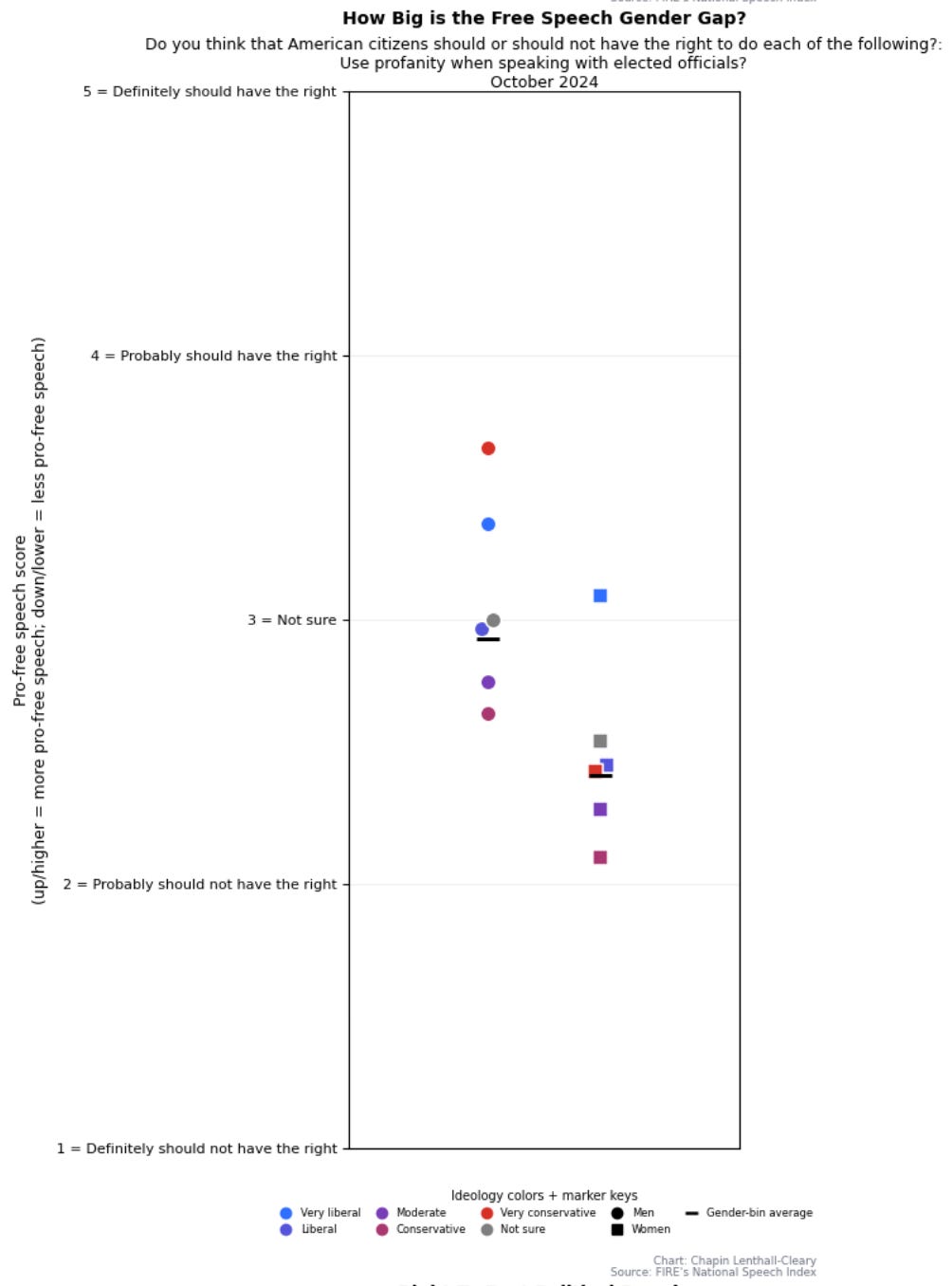
Men are more okay with cursing at politicians than women, by and large. Very liberal women are also okay with it. Unsurprisingly, conservative women are not fans of profanity. But very conservative men are.
It’s striking to see how often speech issues don’t divide along simple political lines. Support for free speech isn’t a simple story about whether people agree with opinions or not. Oftentimes, it’s more influenced by social factors including gender, or driven by personality traits such as disagreeableness, or even more bizarre factors.

Depressing but not surprising. I'd hazard a guess that people who say "words are violence" have led pampered lives and have never actually experienced violence themselves, but sure do know a lot about having hurt feelings.