“It’s satire and free speech.”
—Jonathan Rinaldi, New York City Council candidate, after being charged with forgery over AI-generated fake endorsements and news reports.
FIRE sues DHS
FIRE is suing the Department of Homeland Security after agents tracked down New York resident David Streever for emailing then-ICE head Todd Lyons that his conscience would haunt him forever. Five months later, while Streever was overseas with his 7-year-old daughter, agents visited his home, then attempted to locate him at a New York hotel after he returned.
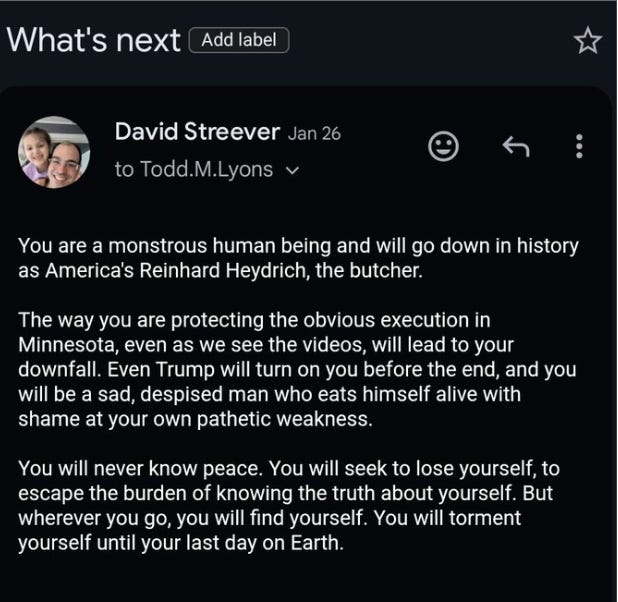
“If someone is really threatening a government official, you don’t wait five months to act on it,” said FIRE Senior Attorney Adam Steinbaugh. “The fact that authorities didn’t respond immediately shows that David presented no threat. This pursuit is designed to intimidate lawful speech, pure and simple.”


Court blocks Florida’s Stop WOKE Act
Following a lawsuit by FIRE, a federal appeals court ruled that Florida’s “Stop WOKE Act” — a broad ban on what faculty at public universities can say in the classroom — violates the First Amendment rights of Florida university faculty and students.
“Today’s important decision means that college remains a place where professors and students are allowed to debate controversial topics,” says FIRE senior attorney Greg Greubel, “even if politicians disagree with them.”
Below the fold
For nearly 40 years, Hazelwood v. Kuhlmeier has given public school officials broad authority to censor student speech. In her latest, Marie McMullan argues it’s time for the Supreme Court to revisit the decision before things get worse.
From Kentucky to Taiwan, governments are using AI-powered civic forums to broaden public participation by helping officials make sense of thousands of citizen voices. Chloe Ratner explains how AI can improve democracy.

Signal and noise
This week, Tyler Tone argues that new laws regulating AI in hiring, health care, and other high-stakes decisions target the wrong thing. Although AI use in these areas can produce biased or unfair outcomes, instead of punishing discriminatory or negligent decisions, lawmakers are burdening AI itself with disclosure and design mandates that violate the First Amendment. The result is a provocative challenge to one of today’s biggest policy debates: Should the government regulate bad outcomes — or the tools people use to reach them?
Blessings of Liberty
Bestselling author and constitutional scholar Jeffrey Rosen’s new podcast, The Blessings of Liberty, explores constitutional history, Supreme Court debates, and the “American Idea.”
In this episode, former president of FIRE David French explores evolving threats to free speech, the rise of Christian nationalism, the importance of religious liberty, and the thorny legal issues posed by AI and social media.

Today in history with Sheridan Macy
On July 9, 1868, Georgia ratified the Fourteenth Amendment, becoming the final state whose approval enabled the amendment’s certification later that month. Congress had required the former Confederate states to ratify the amendment as a condition of regaining representation.
The Fourteenth Amendment transformed the Constitution by guaranteeing citizenship to all persons born or naturalized in the United States, including formerly enslaved people. It also prohibits states from depriving any person of life, liberty, or property without due process of law and requires states to provide equal protection of the laws to everyone within their jurisdiction. Through a series of Supreme Court decisions, the amendment’s Due Process Clause became the primary basis for the incorporation doctrine, which made most of the protections in the Bill of Rights — including the First Amendment — applicable to state and local governments.
In the feed by Blake Fox
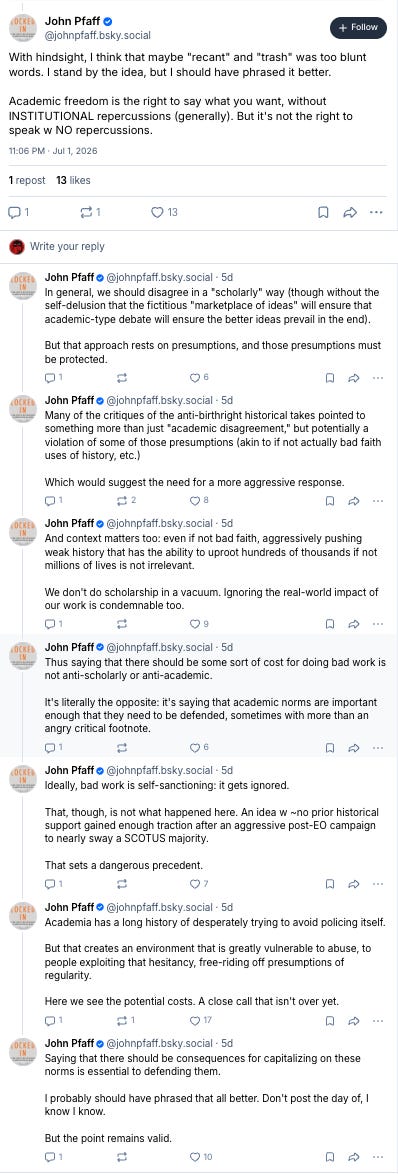
On June 30, the Supreme Court held that the 14th Amendment guarantees birthright citizenship to the children of illegal immigrants and visitors. In dissent, Justices Clarence Thomas and Neil Gorsuch cited an article by University of Minnesota law professor Ilan Wurman arguing the contrary. Fordham law professor John Pfaff, who agrees with the Court’s decision, then posted on Bluesky:
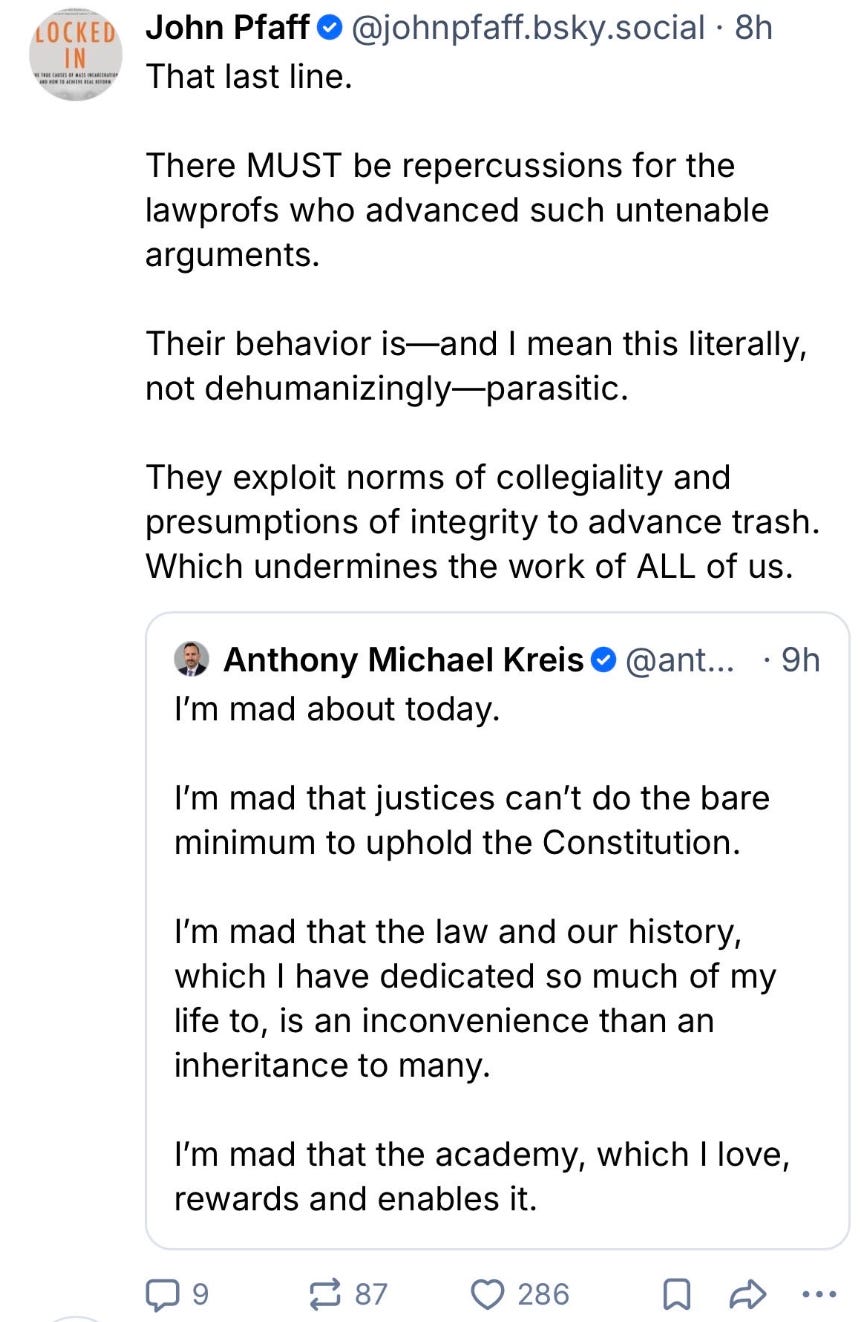
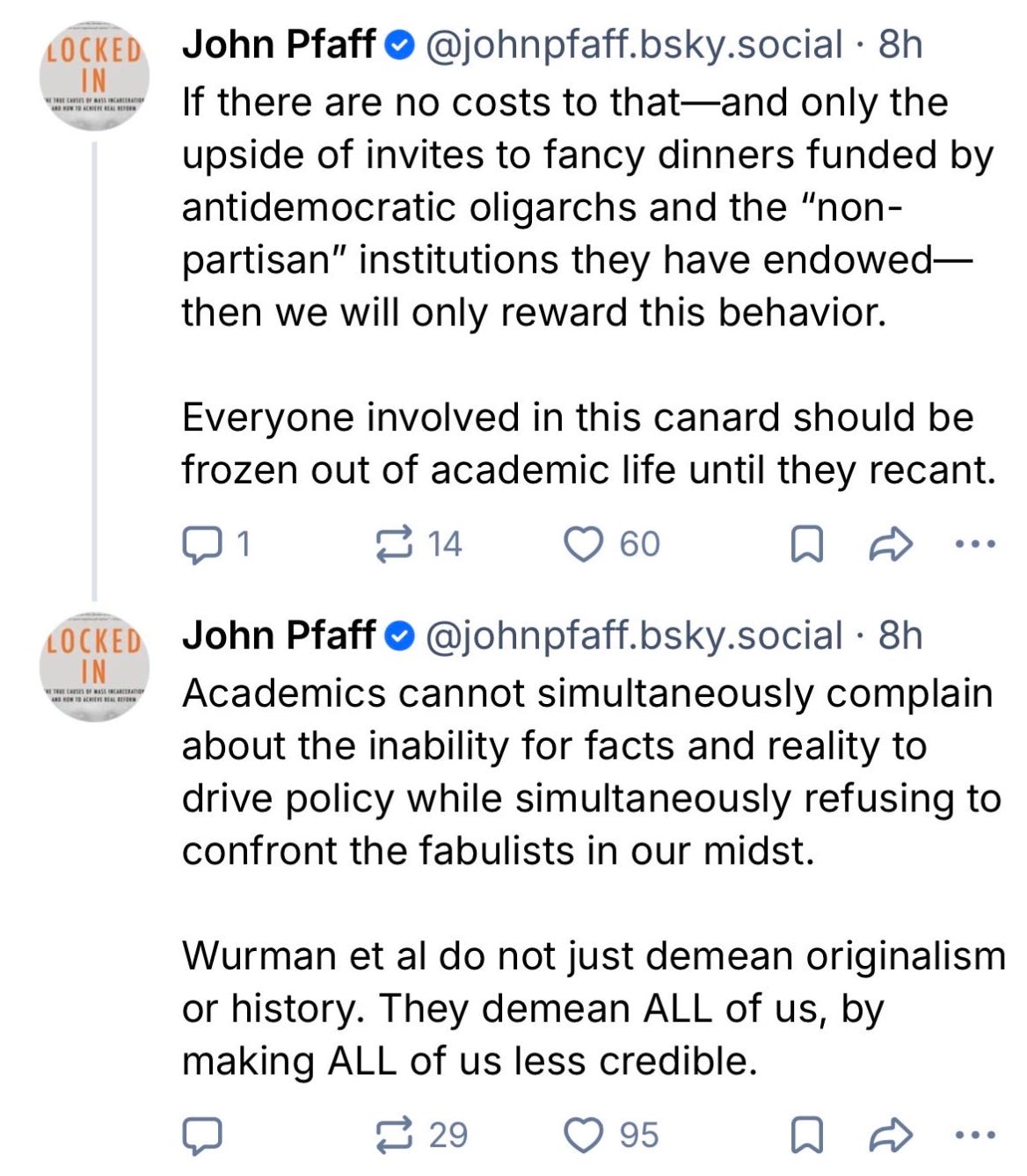
But Wurman did what constitutional scholars are supposed to do: interpret the Constitution. Pfaff’s initial call to punish Wurman would chill that process. As Justice Felix Frankfurter wrote in the Court’s seminal opinion on academic freedom, Sweezy v. New Hampshire (1957), such inquiry “must be left as unfettered as possible.” Consider also that four Supreme Court justices have endorsed some version of Wurman’s claim.
Pfaff later deleted the post and softened his rhetoric, adding that he still stands by his position and believes the “fictitious” marketplace of ideas is not enough, but that scholars like Wurman should face punishment, just “generally” not institutional punishment. That’s not walking it back far enough. As ever, the best way to counter scholarship is with better scholarship.

By the numbers
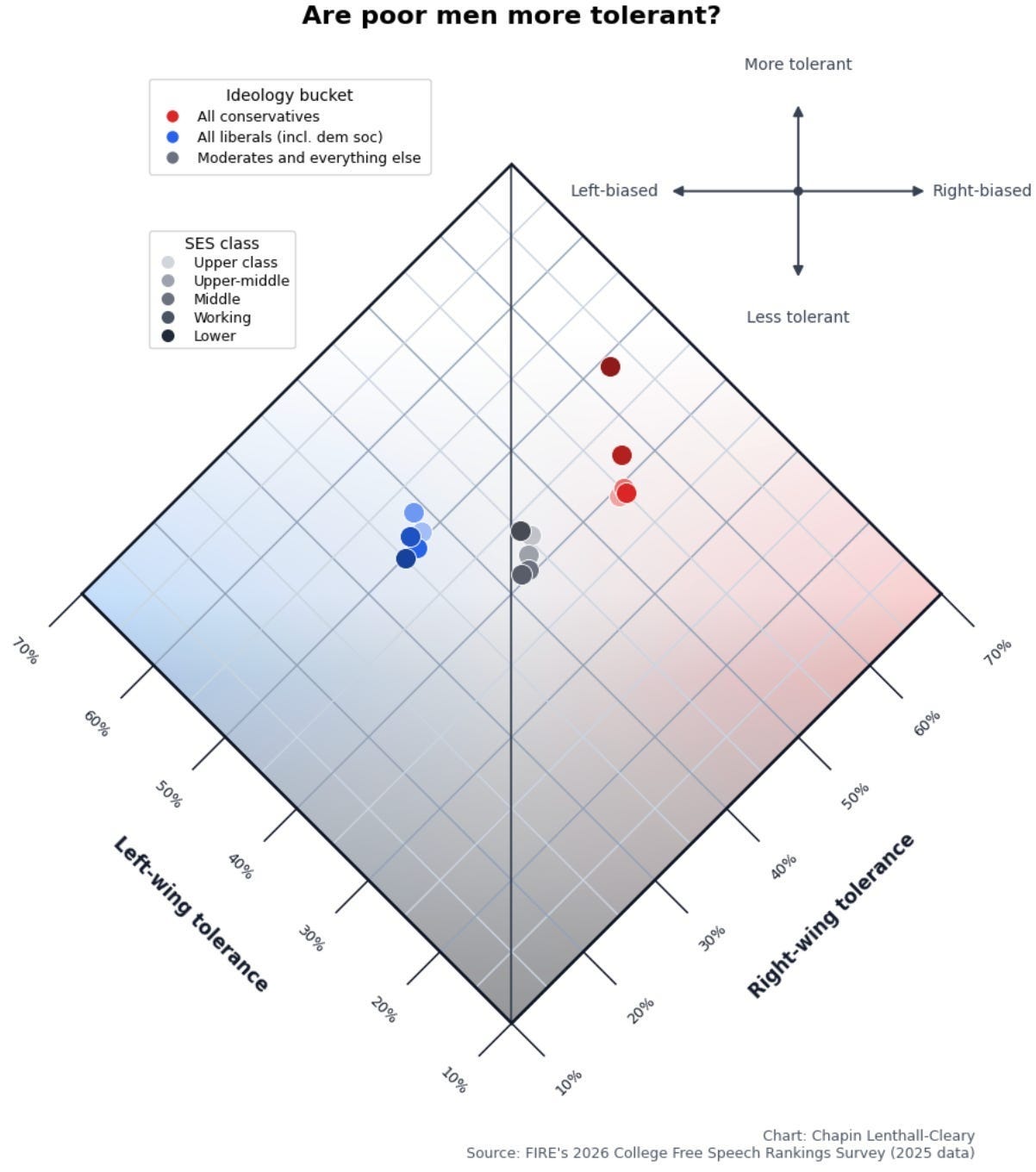
Among liberals and moderates, there’s very little relationship between economic class and tolerance. But among conservative students, the poorer you are, the more tolerant you’re likely to be. The effect holds for both men and women, and it’s no small effect: at roughly 10 percentage points in both dimensions, the gap between rich and poor conservatives almost rivals the gender gap. Indeed, among men, poor conservatives are nearly as tolerant of left-wing speakers as liberals of all classes.