


This post builds on a previous one about gender and tolerance, so I recommend starting there if you haven’t already read it.
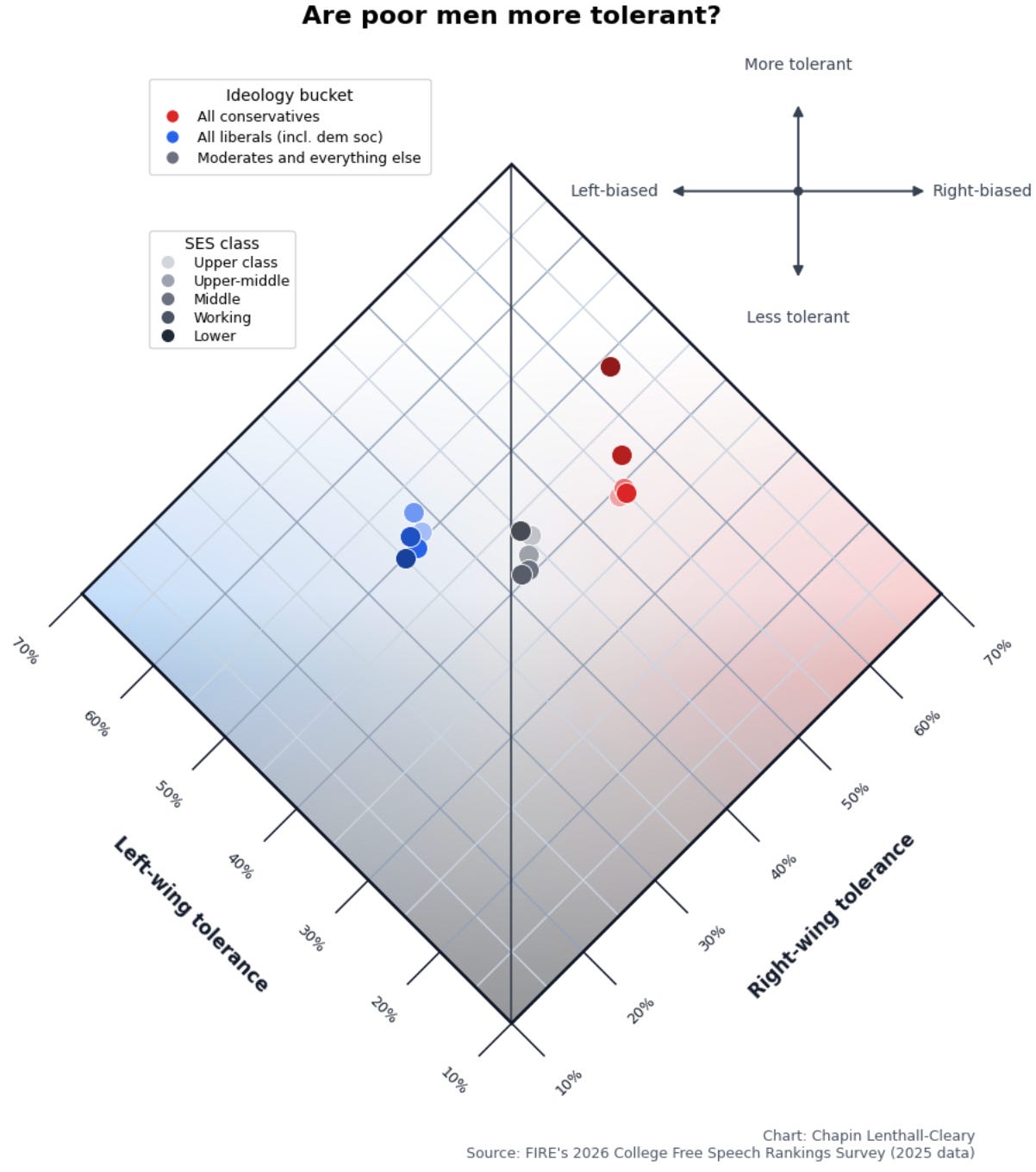
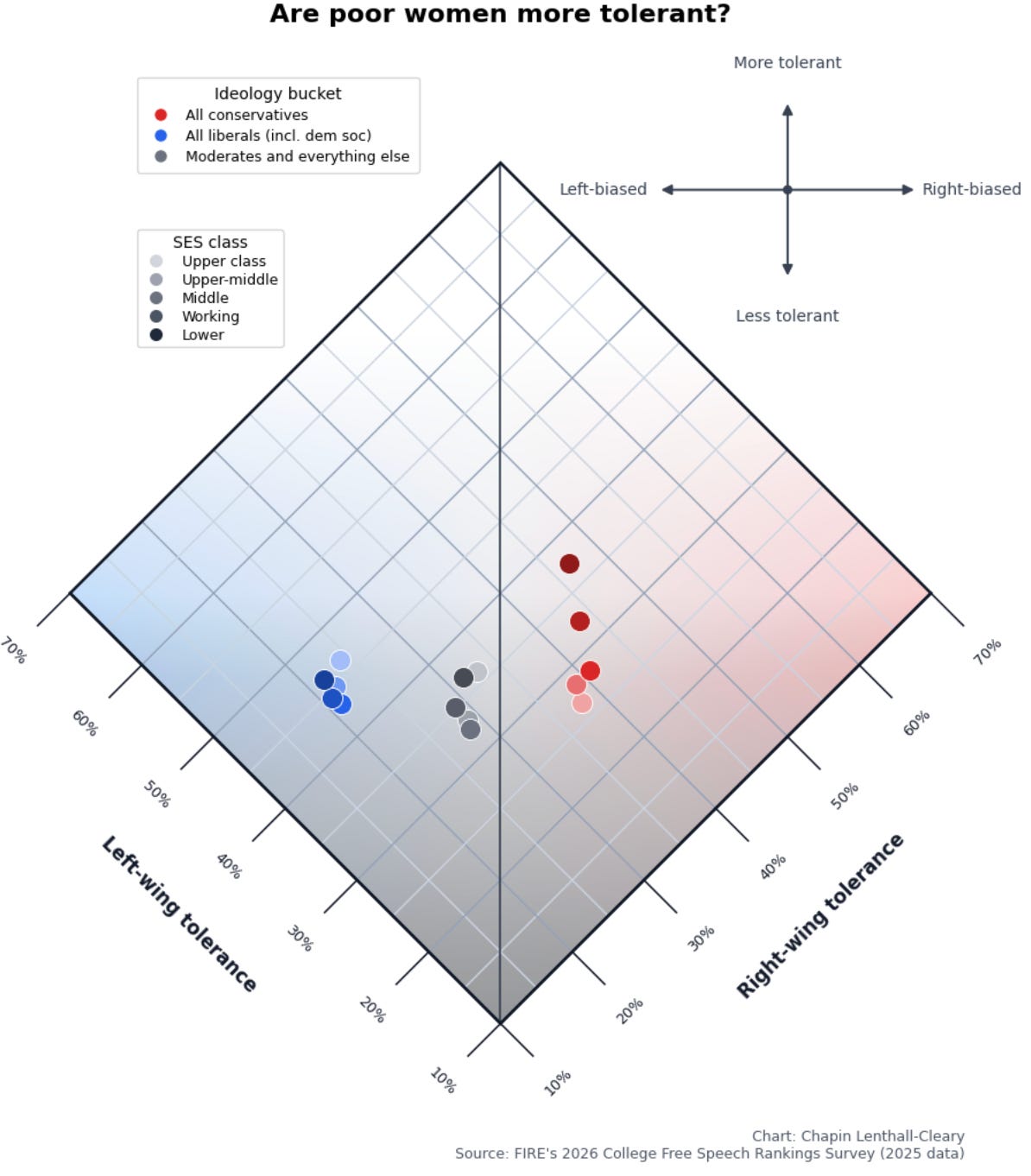
In search of a better understanding of what drives people to support free speech, I’ve looked at the relationship between various demographic and background factors and political tolerance (i.e. support for allowing various hypothetical speakers) in our College Free Speech Rankings data. Previously, we’ve seen some stark effects of various background factors. Any others we could look at that might have interesting results? Well, we have data on socio-economic status. Let’s make the free speech map broken down by that and ideology (with one plot for men and one for women):
Damn.
Among liberals and moderates, there’s very little relationship between economic class and tolerance. But among conservative students, the poorer you are, the more tolerant you’re likely to be. The effect holds for both men and women, and it’s no small effect: at roughly 10 percentage points in both dimensions, the gap between rich and poor conservatives almost rivals the gender gap. Indeed, among men, poor conservatives are nearly as tolerant of left-wing speakers as liberals of all classes.
I see two possible explanations here. The first is a sort of cross-classification effect, where having clashing or rarely-seen-together traits associated with diverse backgrounds or a variety of life experiences tends to broaden perspectives and increase tolerance. Being conservative and poor and a college student might, for instance, tend to give people more of an opportunity to see why people on both sides of the aisle believe what they do. This general thesis that having a diverse background is related to tolerance is loosely corroborated by other results, including mixed-race people having unusually high tolerance.
The second possible explanation is a selection effect: among, say, wealthy liberals, going to college is something approaching the norm. But for poor conservatives, going to college is anything but. If going to college is both unusual and seen as culturally aberrant or frowned upon, choosing to go anyway may often represent uncommon open-mindedness.
The code, data, and codebook used to generate these plots can be found here.

Third possibility: poor conservatives may be singularly focused on producing results that move things forward, not taking time to decide how tolerant they are or are not. Like the Boston song states, "Lots of people have to make a living living; can't decide who they should be."