


One of our main goals here at FIRE is the cultivation of public support for free speech. We not only defend the First Amendment in court, we also work to spread a culture of free speech in American society. So we are really interested in what makes people more tolerant of speech they don’t already agree with. One factor is religion.
Data Byte
Students who choose to identify as Protestant are the most tolerant religious group on campus.
When given a choice between “Protestant” and “Christian,” most Protestant students seem to identify as Christian. Those who do are not nearly as tolerant as those who identify as Protestant.
Mormon students are also very tolerant.
Atheists and agnostics are especially tolerant of left-wing, but not right-wing, speakers.
Buddhist and Hindu students are especially intolerant of right-wing speakers.
Catholic students have the lowest average tolerance.
Deep Dive
We’ve seen before that students who frequently attend religious services as well as students who are studying religion are unusually tolerant of controversial speakers1, meaning they are willing to let them speak on campus. (We measure left- and right-wing tolerance by whether students say they would allow those controversial speakers on those sides.) This raises a few questions. Are religious people more tolerant? More specifically, which religions’ members tend to be more tolerant? (When I refer to people of a particular religion in this article, unless otherwise indicated, I generally mean those who identify as that religion.)2
Look at the following map. Being higher up means that a religion has greater average tolerance, while being more to the left or right means that a group shows bias in those directions.
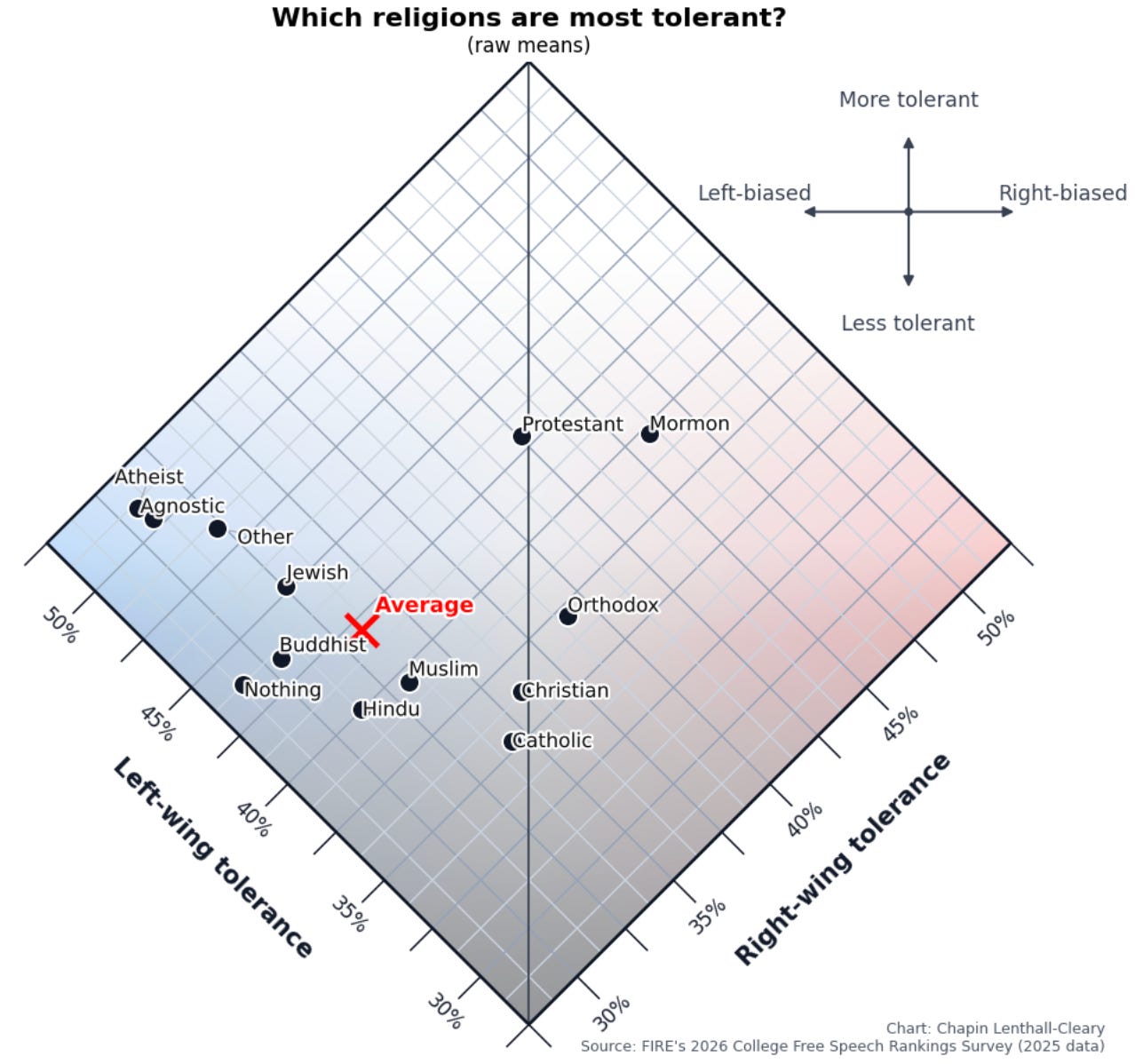
Looks like God’s been busy.
Okay, there’s a lot going on here. Protestants are the most tolerant, so we’ll look at them in more detail. (Mormons are nearly as tolerant, though more right-biased, but we have more data on Protestants, so they’ll be easier to examine.) The first thing one might ask is whether Protestants are more tolerant because of their religion. We already know that, at least among college students, there’s a large gender tolerance gap (men are more tolerant than women) and a small ideology tolerance gap (conservative students are slightly more tolerant than liberal students). So then are Protestants more tolerant because they’re more likely to be male (or conservative)?
We can check by making a scatterplot binned by ideology, gender, and whether the person is Protestant or not, then seeing whether each Protestant point is more tolerant than the corresponding non-Protestant point:
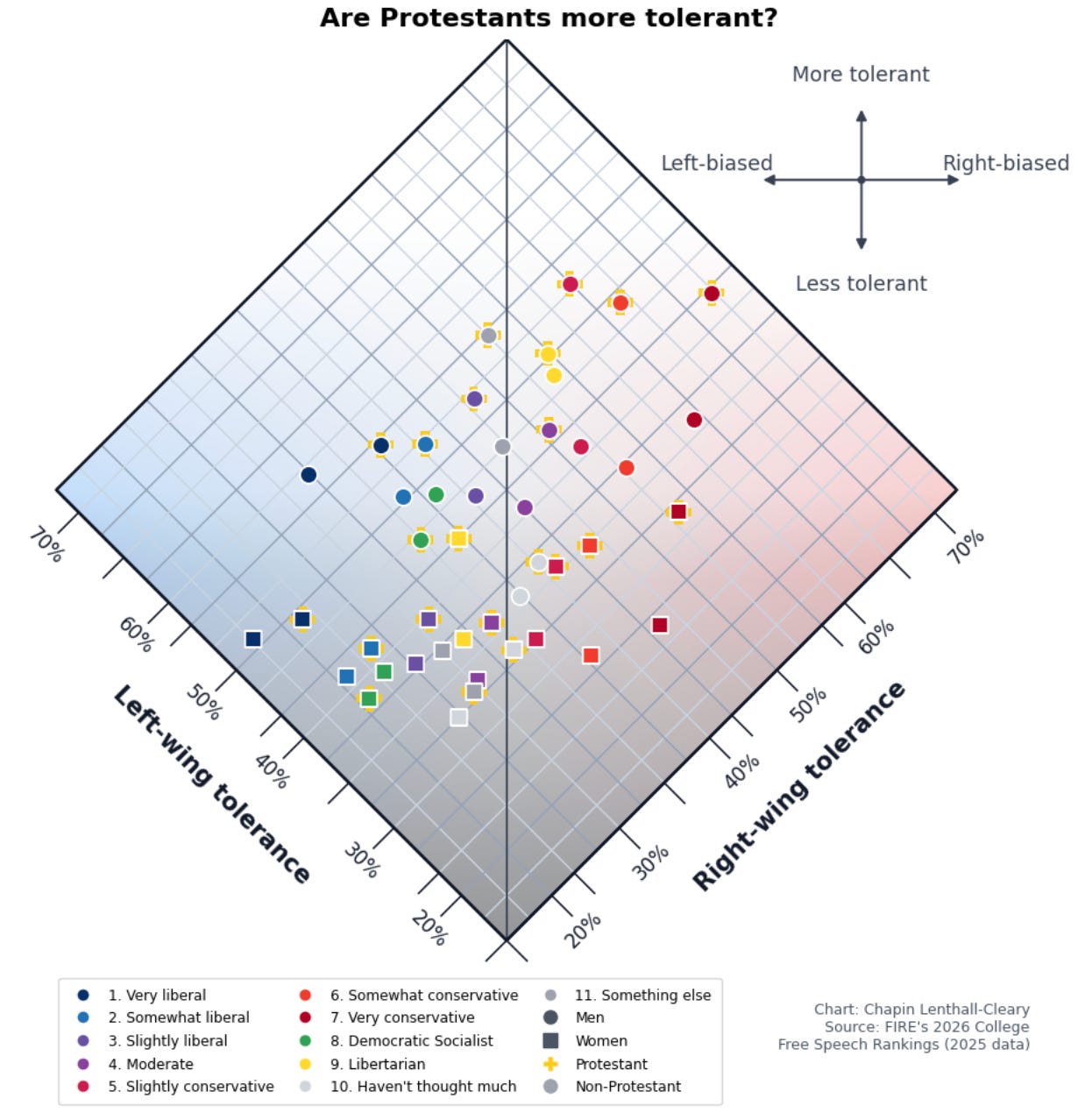
So that’s hard to read. To make it clearer, we’ll make vector difference plots showing the vectors from non-Protestant to Protestant within each ideology and gender. Each line shows the path from non-Protestants of that ideology/gender to their Protestant counterparts. In other words, we can show how much “the Protestant effect” impacts tolerance for a certain group, regardless of how well that group does overall. We are not showing causation. That is, factoring in the Protestant effect doesn’t mean being Protestant is the cause of higher tolerance, just that the two are correlated. So, here’s a look at the Protestant effect for men and women:
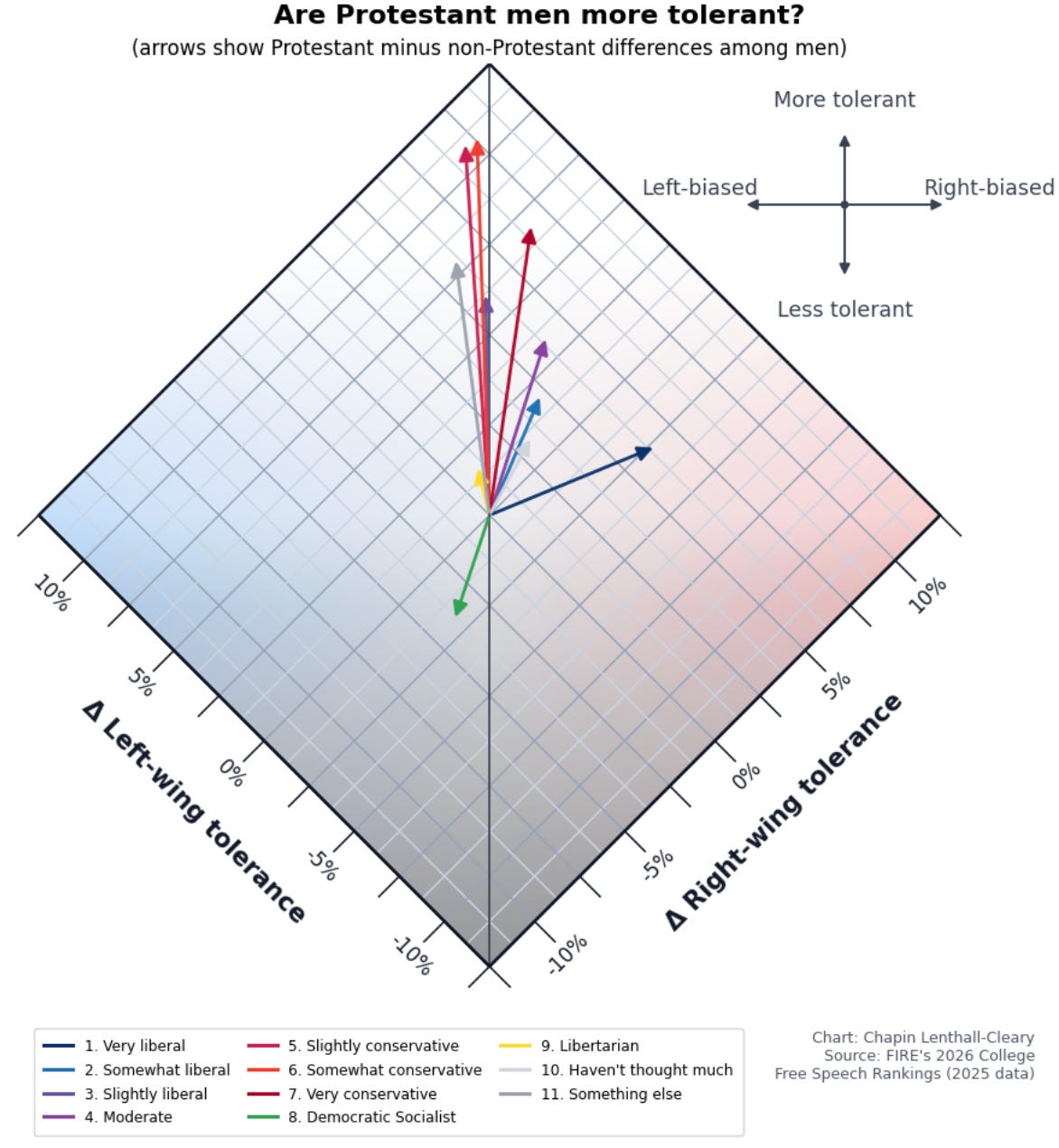
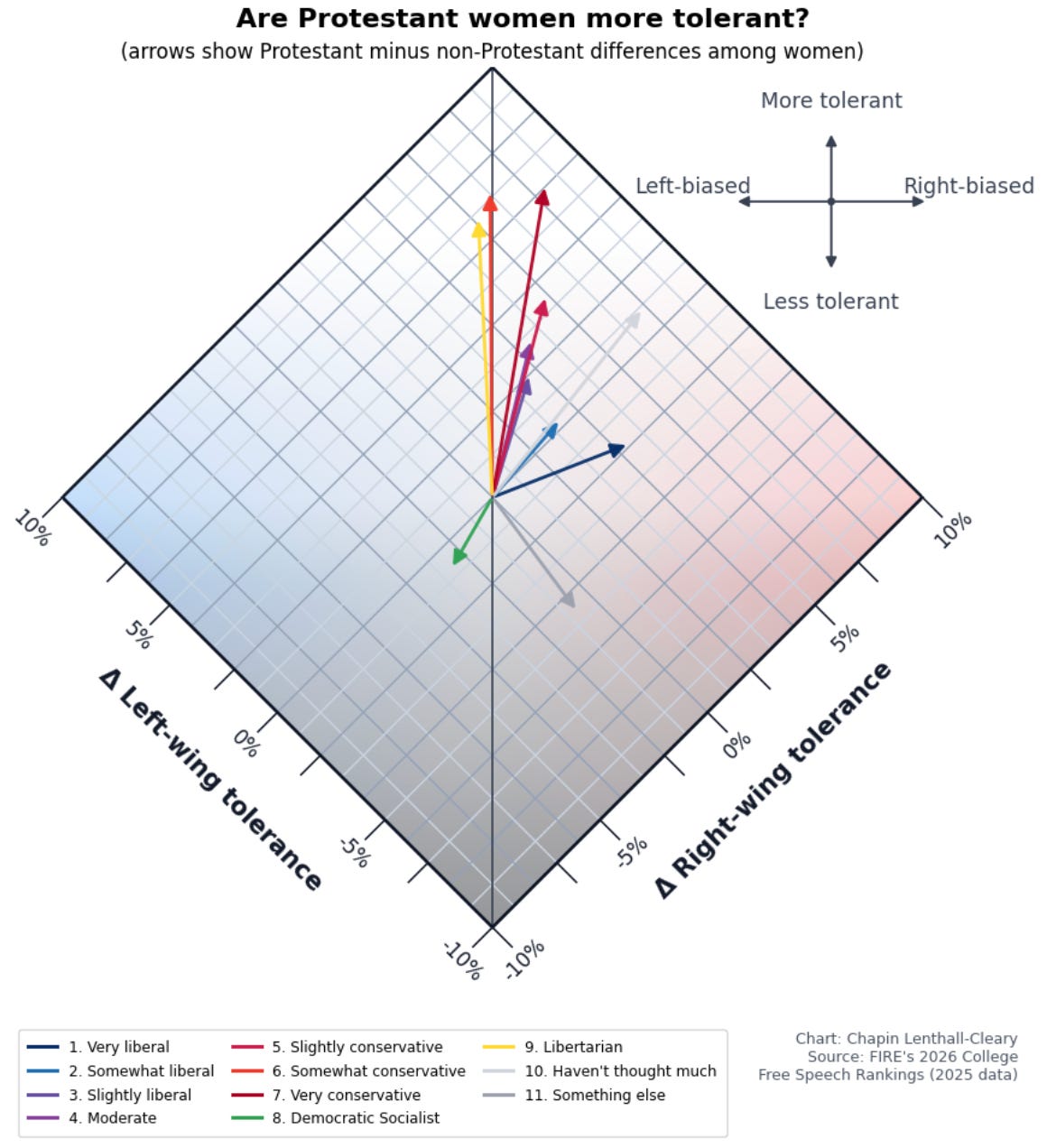
When it comes to nearly every ideology or gender, Protestants are significantly more tolerant than their non-Protestant counterparts, and not only that, they’re usually more tolerant of both sides. So the Protestant effect isn’t (primarily) a result of gender or ideology. For some reason, Protestants are just unusually tolerant of controversial speakers. We can also show this (less intuitively, but more concisely) by just making a version of the religion free speech map that controls for gender and ideology:
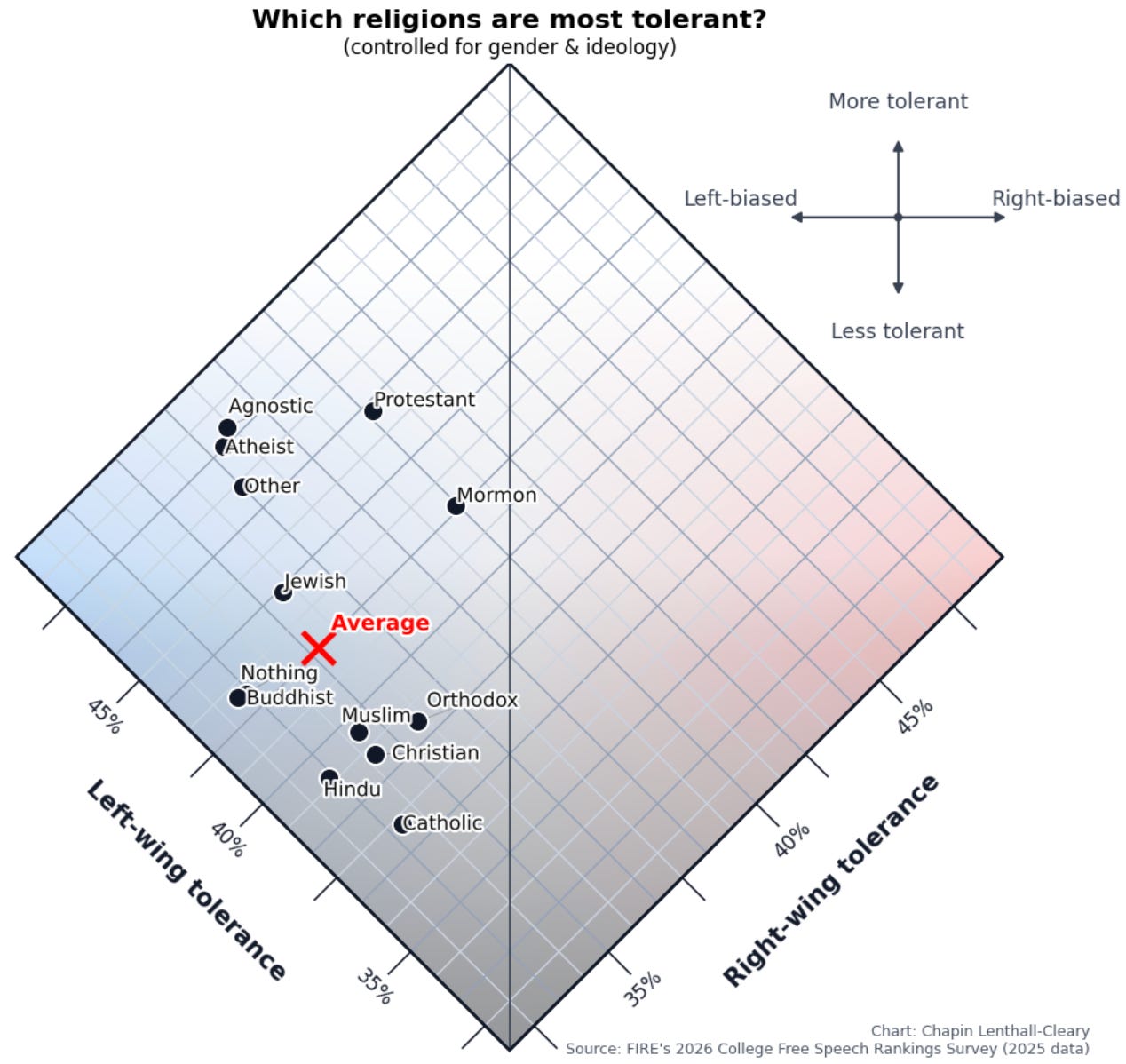
Protestants remain unusually tolerant.
We can more closely examine what these tolerance differences look like by making heatmaps. Below, each small diamond is a particular set of left- and right-wing tolerances, and the brighter squares are where more of that group is:
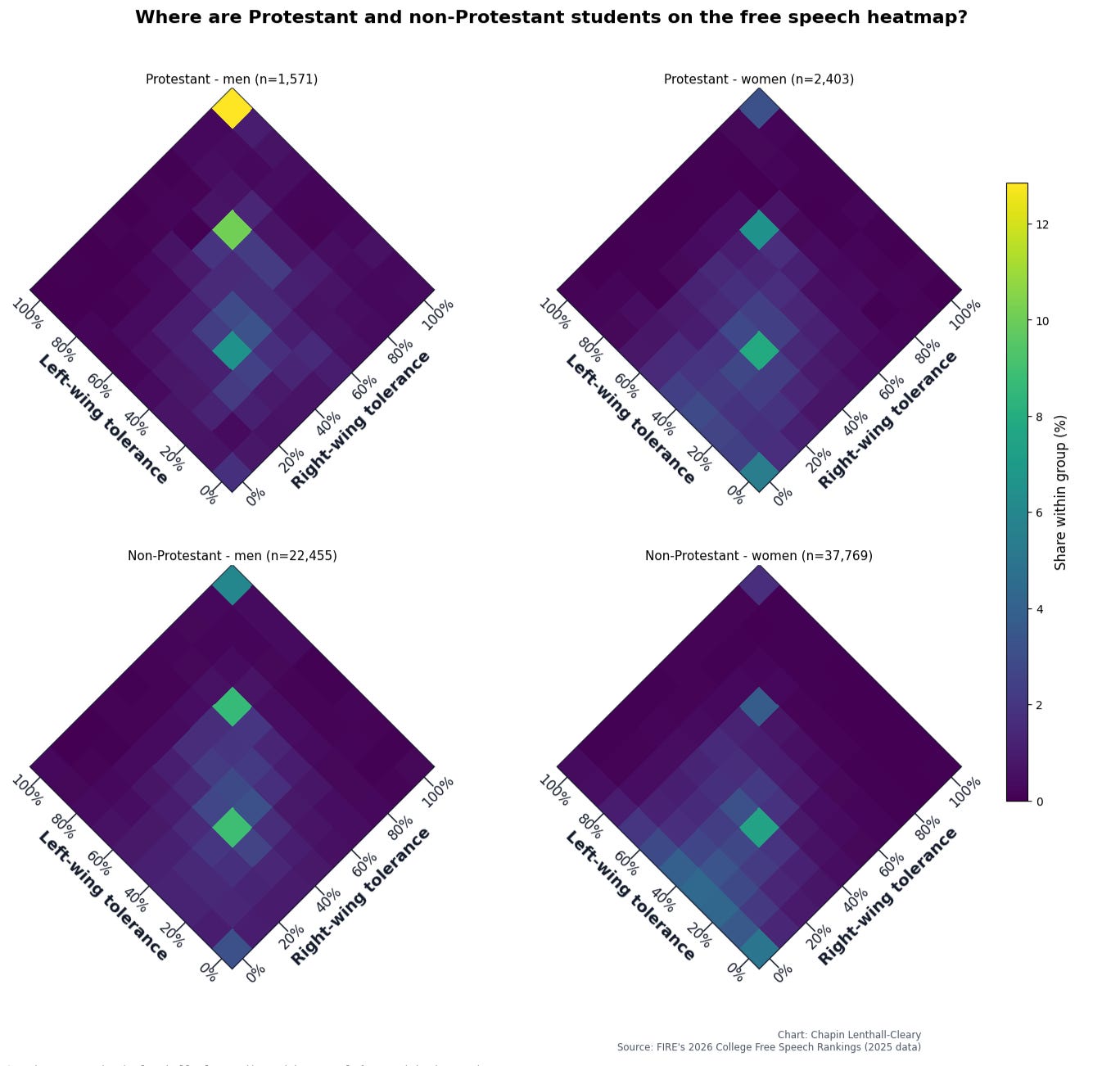
Ah. So the big effect here is that Protestant men and women have roughly double the chance of being perfectly tolerant of their non-protestant counterparts. Whatever’s going on, it’s primarily about Protestants having a higher chance of being perfectly tolerant, rather than a general increased tolerance.
Okay, wait a minute. That’s about four thousand Protestants in a sample of over 68,000 students. Only four thousand? That doesn’t seem right. Let’s check how many students are in each religion:
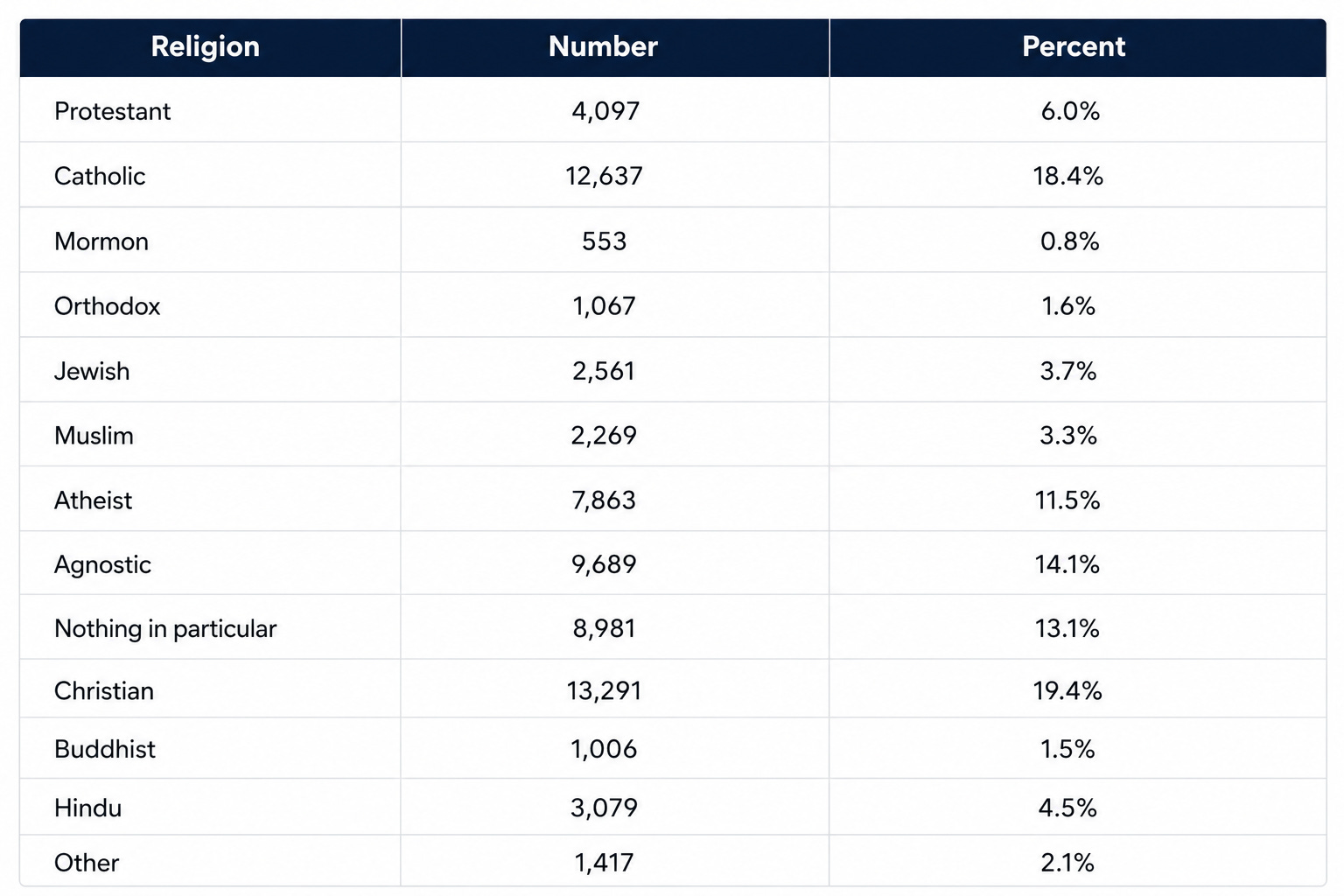
There are a lot more students who identify as Catholic than Protestant, but even more who identify as “Christians.” Given that Protestants outnumber Catholics in the general population, while we can’t be certain, this sure looks like most Protestants tend to identify as “Christian,” whereas most Catholics tend to identify as “Catholic.”3
The Protestants who identify as “Protestant” are unusually tolerant, but the Protestants who identify as “Christian” aren’t. So what’s different about those two groups that could cause this? Well, maybe the Protestants who identify as “Protestant” tend to be more devout. Do the students who identify as “Protestant” attend services more than those who identify as “Christian”?
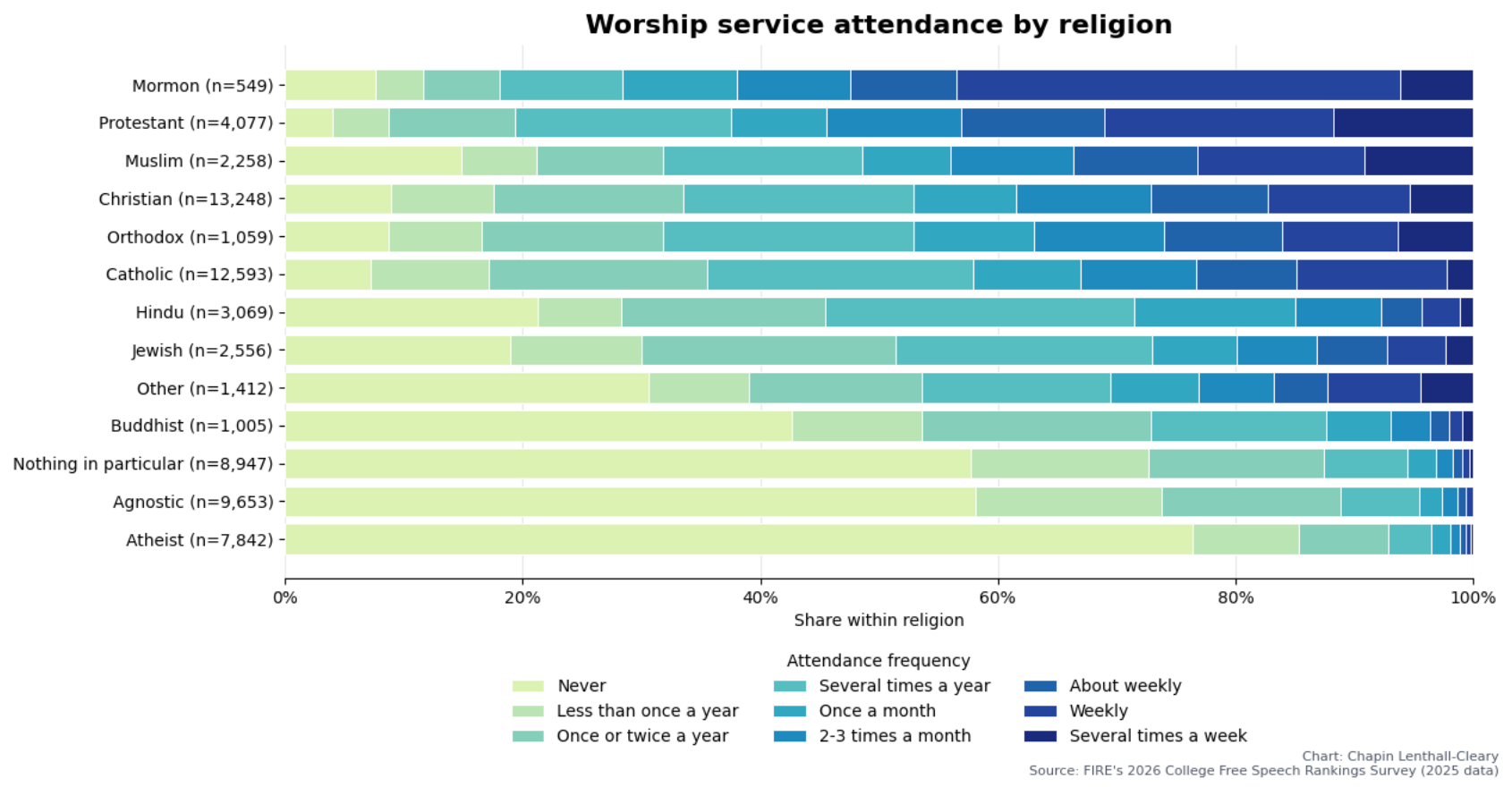
Well, there we go. Clearly, the answer is “yes.” On a separate note, it’s notable that Mormons, the other group with similar tolerance to Protestants, top the religious attendance chart.
On a separate note, remember that we’re looking at college students here. Colleges are often hostile environments towards conservatives or dissenting voices. What if there’s a selection pressure that means only the most tolerant Protestants decide to go to college? Ideally, we’d hope to ask the same questions to a large nationally representative sample. While we do have national data on free speech and religion (Protestants don’t do particularly well on allowing people to speak), the sample sizes are much smaller, it doesn’t ask the tolerance questions, and — very importantly — the religion data doesn’t include a separate Christian category.
So how else can we check for selection effects? Well, I’d imagine that pressures against Protestants or conservatives (which Protestants are more likely to be) are much smaller or nonexistent at conservative schools.4 Let’s make our map again, but this time we’ll exclusively use data from schools with conservative student bodies:
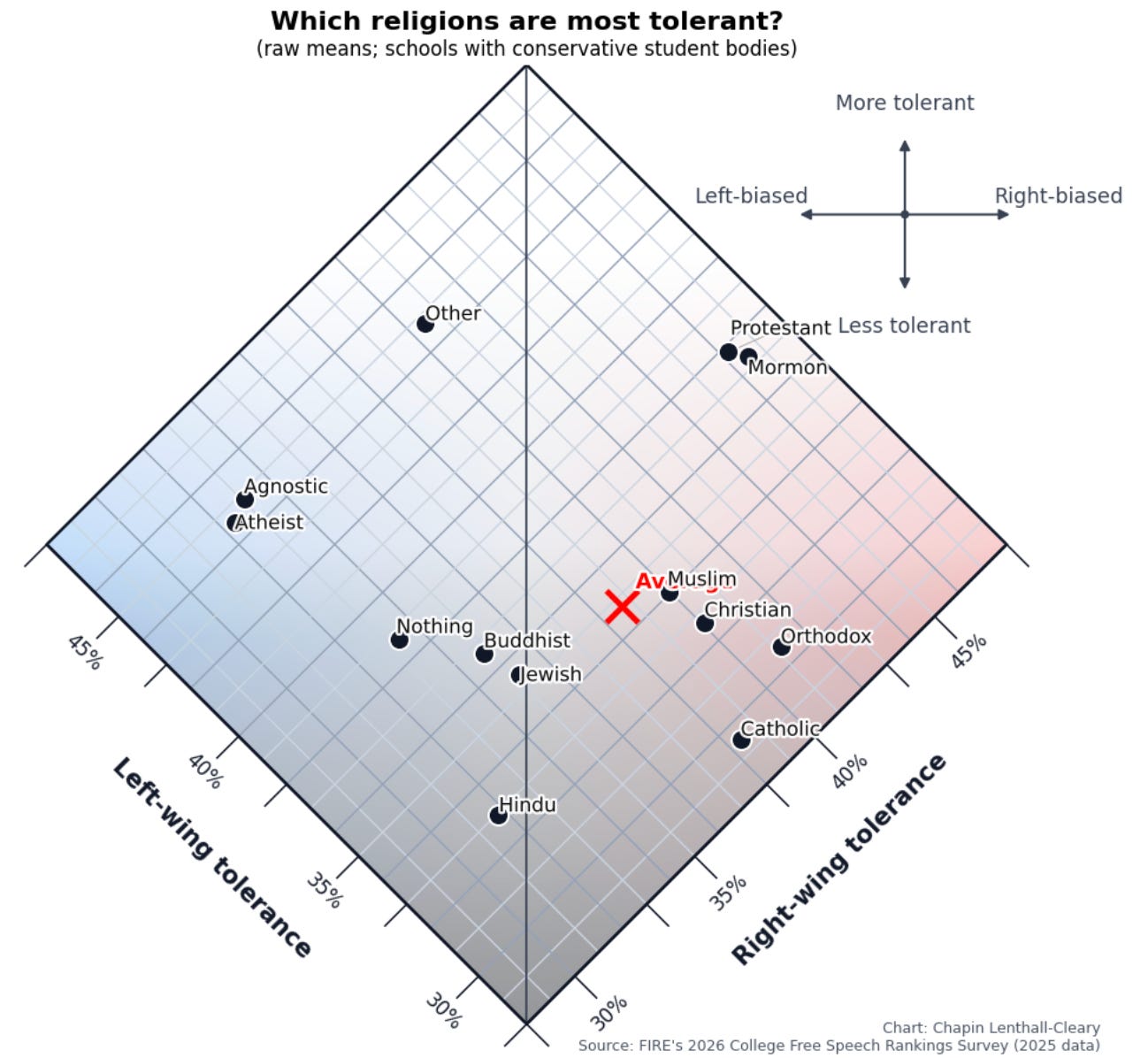
Unsurprisingly, there’s general rightward movement, but Protestants remain unusually tolerant. So it’s unlikely that Protestant tolerance is a selection effect.
We see a similar thing happen with atheists and agnostics compared to students who cite “Nothing in particular” as their religious belief. In both cases, the group willing to use more precise labels to describe themselves is significantly more tolerant.5
There’s an entertaining final piece of evidence that something like religious devotion is tied to greater tolerance. If someone selects “Other” for religion, it allows an open-ended response. Out of 68,510 students who responded to the survey, two used the open-ended response to argue with our classification scheme:
Anglican. Common mistake that there is an assumed binary between Catholic and Protestant (Anglican is neither).
Lutheran (LCMS) (the original Protestants, who are very different from Baptists, Methodists, Pentecostals, and especially Jehovah’s Witnesses, who are not Christian. I will not select an option that includes Jehovah’s Witnesses in the list of examples.) (By the way, JWs don’t even consider themselves to be Protestants either: https://www.jw.org/en/jehovahs-witnesses/faq/are-jehovahs-witnesses-protestants/)
Both students were perfectly tolerant of both sides, i.e. would definitely allow all speakers. This is only two students, so it shouldn’t be taken as strong evidence,6 but it’s still striking.
So okay, is Protestantism making people more tolerant? We can make a reasonable guess about which way the causality goes here. While we don’t have anything here that rules it out with complete confidence, it seems unlikely that being politically tolerant causes students en masse to convert to Protestantism. Much more likely is that either Protestantism teaches tolerance, that environments that raise people to be Protestants also tend to raise them to be more tolerant, or that some other factor causes Protestants to be more tolerant.
I don’t have immediate answers about what exactly seems to produce the Protestant effect. But if we can identify why this is happening, it might point us towards powerful tools to build a free speech culture. This one might be really useful.
The code, data, and codebook used to generate these plots are available here.
We ask students:
Student groups often invite speakers to campus to express their views on a range of topics. Regardless of your own views on the topic, should your school ALLOW or NOT ALLOW a speaker on campus who has previously expressed the following idea?
The left-wing ideas:
The Catholic church is a pedophilic institution.
The police are just as racist as the Ku Klux Klan.
Children should be able to transition without parental consent.
The right-wing ideas:
Transgender people have a mental disorder.
Abortion should be completely illegal.
Black Lives Matter is a hate group.
We phrase the question as: What is your present religion, if any?
Other surveys point to roughly 30% of college students being Protestant and roughly 25% being Catholic. This suggests about 5pp. more Protestants and Catholics than our data, but is otherwise roughly in line with assuming all “Christians” in our survey are Protestant.
Measured by a weighted average of the ideologies of the students at the school.
When controlling for gender and ideology, atheists and agnostics are significantly more tolerant of both sides than those who selected “Nothing in particular.” Also, atheists and agnostics do better than the “Nothing” group in national data about firing professors too.
Even though the probability of two students being perfectly tolerant is 0.17%, or 1.7% given that both are male “Protestants,” both of which meet the 2σ threshold for statistical significance.

I'm reminded of your post from November (https://substack.com/home/post/p-177992744), which identified regular religious service attendance as more highly correlated with tolerance than many other demographic factors. In that, you noted: "Interestingly, the people who do worst are those who attend religious services very infrequently, whereas those who never attend do a bit better, perhaps suggesting atheists are more tolerant than religious backsliders." This current piece again identifies the importance of something like clarity or specificity -- "...the group willing to use more precise labels to describe themselves is significantly more tolerant." I think there's something here about clarity in itself, especially for young people, where a stronger and more traditionally grounded sense of self enables a less personalized, more objective view of "controversial ideas." I also think it's unavoidable that Protestant Christianity is very closely connected to the intellectual tradition that gave birth to ideals like free speech.
Id say Protestants who self identify as protestants are more likely to be mainline than Protestants who identify as Christian, the latter will be full of "non-denominational" types.