



Data byte
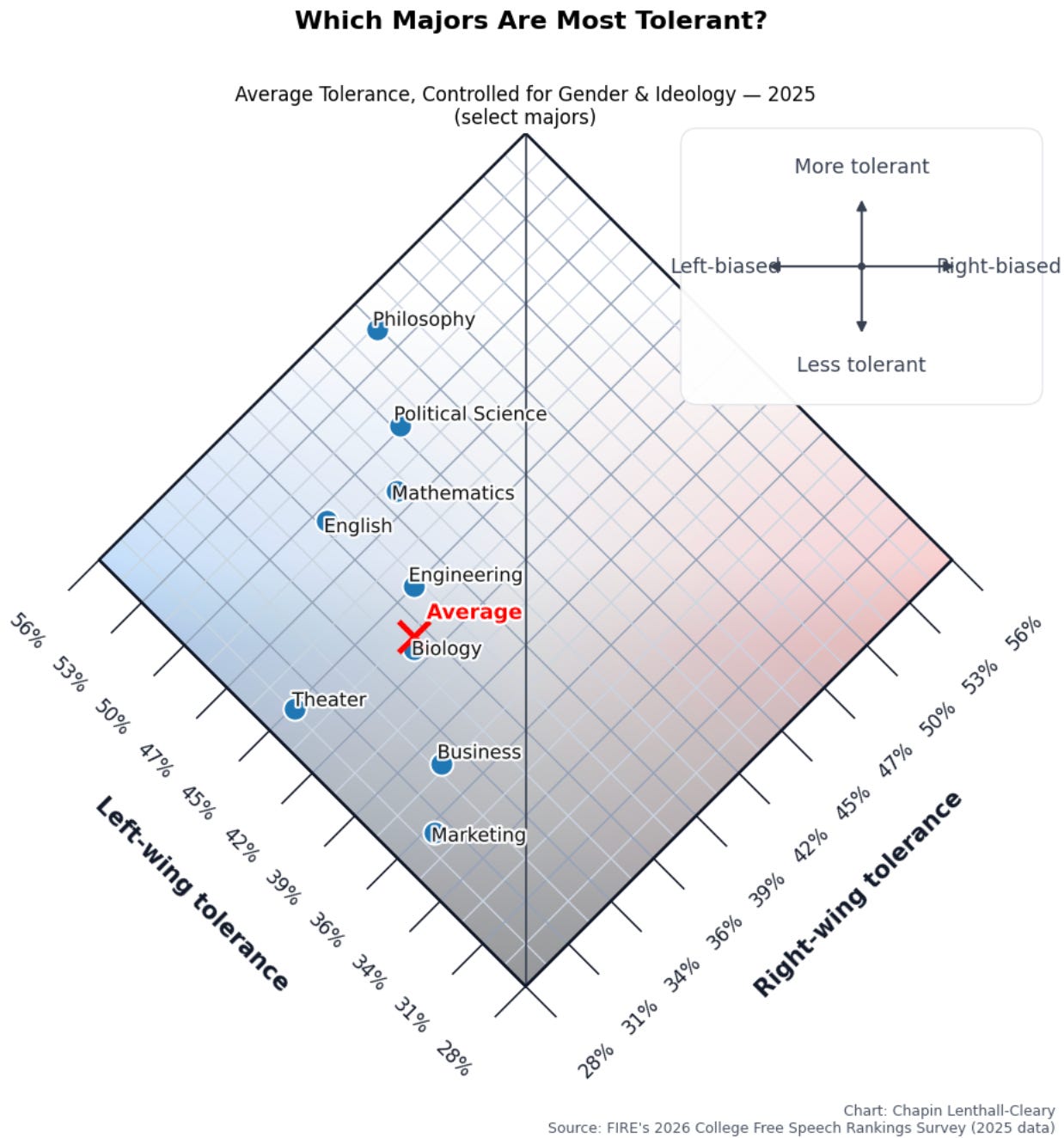
Students studying religion and philosophy have the highest average rates of political tolerance. The majors with the lowest average tolerance are preprofessional ones — fashion, marketing, and real estate sit at the very bottom.
Majors often mocked as “woke studies” perform better than critics might guess. Gender studies students tend to show higher tolerance than those in finance, real estate, or marketing, while students in African American studies tend to be more tolerant of both left- and right-wing speakers.
Our data suggests that learning philosophy, political science, or math may increase political tolerance while studying business, finance, or marketing may decrease it, especially in women.
For certain majors, the tolerance gap is larger than the gender tolerance gap. Women studying philosophy or religion have higher average tolerance than men studying a number of fields including finance, business, theater, or nursing.
Deep dive
I’ve previously discussed surprising results around tolerance for hypothetical controversial speakers, which we assess by asking whether students would allow those speakers on campus1, including the fact that men are substantially more tolerant — so much so, in fact, that men are often more tolerant of their political enemies than women are of their own allies.
These results have left me wondering what, if anything, can be done to make people more tolerant. One possible answer is education. One would hope, for instance, that studying philosophy teaches people to engage in open debate and meet ideas they disagree with using rational argument rather than censorship. But is that true?
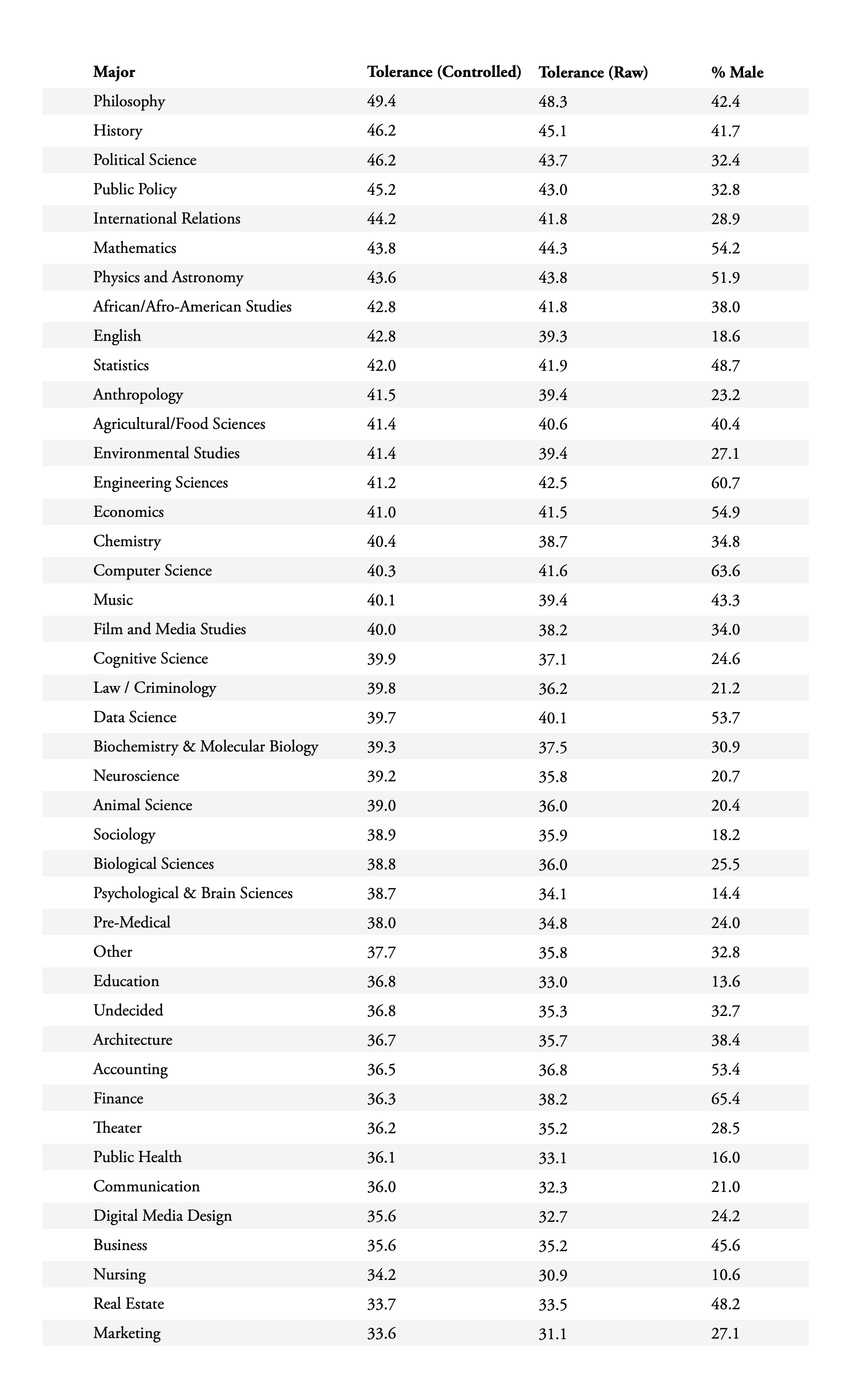
That question isn’t easy to definitively answer using our data, but one way to approach an answer is by looking at which majors have students who are unusually tolerant. Here’s a list of all majors with at least 100 men and 100 women in our sample, along with the average rate of political tolerance for each, both controlled for gender and not:
Huh.
Some of that is expected. Philosophy indeed does well, at least relative to other majors, as do other subjects that study political issues like political science and public policy. The top three majors in terms of political tolerance are religion, philosophy, and classics (though not all of them are listed above, as some have too few students). This isn’t shocking, especially given that other results from the College Free Speech Rankings data suggests people who frequently attend religious service tend to be more tolerant.
But it is somewhat surprising to see which majors are at the bottom. One might’ve expected to see what critics might call “woke studies” such as gender studies. Instead, we see preprofessional majors such as fashion, nursing, real estate, and marketing at the bottom — all well below gender studies, which has too few men to be on the list, but a controlled average tolerance of 37.
The decision to control for gender comes from wanting to figure out which majors might make people more tolerant. It’s true that male-dominant majors are, generally speaking, more likely to be tolerant. But what we want to know is not which majors score higher in tolerance simply because they have more men, but which ones might actually instill values or ways of thinking that generate tolerance.
And after controlling for gender, we find that the gender gap is not the only story here. English, for example, ranks high on the list despite being heavily female, whereas finance ranks low despite being heavily male. That said, it’s important to remember that just because a major ranks high doesn’t necessarily mean it’s making people more tolerant. Correlation, as the old saying goes, is not necessarily causation.
Also, this is just average tolerance. A major could have 100% tolerance for left-wing views and zero tolerance for right-wing views, yet score higher than any other major on this list despite being full of incredibly intolerant students. To find out if that’s really happening, let’s look at tolerance for each side by major:
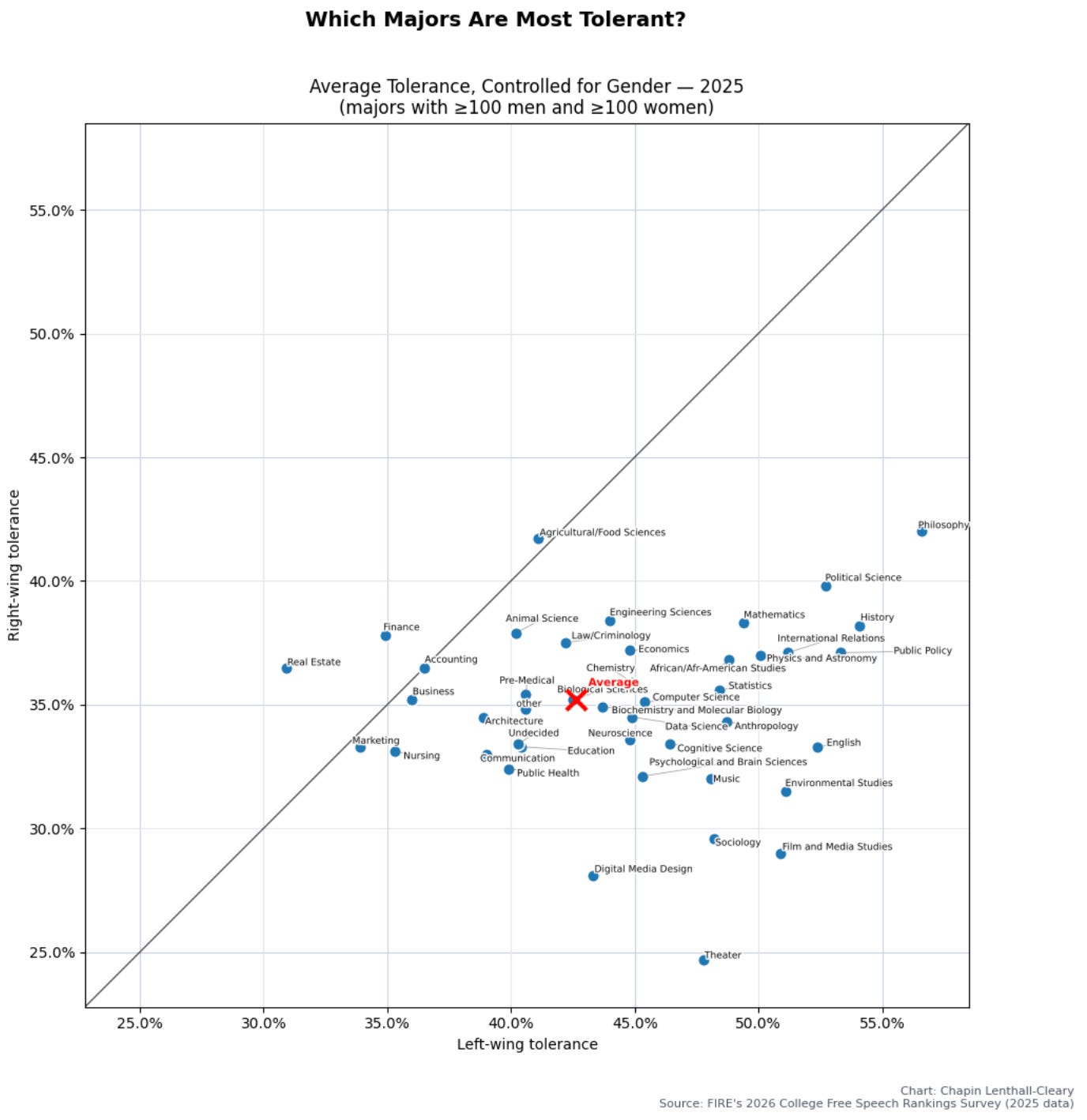
So is the low tolerance of preprofessional majors and high tolerance of some “woke studies” a bias-driven mirage, where high tolerance for left-wing speakers means that a major ranks high despite having abysmal tolerance for right-wing speakers? Not really, though many of the majors listed do well specifically because they have higher left-wing tolerance.
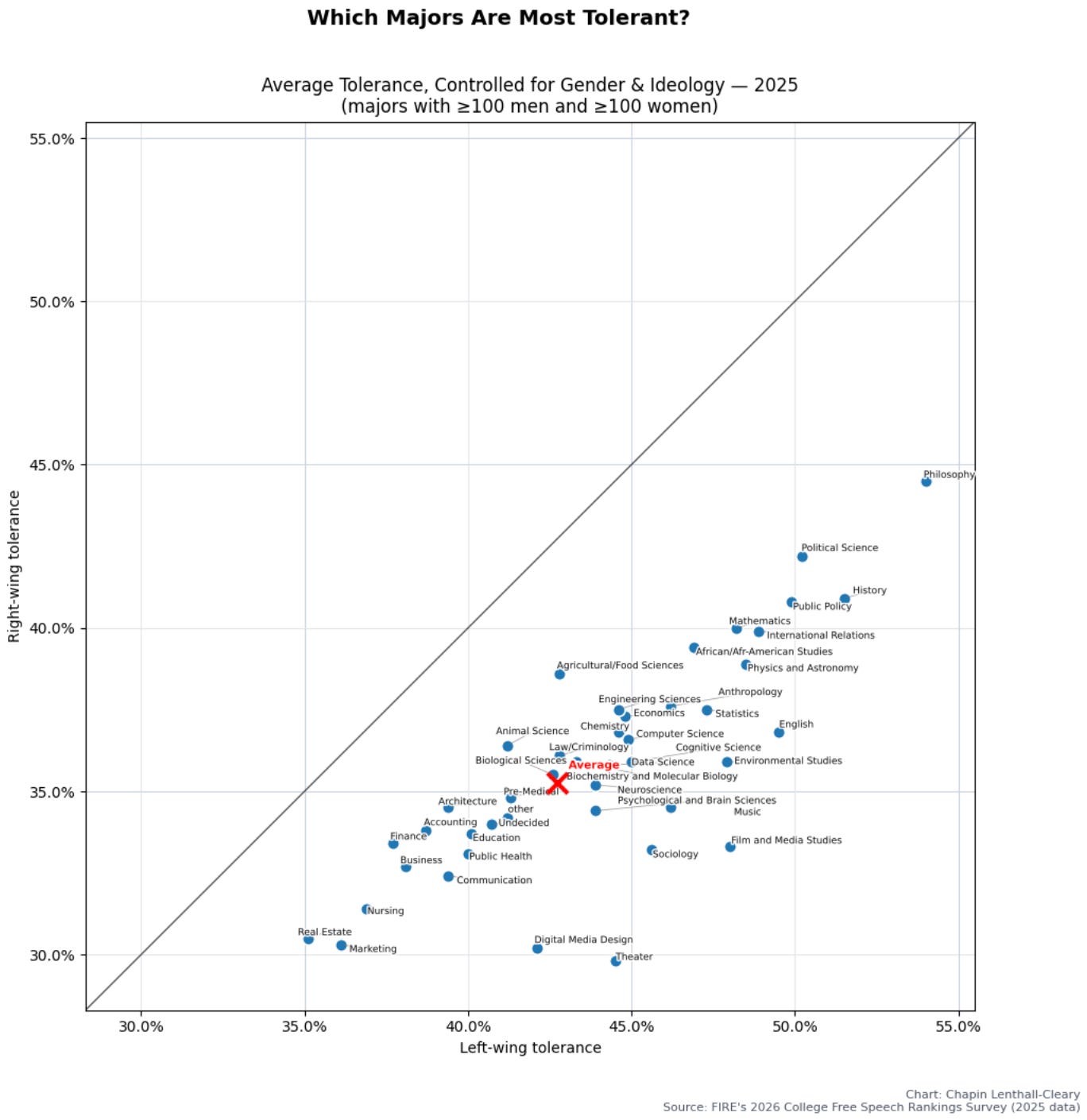
If you walk into an English classroom, you’ll find above-average tolerance for left-wing speakers and below-average right-wing tolerance — but that’s to be expected for a major in which most students are left-leaning. The question is, how much more tolerant of right-wing speakers are English majors than we might expect, given that most of them are left-wing women? Let’s control for ideology to find out:
Wow.
A lot of the more “tolerant” majors are disproportionately filled with people on the left. But once you control for that, they tend to be more tolerant of both sides. The preprofessional majors tend to sit at the bottom of both axes. Conversely, even some of the “woke studies” majors actually do fairly well. African American studies has above-average left- and right-wing tolerance.
That said, theater is indeed extremely intolerant of right-wing speakers, and gender studies is similar in that regard. Interestingly, women in theater have roughly average female tolerance, while men in theater have the lowest right-wing tolerance of men of any major on the chart by a large margin (~5 percentage points). In fact, men studying theater have about the same right-wing tolerance as women in theater.
Philosophy occupies a unique position, beating every other major on the chart in terms of tolerance toward both left-wing and right-wing views. Meanwhile, religion beats philosophy at right-wing tolerance and every major except philosophy when it comes to left-wing tolerance.
Do these majors make people more tolerant? Do more tolerant people choose these majors? Or is it both? To answer this, we’d ideally set up a controlled experiment, though logistics make this untenable (if you have the resources to make it happen, please reach out). But if a major makes students more tolerant, we’d expect seniors who have spent more time in that major to be unusually more tolerant than freshmen (older students tend to be more tolerant anyway). So what does the data say?
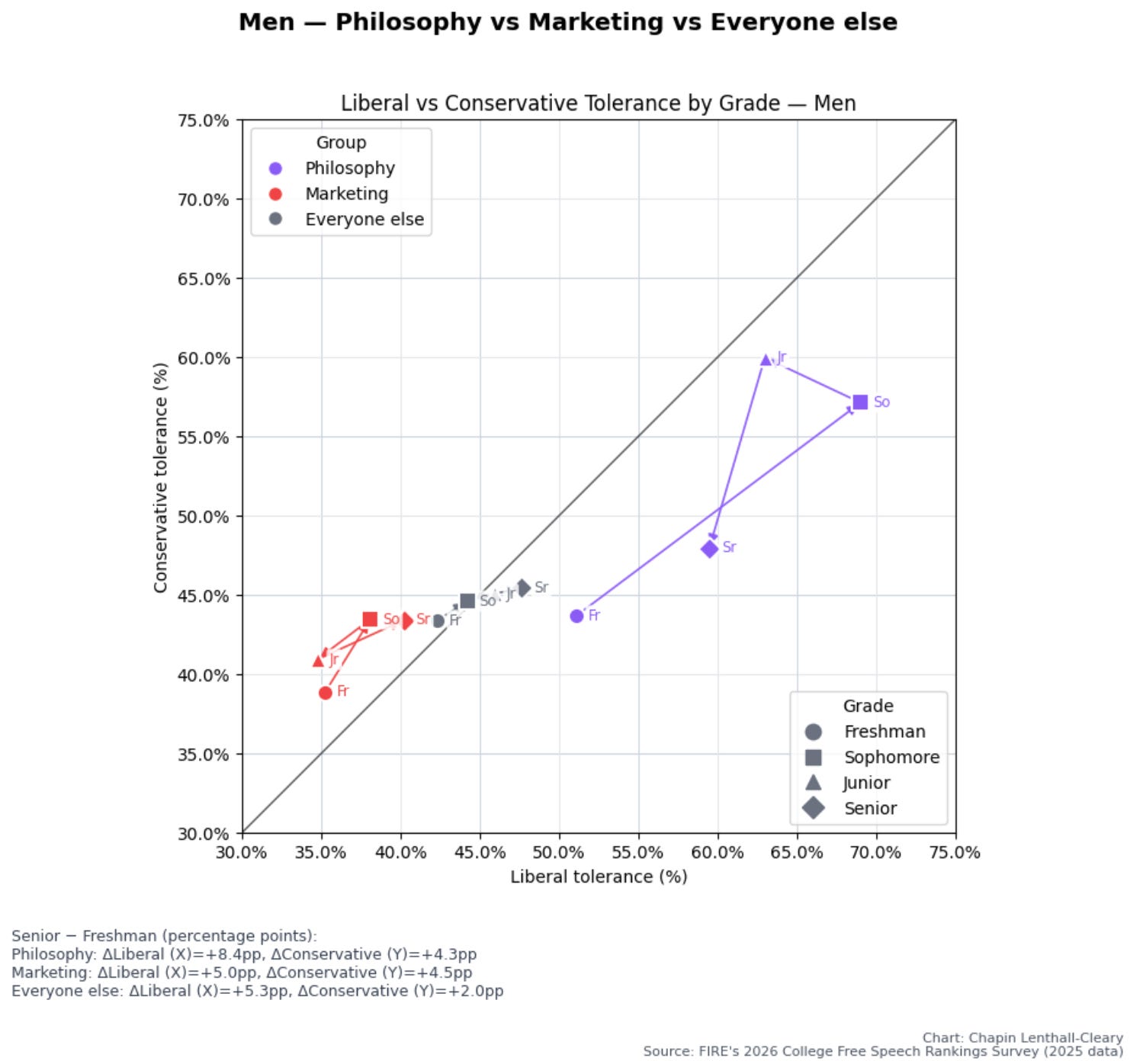
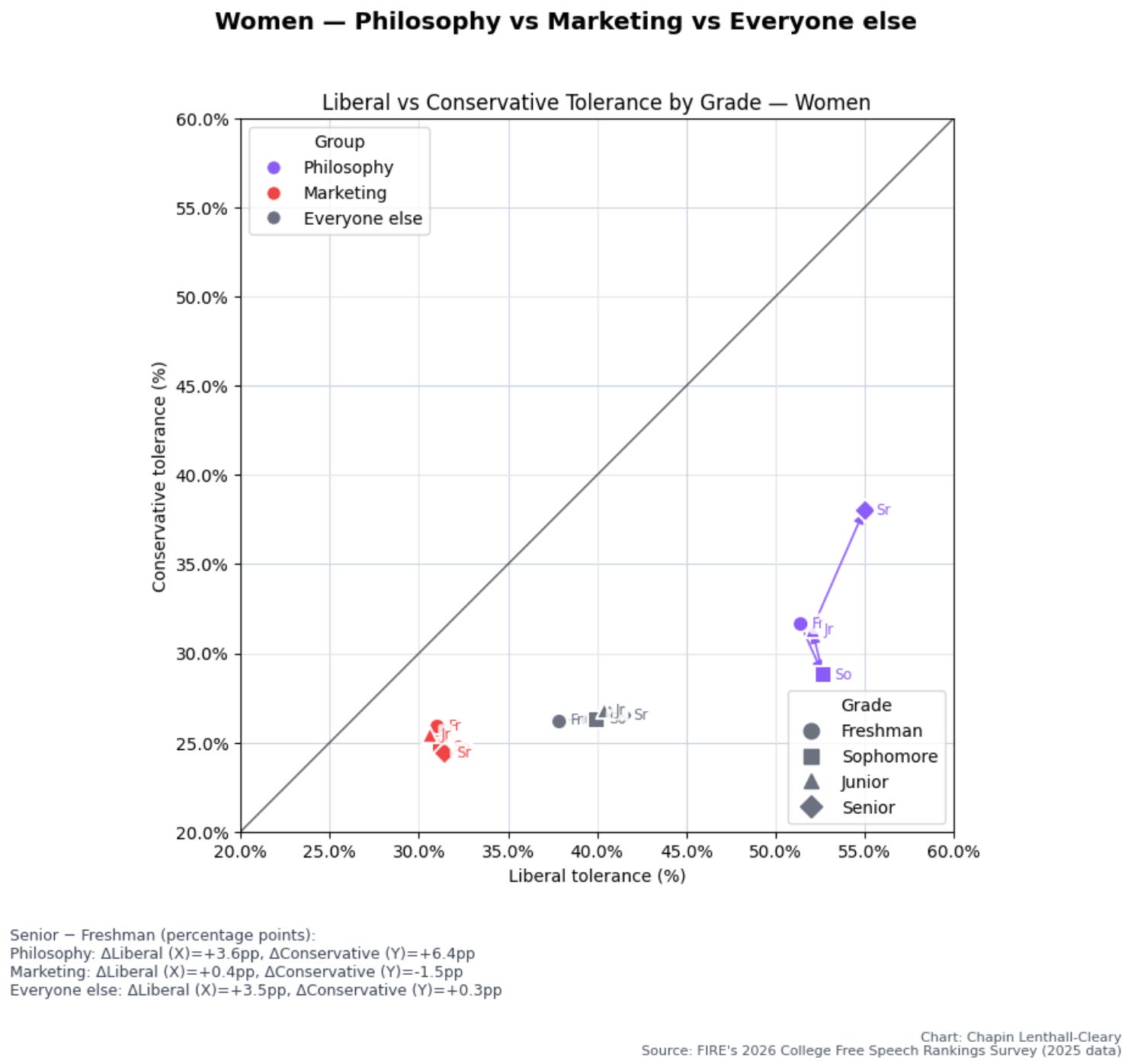
Okay, that sort of looks like philosophy has a larger gap between younger and older classes, and marketing a smaller one, but there’s too much noise to really tell. We’re talking about groups of roughly 60-70 philosophy students per grade, so go figure. Let’s toss in some more majors with large sample sizes:
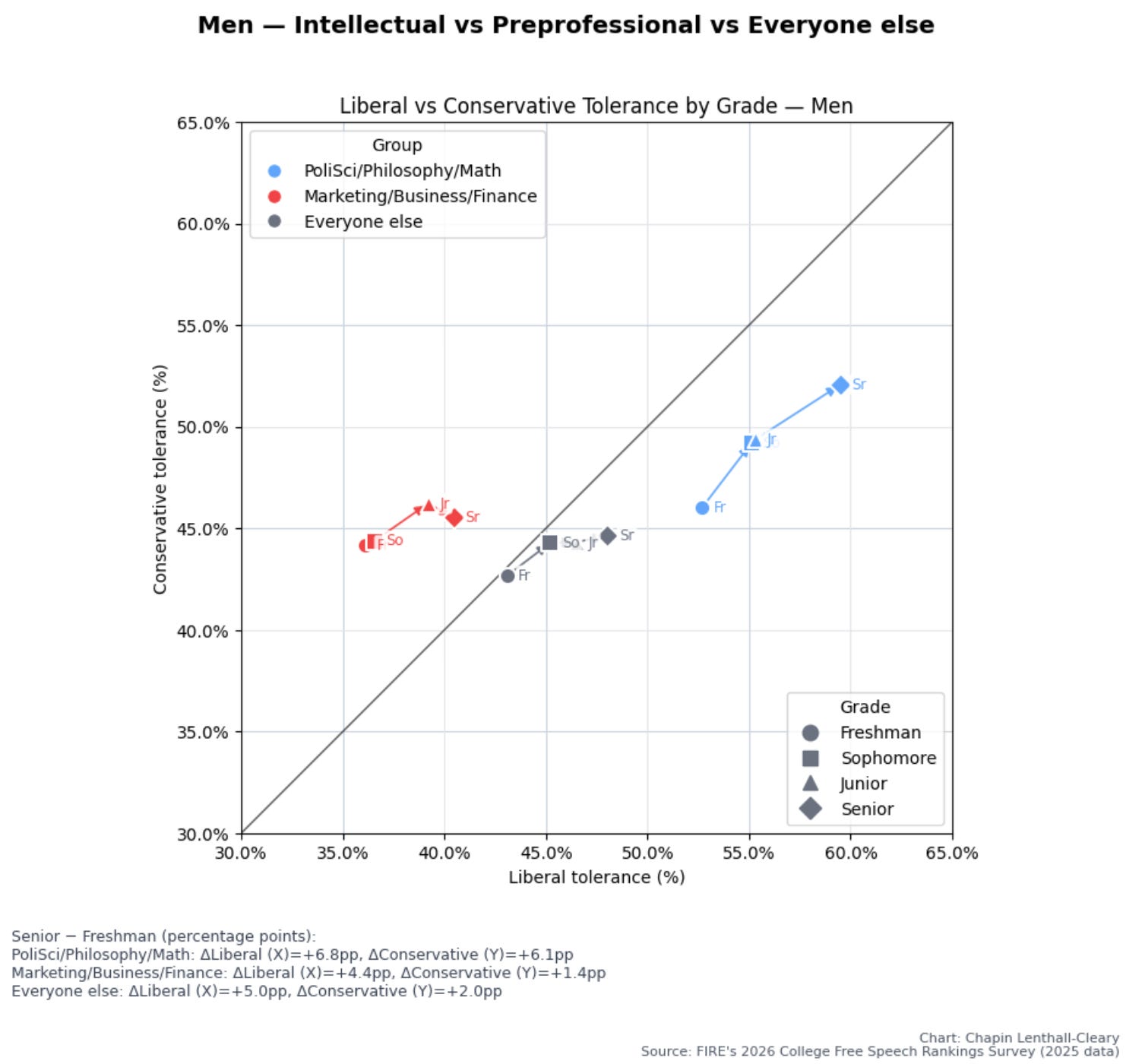
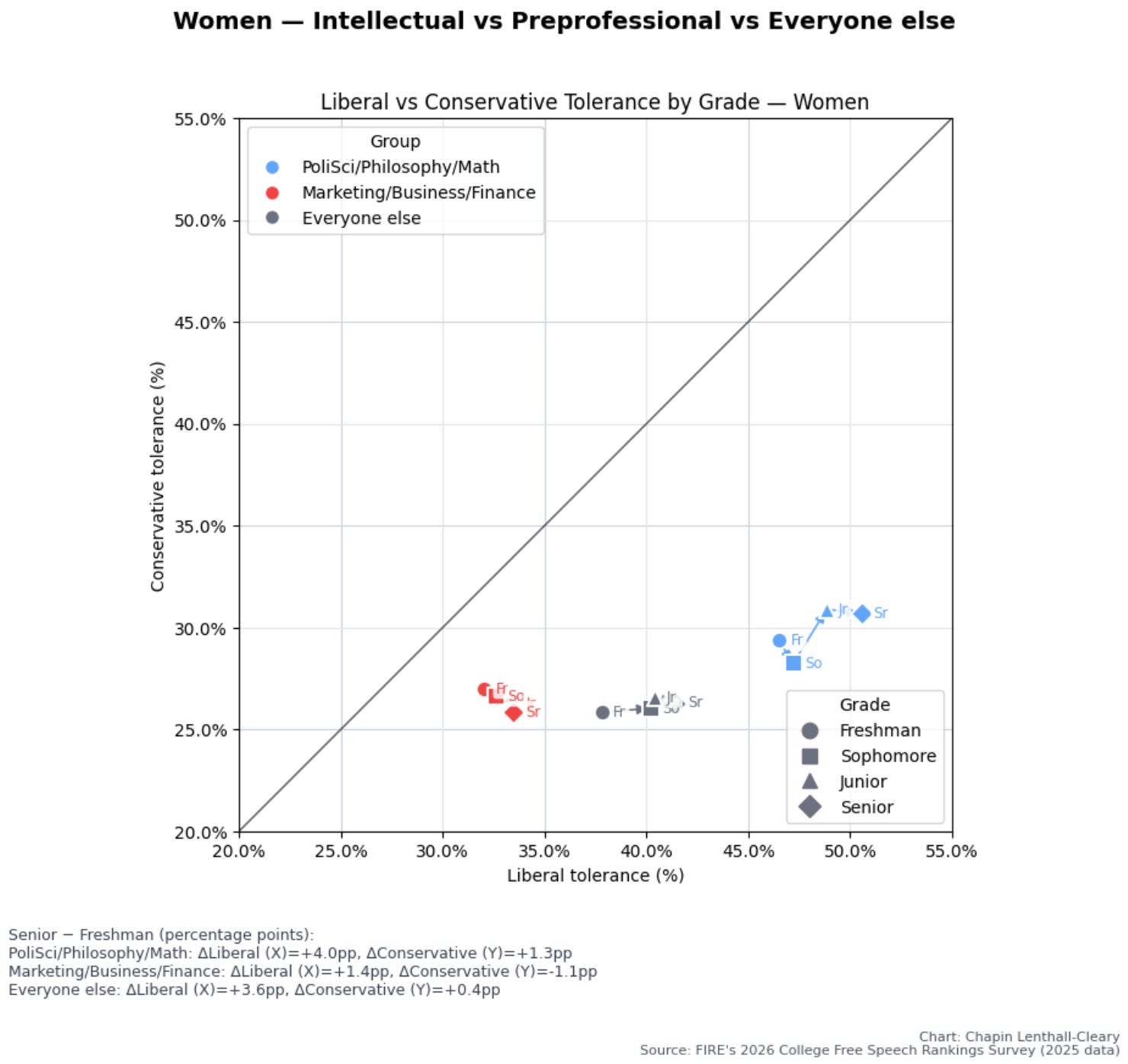
It just might work.
Among men, all bins have seniors higher in both dimensions than freshmen, but the gap is smaller (compared to everyone else) for the marketing/finance/business bin, and noticeably larger for the poli sci/philosophy/math bin. Women show a similar effect, but with smaller gaps in general, and seniors in marketing/finance/business showing lower right-wing tolerance than freshmen in those subjects, suggesting a decrease during college.
This suggests (but does not prove) that learning math, philosophy, and certain other subjects causes an increase in political tolerance in both genders, especially men. And it suggests (but does not prove) that learning business, finance, marketing, etc. causes a decrease in political tolerance in both genders, especially women. (This is based upon an assumption that the gap for everyone else is a baseline tolerance increase due to college/getting older, and the additional in/decrease for subject bins is the effect learning them has. That assumption is obviously far from certain, but it being wrong doesn’t necessarily mean that these subjects aren’t in/decreasing tolerance.)
Again, it’s worth emphasizing that there’s a lot of uncertainty here, and there are other possible explanations for the tolerance change. But conversely, this method may significantly underestimate how much an excellent philosophy education increases tolerance. It ignores effects of pre-college education (though those should show up in the tolerance gap between philosophy and other majors). It’s binning high-tolerance (relative to average) majors in to assess a very-high-tolerance (relative to average) major. And it averages together the change for all math/poli sci/philosophy majors.
Still, it seems to me that an excellent philosophy education, and perhaps even just an excellent course or two, should be able to do significantly better than the mean. This one just might work.
The code, data, and codebook used to generate these plots are available here.
We phrase the speaker question as:
“Student groups often invite speakers to campus to express their views on a range of topics. Regardless of your own views on the topic, should your school ALLOW or NOT ALLOW a speaker on campus who has previously expressed the following idea?”
The listed views of left-wing speakers are:
The Catholic church is a pedophilic institution.
The police are just as racist as the Ku Klux Klan.
Children should be able to transition without parental consent.
The listed views of right-wing speakers are:
Transgender people have a mental disorder.
Abortion should be completely illegal.
Black Lives Matter is a hate group.

There's an assumption of causality that might not hold. It may very well be that more tolerant majors simply attract students who sre already more tolerant, rather than teach them to be more tolerant.
I think a more ideal comparison for estimating a causal effect would be looking at people who barely get into a major vs people who barely don’t get in at a competitive school. At the limit, these are essentially the same people. However, I don’t know if this is a group that actually exists.
At my school, Purdue, you could compare students who barely qualify for Mechanical Engineering vs students who barely don’t, but at that point you’re already looking at 2 different types of engineering anyway