“In light of the First Amendment to our Constitution, the government cannot properly silence the People or the Press simply because the government disagrees with public protests, demonstrations, press reporting, or other speech criticizing the government.”
– Judge Ronald M. Gould on federal immigration officers using crowd-control weapons in Los Angeles Press Club v. Noem.
Trump threatens CNN over Iran reporting
President Trump claimed on Truth Social that CNN’s reporting of a statement in which Iran declared victory in the ongoing war is disinformation, adding, “CNN is being ordered to immediately withdraw this Statement with full apologies for their, as usual, terrible ‘reporting.’”
FCC Chairman Brendan Carr also weighed in, calling for “change at CNN.” But as we have explained before, jawboning is a clear violation of the First Amendment.
Turkey seeks to end online anonymity
The Turkish government is submitting a proposal to parliament requiring people to ID themselves to use social media. Unregistered accounts will be removed by platforms. As Sarah McLaughlin recently explained:
We need the ability to speak anonymously online, whether to criticize our leaders, search for embarrassing medical advice, or even just to ask the age-old question: r/AmItheAsshole? What’s happening in Turkey should signal a clear shot across the bow. We need to fight for this right, or we are going to lose it. Fast.
Below the fold
President Trump threatened to jail a journalist in efforts to find who leaked reports that a second Air Force officer from a downed U.S. fighter jet in Iran was missing, saying, “We’re going to go to the media company that released it, and we’re going to say, ‘National security, give it up or go to jail.’ The person that did the story will go to jail if he doesn’t say.”
A former philosophy professor is suing Texas State University for firing him one year after he gave a speech — in a different state as a private citizen — on the Israeli-Palestinian conflict.
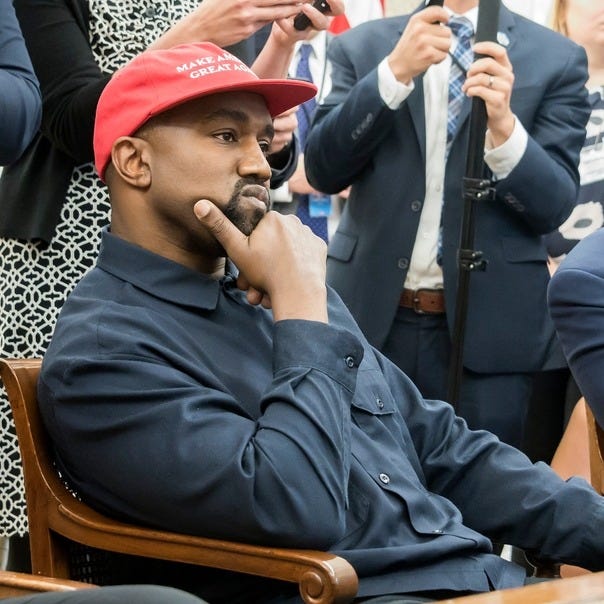
London’s annual rap and hip-hop Wireless Festival was canceled this week after the British government refused entry to Kanye West over his antisemitic comments in the past.
Florida Gov. Ron DeSantis signed a bill (HB 1471) allowing him to designate foreign and domestic terrorist organizations.
Terms of service
London Mayor Sadiq Khan has called on ministers to take stronger action against social media companies that spread disinformation, calling it “the outrage economy,” after a study showed a surge in the number of people talking about the city’s crime rate, often in relation to immigration. Khan even called for the formation of a new watchdog group. “We need a new central body with the agility and authority to protect our democracy from disinformation,” he said, “and deal with the scale and speed of this crisis. And we need more aggressive enforcement of the rules we already have.”
This week in history
On April 8, 1999, FIRE was founded by UPenn professor Alan Charles Kors and Boston civil liberties attorney Harvey Silverglate as the Foundation for Individual Rights in Education. After publishing their book, The Shadow University: The Betrayal of Liberty on America’s Campuses, they received hundreds of pleas from college students and faculty who had been harmed by illiberal policies and double standards.
FIRE originally focused our work on college campuses before expanding in 2022 to defend free expression generally. We also changed our name to the Foundation for Individual Rights and Expression. Today, FIRE defends free speech not just on campus but across American culture, taking on threats to civil liberties wherever they arise.
Where there’s smoke
In this new FIREwire section, we’ll be covering the ongoing cases we’ve got our eyes on and the ones we think you should be watching too.
UNC Chapel Hill students celebrated April Fools’ Day by creating satirical content, including one video mocking performative liberal attitudes, then the university condemned the material and launched an investigation. But student satire is protected under the First Amendment, as Marie McMullan recently explained.
By the numbers
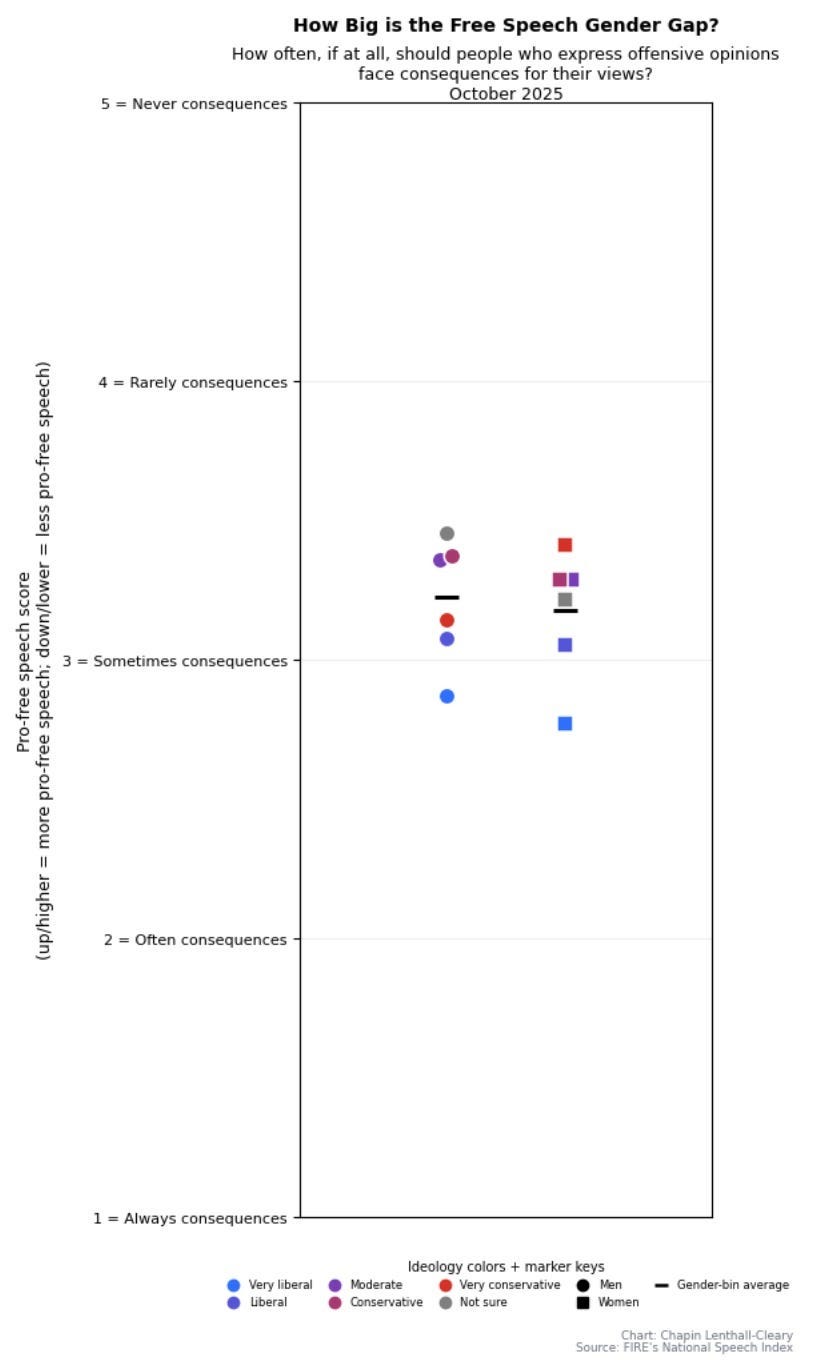
People who agree with the claim “words can be violence” are generally more likely to support censorship. But how widely held is this idea, and who holds it? It turns out, this belief is not just a disproportionately liberal opinion but also a disproportionately female one. In fact, even very conservative women are more likely to think “words can be violence” than very liberal men.