


Colorado may regard its policy as essential to public health and safety. Certainly, censorious governments throughout history have believed the same. But the First Amendment stands as a shield against any effort to enforce orthodoxy in thought or speech in this country. It reflects instead a judgment that every American possesses an inalienable right to think and speak freely, and a faith in the free marketplace of ideas as the best means for discovering truth. However well-intentioned, any law that suppresses speech based on viewpoint represents an ‘egregious’ assault on both of those commitments.
– Justice Neil Gorsuch, writing for the Supreme Court majority in Chiles v. Salazar, holding that Colorado’s ban on conversion therapy violates the First Amendment.
Supreme Court strikes down Colorado conversion therapy ban
The U.S. Supreme Court ruled 8–1 that Colorado’s ban on conversion therapy may violate the free speech rights of licensed counselor Kaley Chiles, who provides talk therapy to clients on sexual orientation, and sent the case back to lower courts to reconsider it under the toughest constitutional standard — strict scrutiny.
Strict scrutiny requires the government to show that its goal is important, that the law helps it achieve that goal, and that there’s not a less restrictive way to do it. The decision could affect similar laws in nearly 30 states and marks a major expansion of speech protections into professional and medical regulation, despite opposition from major medical groups.
Ohio restricts drag shows to adult venues
Ohio lawmakers passed a bill expanding the state’s public indecency and adult entertainment laws to restrict adult drag shows in places where minors could be present.
The law imposes potential felony charges for drag shows deemed obscene if performed in front of anyone age 12 or younger. Critics warn this could chill artistic expression and disproportionately target LGBT performers under the guise of obscenity regulation.
UK looks to curb policing lawful speech
After years of logging tens of thousands of “non-crime hate incidents” over perfectly lawful speech, the UK government now says NCHIs will be “scrapped” to “end policing of petty squabbles,” scaling back a widely criticized system that blurred the line between crime and protected speech.
Still, as Sarah McLaughlin carefully explains, there are reasons to remain concerned — and already signs that similar practices are quietly emerging in the United States.
Terms of service
What if the next big threat to free speech doesn’t come from banning content, but from making it too engaging? In their latest issue of Notice and Takedown, Ari Cohn and Tyler Tone take aim at the latest wave of lawsuits blaming “addictive design” (think infinite scroll and algorithms) for social media harms. They argue it’s a clever — but dangerous — end run around the First Amendment. Basically, if courts accept that platforms can be punished for making speech compelling, they’re effectively creating a rule against speech that works too well. Even if you’re skeptical of Big Tech, this is a sharp analysis that forces you to think more critically about where product design ends and protected expression begins, and what happens if we get that balance wrong.
Know your rights
The encrypted messaging app Signal has been in the news lately, and people have questions. What’s the news story? How does Signal work? Can using it get me in trouble? Can it help me get away with murder? The first thing to know is, your rights are the same as if you were speaking in person or on the phone. The First Amendment protects your ability to communicate, organize, and even criticize the government, while the Fourth Amendment limits how the government can access your data without a warrant. Signal’s strong encryption means it collects very little information, but that doesn’t mean it can shield illegal activity. If you break the law, you can still be investigated through other means. In his latest explainer, Adam Goldstein addresses all these questions and more concerning Signal.
This week in history
On March 29, 1940, the New York legislature unanimously authorized what became known as the Rapp-Coudert Committee — a sweeping inquiry into alleged “subversive” activity in the state’s schools, specifically Brooklyn College, City College of New York, Hunter College, and Queens College. Over the next two years, the committee spent the equivalent of more than $11 million today to identify and purge suspected communists and sympathizers from public education.
The investigation produced a list of more than 600 names, which was shared with law enforcement and later federal authorities, and led to the dismissal of roughly 40 faculty and staff from municipal colleges. It also helped dismantle two local teachers’ unions, with the support of the American Federation of Teachers. This episode, which forms part of the broader “little red scare” that preceded McCarthyism, is a reminder that politically driven censorship campaigns—and the urge to root out ideological “threats”—have not been confined to any one party or era.
By the numbers
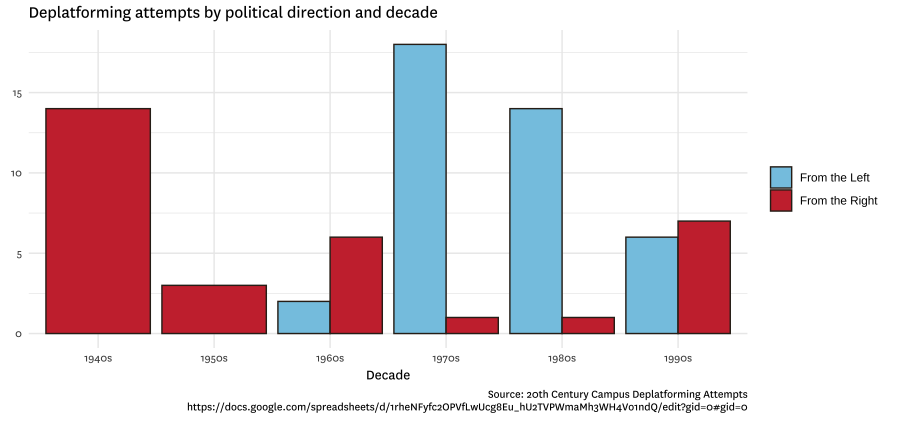
The 1970s were the high-water mark of campus deplatforming with a total of 19 attempts. While earlier controversies centered around political views and the Cold War, deplatforming efforts in the 70s pivoted sharply to race. That shift was driven largely by repeated controversies involving the Nobel physicist and eugenicist William Shockley. This week, Sean Stevens explores the data going back to 1947 and tells the story of how campus deplatforming has evolved since World War II.
Good ruling!