


The history of campus deplatforming in the United States is older and messier than either its critics or defenders usually admit. Long before online petitions, viral outrage, and bloated bureaucracies with too much time on their hands, colleges were wrestling with decisions to block speakers, revoke invitations, and shut events down.
An analysis of 72 campus deplatforming attempts — efforts to stop public expression on college campuses — from 1947 to 1999 shows that these efforts have their roots in the immediate post-World War II period.
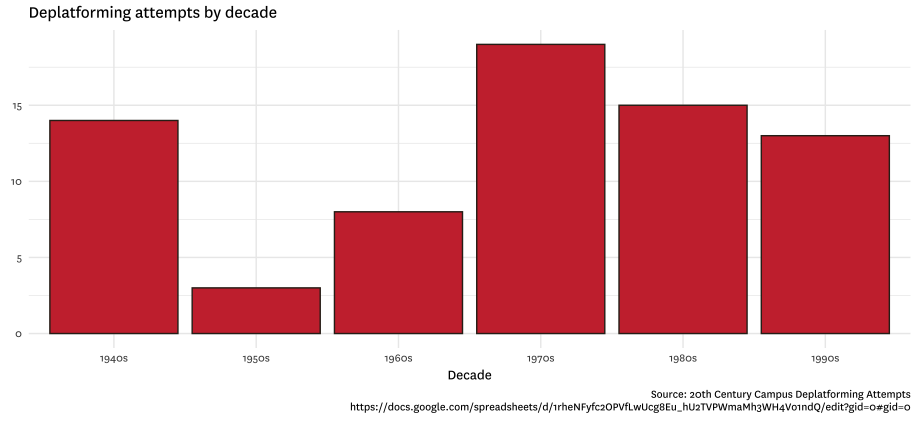
In the 1940s, 50s, and 60s, almost every incident in the sample comes from someone to the political right of the expression they are targeting, and almost all of them were successful. Campus speaker-bans, ruled unconstitutional in 1968, were used to bar communists, communist sympathizers, and socialists from speaking on campuses across the country — including at Columbia University, UC Berkeley and UCLA, University of Michigan, and the University of North Carolina. But by the 70s, this pattern had reversed and deplatforming attempts now came overwhelmingly from the other direction.
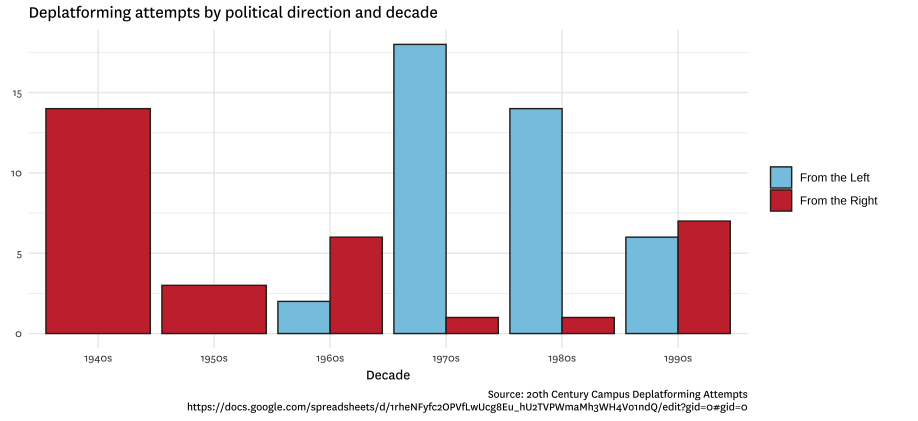
The 1970s were the high-water mark of 20th century campus deplatforming with a total of 19 attempts. While earlier controversies centered around political views and the Cold War, deplatforming efforts in the 70s pivoted sharply to race. That shift was driven largely by repeated controversies involving William Shockley, a Nobel Prize-winning physicist turned eugenicist and, often, Roy Innis, the national director of the Congress on Racial Equality. Together, they account for nearly three-quarters (14 in all) of the deplatforming attempts that decade.
Shockley’s role is especially important. He had become a national symbol of controversy because of his views on race and intelligence. Invitations to speak on campus no longer functioned like ordinary academic events, but instead became flashpoints. When he was invited to speak at a symposium at the Brooklyn Polytechnic Institute in May 1968, a small group of faculty complained and the convocation was ultimately canceled, despite 493 scientists and engineers having already agreed to come, for fear of violence. Harold Taylor, the former president of Sarah Lawrence College, said of the scandal, “If we are never to discuss any controversial issues for fear there might be demonstrations, then the whole purpose of the university is destroyed.”
Innis matters here too because of his repeated connection to Shockley, and his willingness to debate him. In 1973, Innis was scheduled to debate Shockley on television on the topic of black intelligence, but Innis pulled out at the last moment because the student society at Princeton, which was organizing the event, would not grant access to the press or public. In 1974, Yale canceled a debate between Innis and Shockley on eugenics, an infamous decision that led to the publication of the Woodward Report, in which the university made the protection of freedom of expression an official school policy.
The 1980s brought geopolitics back. The decade’s deplatforming attempts were about the Cold War conflict, with Central America looming large. That makes the 80s distinct from both the anti-communist postwar years and the Shockley-driven scandals of the 70s. Now the targets were often appointees in the Reagan administration — figures like UN envoy Jeane J. Kirkpatrick, CIA Director William Casey, or Defense Secretary Casper Weinberger.
The 90s are the most politically mixed decade of all. There is a roughly even number of censors on the left and the right of the targeted expressions, the topics are all over the map, and the targets range from pro-choice commencement speakers to racial firebrands, conservative political figures, and culture-war provocateurs. Rather than one coherent wave, this decade looks like a transitional moment. This is the period when campus deplatforming began to take on the fragmented and multi-issue character it would have in later years.
But regardless of the decade, the attempts often succeeded. Of the 72 incidents in the sample, 53 ended by successfully deplatforming the target, including essentially all those prior to 1970. That’s a 74% success rate. But if that era was bad, the current one is even worse.
The 20th-century shows that campus deplatforming is not new. It has roots in the immediate post-World War II period, shifts ideological direction over time, and repeatedly clusters around the dominant controversies of a given era: anti-communism, race and intelligence, Central America, abortion, immigration, and the culture wars. But deplatforming attempts have become far more numerous since 2015. In the last few years, they’ve intensified even more: 171 in 2023, 179 in 2024, and 172 in 2025. We’ve already recorded 77 in just the first three months of this year. That’s more than the total number attempts in the entire dataset spanning from 1947 through 1999.
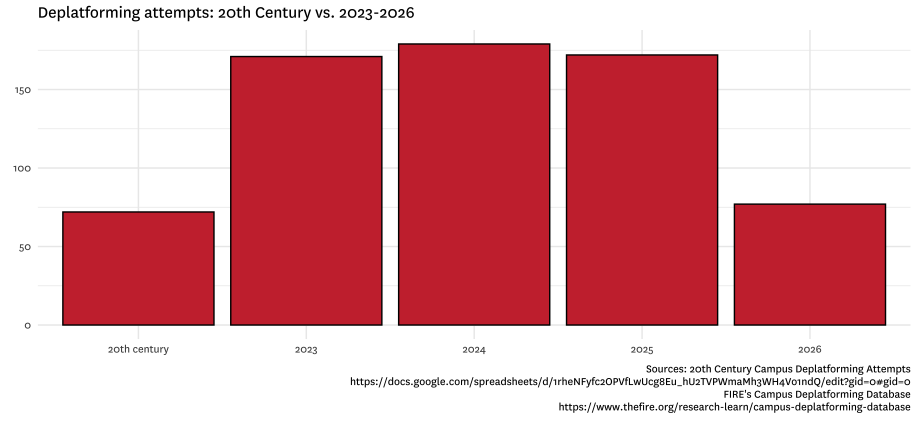
The post-World War II era saw widespread efforts to keep disfavored speakers off campus, often with remarkable success. But the modern era appears worse not simply because deplatforming still exists, but because it has become more frequent, more sustained, and in the most recent data, more successful. A 74% success rate in this 20th-century sample is troubling enough. But early 2026 data reveals a 93% success rate. The lesson is not merely that campus deplatforming has a long history, but that we are far from done with this fight. Indeed, by one crucial measure, this is our darkest hour.

Sean Stevens: Concerning your writing about deplatforming (after the second world war you remarked that tehe deplatforming data the three first months of this year is indicating a new deplatforming record this year. Does the data-information tell something about how the deplatformings are distributed politically among the liberal left anf the conservative right? Best regards. Arnt Folgerø: ar-folge@online.no
Sean Stevens: Concerning your writing about deplatforming (after the second world war you remarked that tehe deplatforming data the three first months of this year is indicating a new deplatforming record this year. Does the data-information tell something about how the deplatformings are distributed politically among the liberal left anf the conservative right? Best regards. Arnt Folgerø: ar-folge@online.no