


“I’ve been asked to speak about freedom of speech, and I have to be honest, I naively assumed it was a guarantee in this country until Sept. 16, 2025. It’s something that I took for granted. Something I thought I’d always have, like my period. Did you guys know that those just stop? They just stop. And it turns out your freedom in this country can too . . . I watched a show, co-workers, friends, and the man I love be put on ‘indefinite suspension’ after our thin-skinned president asked for his removal and his FCC chair publicly threatened the company we work for. It is a fragile time for freedom.”
– Molly McNearney, on her husband Jimmy Kimmel, Dec. 4, 2025
New York Times sues Pentagon
The New York Times is suing the Pentagon over new press rules that force reporters to get official approval before gathering or publishing information, arguing that the restrictions violate the First Amendment.
As Adam Goldstein, vice president of strategic initiatives at FIRE, has explained:
While a journalist might reasonably infer that the United States is engaging in some activity that falls into the sensitive or classified categories, they don’t have any power to determine what answer they actually receive . . . The legal problem with this provision is that it’s not based in any actual law. As stated, it undermines well-established law.
House Dem launches probe into Trump
Democratic Rep. Jamie Raskin is demanding CBS and its parent Paramount explain how it edited a recent 60 Minutes interview with President Donald Trump, citing Trump’s “improper influence” and the network’s decision not to remove his boasting about a $16 million settlement Paramount paid his presidential foundation this year.
But as we wrote on X:
FIRE sounded the alarm when the FCC abused its authority to insert the federal government into CBS’s editorial decisions. That shameful episode demands congressional oversight. But intruding upon those same editorial processes, even to investigate government overreach, only further burdens CBS’ First Amendment rights.
In the frame
Reddit user @ComicBookCanon recently aggregated 655 “Best Comics” lists into one monster meta-ranking — and the Top 10 all share a common theme: censorship and dissent. Sitting at No. 1 is Art Spiegelman’s Maus, the Pulitzer-winning story of a Holocaust survivor. Others in the Top 10 — Watchmen, The Dark Knight Returns, From Hell, Persepolis, V for Vendetta, Akira — similarly pit their heroes against regimes that silence dissent. Fun Home focuses more on the corrosive power of self-censorship, The Sandman repeatedly shows how suppressing stories leads to chaos, and Saga partly follows two journalists who risk everything to publish the truth.
Now listening
“The Lonely Work of a Free-Speech Defender“ with New York Times host Natalie Kitroeff does a wonderful job of charting the history of FIRE and the importance of free speech, as Greg Lukianoff offers his unique story and history with the organization. You don’t want to miss it.
By the numbers
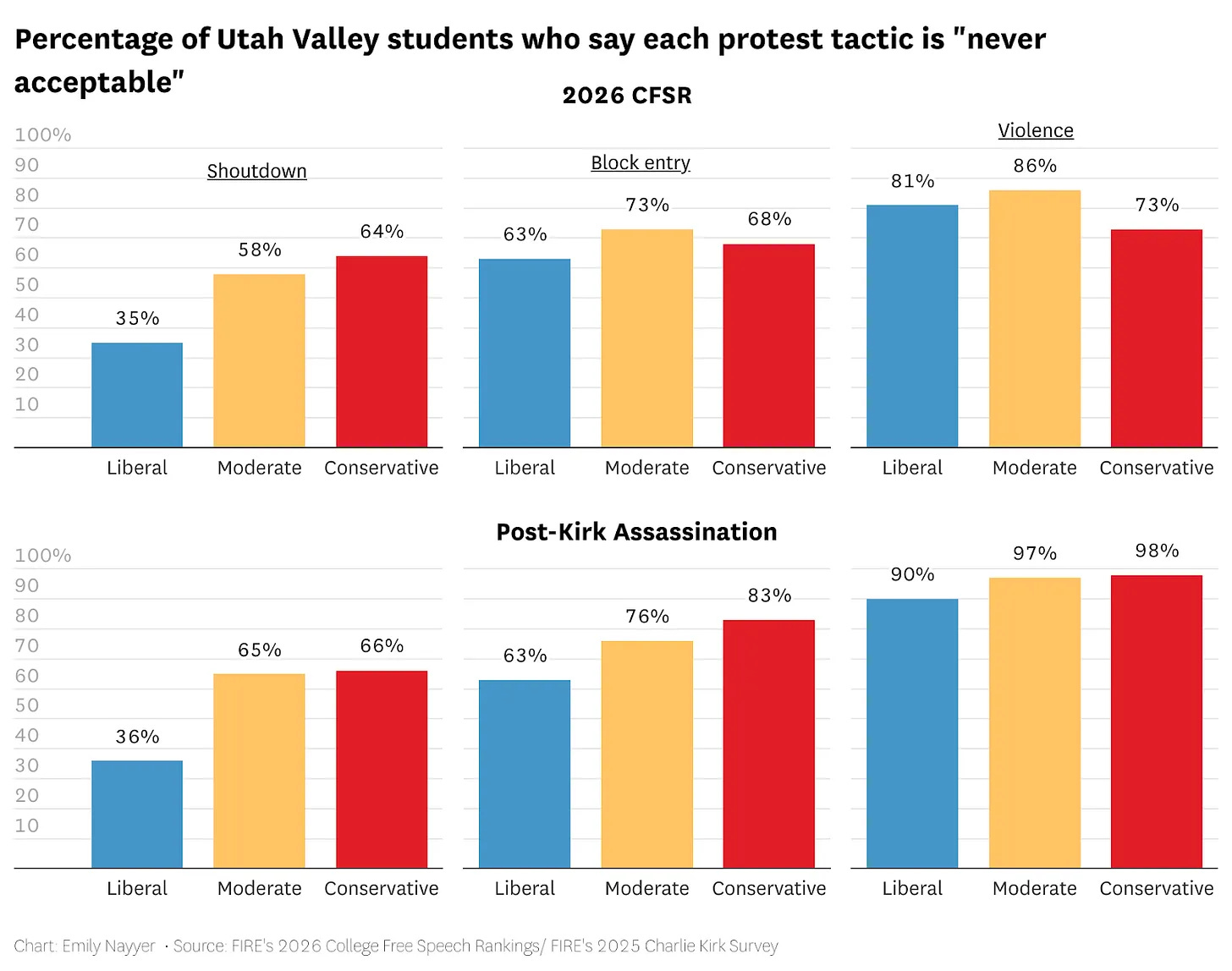
After Charlie Kirk’s assassination, moderate and conservative students became significantly more likely to oppose illiberal protest methods like shouting down speakers, blocking entry to events, or using violence — while liberal students made much smaller shifts, or none at all.
If FIRE is an honest broker for free speech it should be defending Elon Musk and X against the EU with the same passion it defends Hamasnik Ol' Moody Khalil
"the network’s decision not to remove his boasting about a $16 million settlement Paramount his presidential foundation this year."
I was so confused by the above statement, even after reading it multiple times. Then I clicked the link to read the original article and discovered that "remove" is a typo. The original word was "include". You need to be careful when editing your cut and pastes. Always reread.