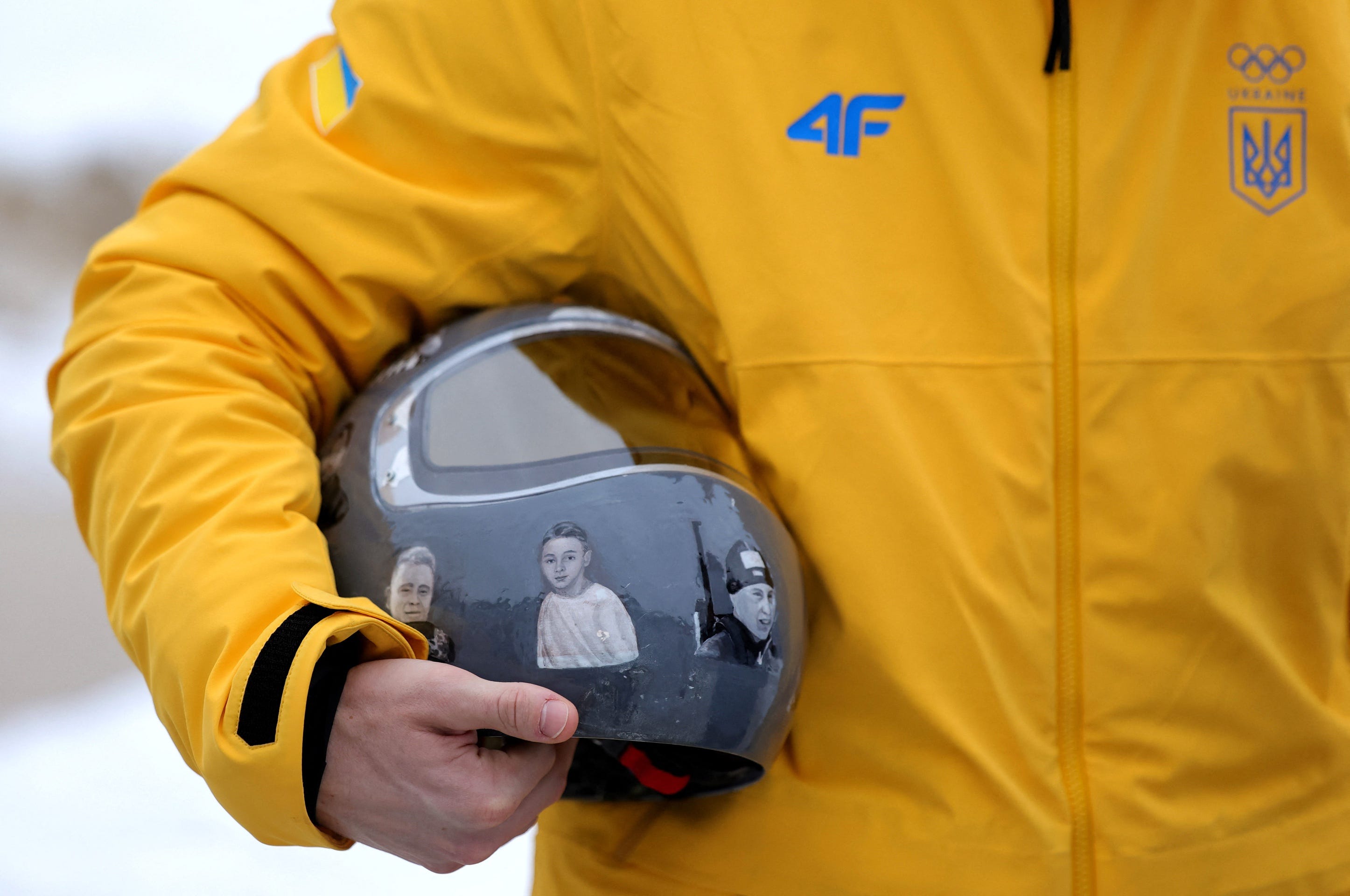
“The world must know the price of freedom.”
— Ukrainian Olympian Vladyslav Heraskevych, explaining why he defied Olympic political-speech restrictions by wearing a remembrance helmet honoring war victims.
Two universities. Two posters. One First Amendment problem.
Penn State and the University of Illinois Urbana-Champaign have each launched investigations into anti- and pro-ICE political posters, respectively, both of which are protected speech at public universities.
Amanda Nordstrom puts it plainly:
You don’t need to sympathize with either political stance taken — pro-ICE or anti-ICE — to defend the principles at stake. Political advocacy is at the core of the First Amendment, especially at a public university. America’s most pressing issues should be debated, not investigated into silence.
NYC officials want to turn yellow cabs into speech police
A New York City official wants to turn yellow cabs into speech police. Manhattan Borough President Brad Hoylman-Sigal urged Mayor Zohran Mamdani to “summarily suspend” the NYC Taxi and Limousine Commission’s partnership with Curb over its deal to air Newsmax updates on taxi screens.
As Stephanie Jablonsky recently explained:
When officials use jawboning — especially behind closed doors — to influence how others moderate or distribute speech, it raises serious constitutional issues because it can circumvent formal legal protections for free expression . . . Perhaps Hoylman-Sigal should take some advice from the late George Carlin, who once said in response to a reverend who complained about something he didn’t like on the radio, “Reverend, there are two knobs on the radio. One of them turns the radio off and the other one changes the station.”
Below the fold
The FCC opens investigation into ABC’s The View after a Texas Democratic Senate candidate’s appearance, part of the agency’s crackdown on applying the statutory equal-opportunity requirement to daytime talk shows.
An immigration judge has dropped the case against Tufts University student Rümeysa Öztürk, finding the Department of Homeland Security showed no legal grounds for her deportation after her arrest last year for an op-ed.
Spain considers banning teens from social media and Jimmy Lai gets 20 years in prison for publishing a newspaper. For more, see the latest Free Speech Dispatch.

In the frame
In a new episode of The New Yorker Radio Hour, the magazine’s editor-in-chief David Remnick interviews civil-liberties attorney Jenin Younes about how she’s come to view threats to free speech as coming from both the left and the right. Younes first gained prominence challenging what she saw as government pressure on social media companies during the pandemic, defending critics of public-health policy, and was associated with libertarian and conservative legal circles. But she now argues that the most serious dangers to free expression stem from President Trump and his political movement, contending that free-speech principles are often invoked selectively rather than consistently. The broader theme is that defending expressive rights in a polarized climate can leave you politically homeless, because each side tends to champion speech when it benefits them and grow queasy when it doesn’t.
Today in history
On Feb. 9, 1919, as part of ongoing protests to pressure Congress into passing the 19th amendment giving women the right to vote, the National Women’s Party burned an effigy of President Woodrow Wilson in front of the White House. The day before the Senate vote, the amendment was expected to narrowly fail. One suffragette, Doris Stevens, wrote in her later book:
Knowing that he always put forth more effort under fire of protest from us than when not pressed, we decided to make as a climax to our watchfire demonstrations a more drastic form of protest. We wanted to show our contempt for the President’s inadequate support which promised so much in words but did so little in deeds to match the words.
The 14th Amendment failed to pass the following day, but it passed Congress as a whole later that year. As for the spectacle outside the White House, the First Amendment protects symbolic speech like burning draft cards, flags, or effigies, so long as there’s no threat to public safety. Effigy burnings were a common form of protest in the 19th and early 20th centuries, and Wilson faced plenty more during his presidency, but arrests rarely followed. Wilson did not pursue broad speech crackdowns until World War I, when his administration used the Espionage Act (1917) and Sedition Act (1918) to target allegedly disloyal expression.
By the numbers
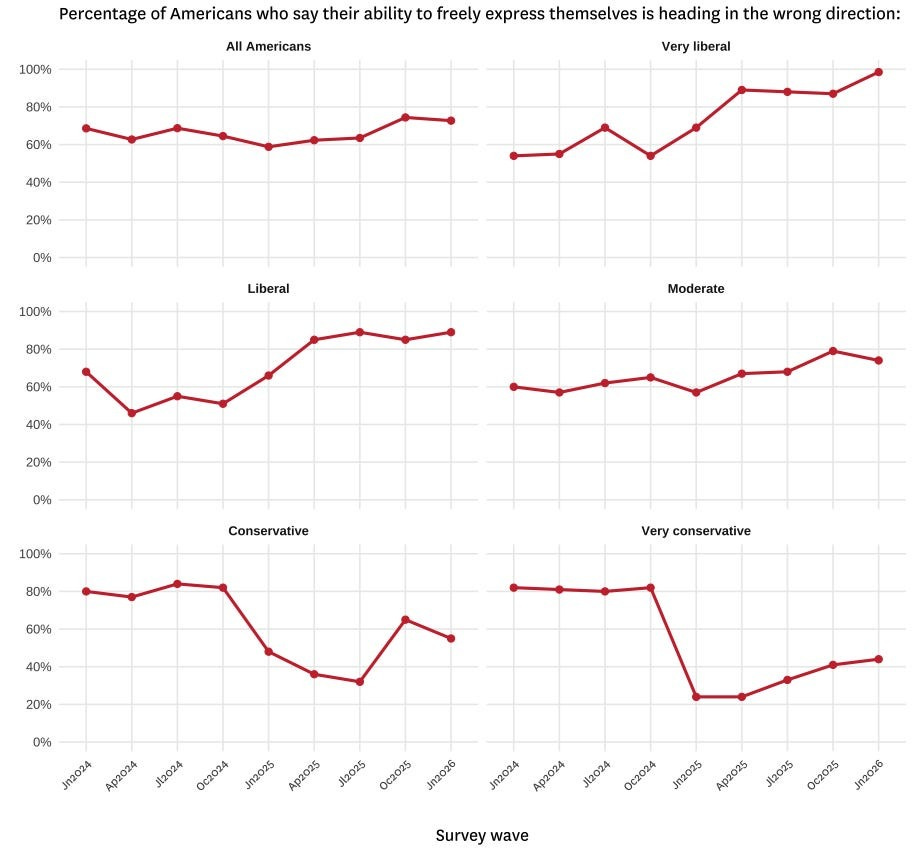
FIRE’s National Speech Index has been regularly taking America’s temperature on expressive freedom since January 2024 — and two notable trends stand out. Americans are more likely to say the country is headed in the wrong direction on free speech. Also, they’re losing trust that President Trump will protect their First Amendment rights.