


“Plaintiffs may struggle to prove jawboning because the government has secretly communicated with the private companies it is coercing. Americans may not even know they were censored by their government.”
— Senate summary of the JAWBONE Act.
FIRE backs JAWBONE Act
Senators Ted Cruz and Ron Wyden have introduced the bipartisan JAWBONE Act, backed by FIRE, which would allow Americans to sue federal officials who pressure individuals and private entities to censor lawful speech, a practice known as “jawboning.”
“Jawboning has proven to be an enduring, bipartisan problem, and we know we cannot rely on platforms alone to protect our rights,” Carolyn Iodice explains. “The JAWBONE Act empowers Americans to take their rights into their own hands.”
Illinois adopts social media tax
Illinois’ new budget imposes a first-of-its-kind tax on social media platforms, raising serious First Amendment concerns and setting the stage for a legal challenge. In his latest, Tyler Tone says the proposal uses a vague definition of social media, fails to clearly define key terms like “user,” singles out social media companies, and above all, is just plain unconstitutional.
We’re not surprised to see a proposal like this riddled with flaws. As states have attempted to turn around the losing streak social media regulation has faced in court, we’ve seen a number of half-baked schemes to find some kind of creative workaround . . . Fortunately for free speech, the courts aren’t impressed. An attempt to punish speech is an attempt to punish speech, any way it’s structured.
Diabetes society ejects researchers
The American Diabetes Association ejected several researchers from its annual conference for distributing copies of an editorial critical of President Trump that had been published in the ADA’s own journal. Aaron Terr weighs in:
Allowing conference attendees to hand out copies of an editorial is not the same as the organization itself promoting the editorial or adopting it as an official position. If the ADA really believes distribution of the editorial endangered its tax-exempt status, it raises an obvious question: Why didn’t the same concern stop it from publishing the editorial in the first place?
U. of Alabama shutters student mags
The University of Alabama shut down two student magazines last December — the woman’s magazine Alice and the black magazine Nineteen Fifty-Six — citing a nonbinding memo from then-U.S. Attorney General Pam Bondi that warned against “unlawful proxies” for discrimination.
“Freedom of speech and freedom of the press are fundamental to our nation,” writes Marie McMullan, “and there’s no place where these rights should be more valued and protected than on our college campuses.”
Below the fold
Florida’s wildlife agency enacted a social media policy that prohibits its workers from criticizing their employer.
Jane Fonda plans to host a New York concert this Sunday for free speech and democracy on the same day MMA fighters will have a cage match on the White House lawn to celebrate Trump’s 80th birthday and America’s 250th anniversary.
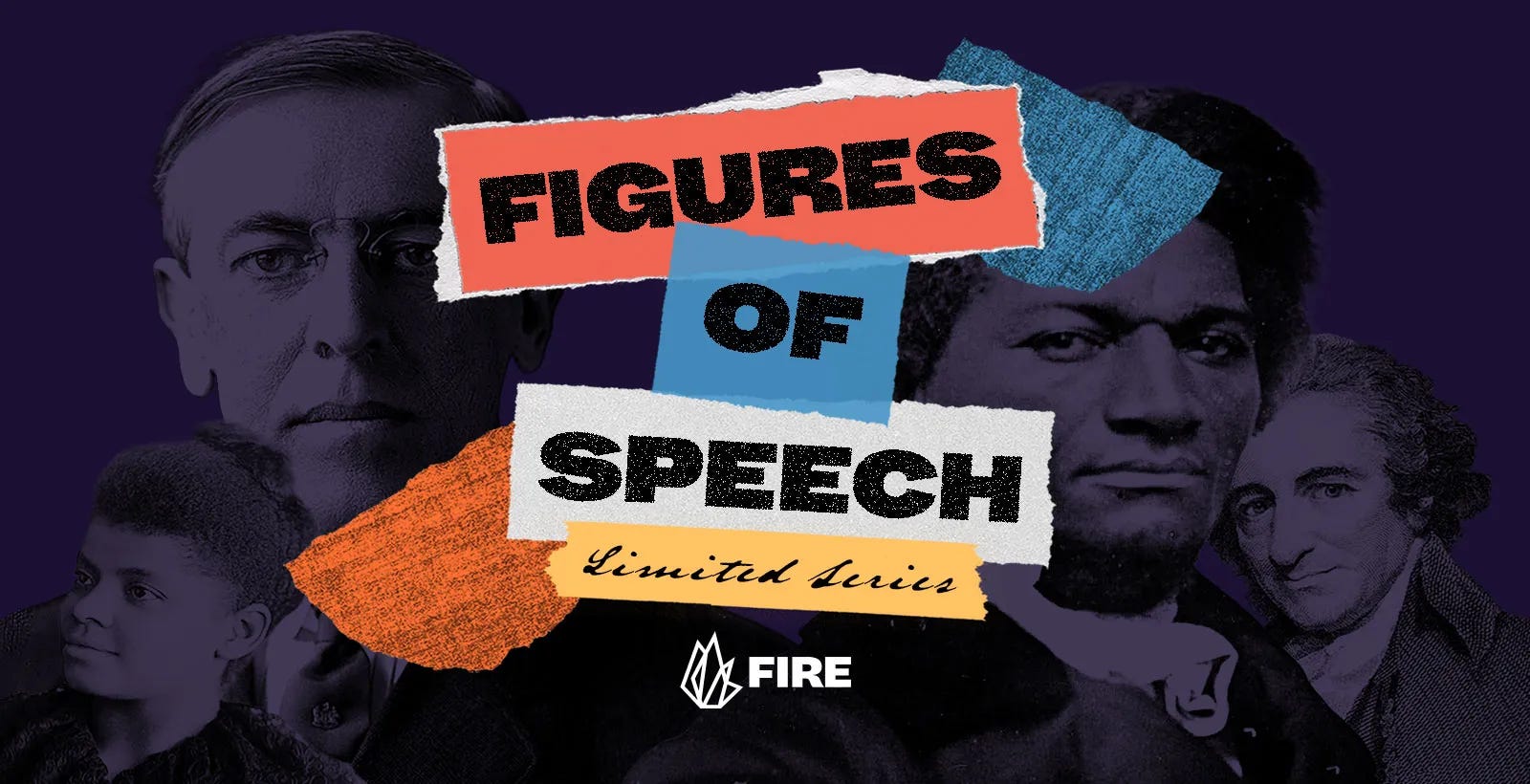
This year, the United States celebrates its 250th anniversary. To commemorate the occasion, FIRE is proud to present the limited series “Figures of Speech,” looking at the heroes and villains of free speech in American history. We began with Joseph McCarthy, the senator who scared America silent. Then we looked at Thomas Paine, American history’s winter soldier. Now we turn to Woodrow Wilson, America’s worst president for free speech.
Thousands of arrests, prosecutions, convictions, and even deportations for speech occurred under his stewardship and instruction. He had even successfully established the first modern propaganda institution in American history, which also controlled and stifled the dissemination of any speech counter to his preferred narratives. Wilson’s iron grip on American speech was short-lived, but devastating at a scale not seen before or arguably since. Continue reading…
Terms of service
The Free Speech App is a member-funded platform that aims to give everyday Americans a secure, anonymous way to share opinions, vote on issues, and influence policymakers without fear of social, professional, or political repercussions. The platform emphasizes verified membership, anonymity, no ads or data mining, and the goal of getting elected officials to pay more attention to the concerns of constituents, parents, and local communities.
In the frame
Speechless is a new documentary about the escalating battles over free speech and identity politics on university campuses. Directed by Ric Esther Bienstock and filmed over eight years, it follows professors, students, administrators, and activists across institutions such as Evergreen State College, Stanford, Harvard, Cornell, and New College of Florida as they navigate various controversies. The film argues that universities have become ground zero for broader cultural conflicts, showing how pressure from the political left helped provoke a powerful conservative backlash.
But rather than taking a simple partisan side, Bienstock explores how intolerance, censorship, and institutional failures can emerge across the ideological spectrum, ultimately asking whether universities can still serve as places for open inquiry and debate. And like any good documentary, it offers no easy answers.
So to Speak
So to Speak: The Free Speech Podcast takes an uncensored look at the world of free expression through the law, philosophy, and stories that define your right to free speech. Hosted by FIRE’s Nico Perrino.
In this episode, Rainey Reitman joins the show to discuss what happens when people are denied access to financial services because of their lawful speech. Reitman is the author of Transaction Denied: Big Finance’s Power to Punish Speech, which looks at how financial companies like Visa, Chase, and PayPal police silence speakers.
Blessings of Liberty
Bestselling author and constitutional scholar Jeffrey Rosen’s new podcast, The Blessings of Liberty, explores constitutional history, Supreme Court debates, and the “American Idea.”
In this episode, Stephen Breyer, retired associate justice of the Supreme Court, joins to discuss our republic’s founding principles, the First Amendment, and the pursuit of happiness. He also provides a preview of his upcoming memoir and his foreword for the NCC’s new volume, The Promise of America: Reflections on Our Enduring Ideals.

This week in history
On June 15, 1215, following a rebellion against his abuses of power, King John of England was forced by a group of nobles to accept the Magna Carta. This landmark document said that no one — not even the king — is above the law. Clause 61 authorized a committee of 25 barons to seize the king’s castles and lands if he violated the charter. Imagine if our Constitution explicitly gave Congress the right to seize Mar-a-Lago if President Trump ignored the law.
The Magna Carta also said no free man could be imprisoned, stripped of rights, or punished except “by the lawful judgment of his equals or by the law of the land.” That one line helped inspire the concept of due process and echoes through the Fifth and Fourteenth Amendments, remaining one of the most influential legal ideas ever written. The general principles established in the Magna Carta later influenced the Declaration of Independence and the U.S. Bill of Rights.
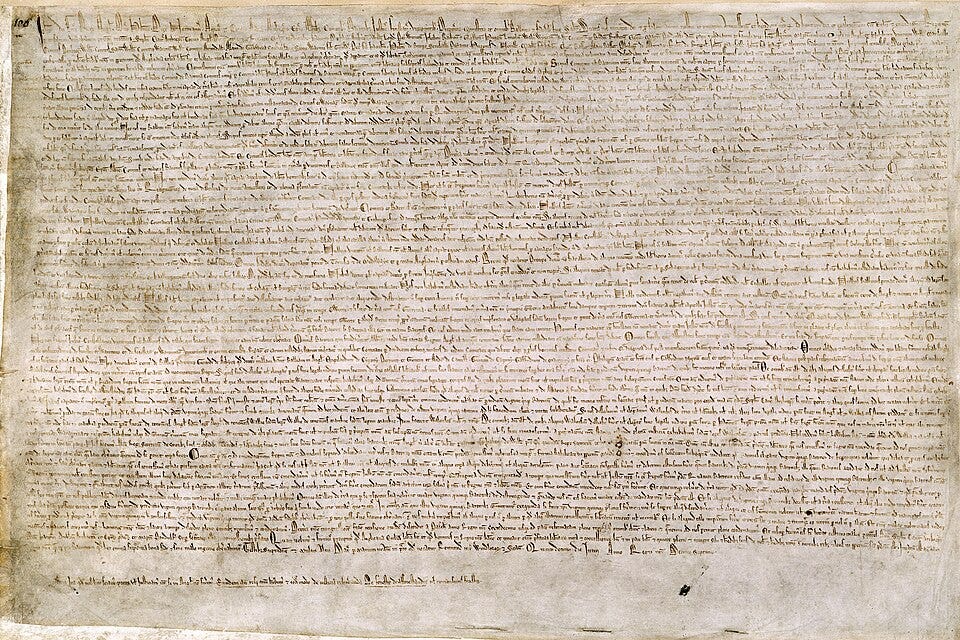
Its recognition that nobles could assemble and present grievances to the king foreshadowed the rights of peaceful assembly and petition that would later be protected by the First Amendment. In 2007, financier David Rubenstein bought a rare 1297 copy of the Magna Carta at a Sotheby’s auction for $21.3 million. He then loaned it to the National Archives in Washington, D.C.
By the numbers
Law professors earlier in their careers are more likely to keep certain opinions to themselves. As seniority and job security increase, self-censorship declines. But one group breaks the pattern. Adjuncts and lecturers report less self-censorship than any rank of tenure-track faculty. They’re also more comfortable discussing controversial topics and less worried about reputational harm from being misunderstood than even chaired and distinguished professors. This week, Nate Honeycutt dives into the data and comes back up with a surprising explanation.