


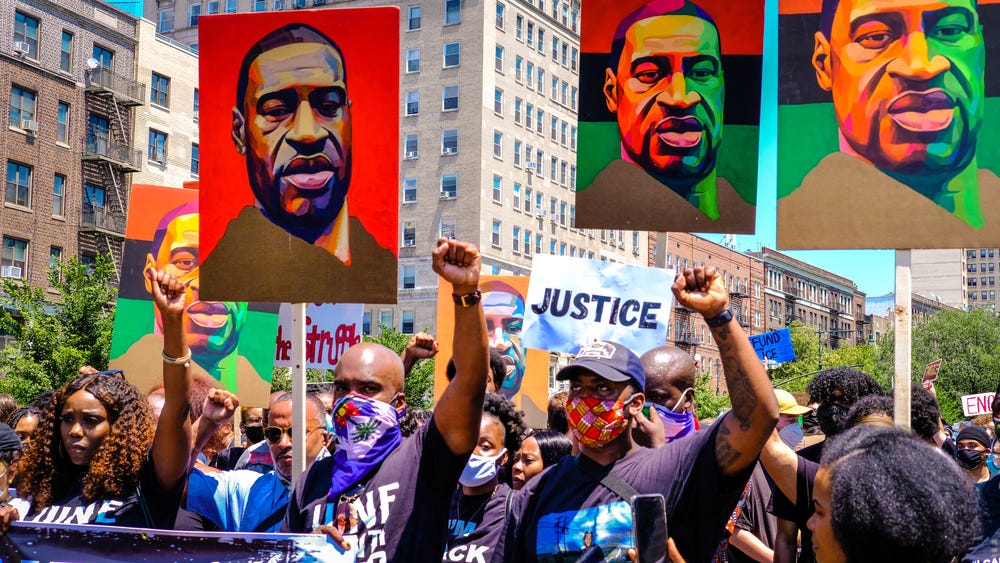
The assassination of Charlie Kirk at Utah Valley University last year sparked a wave of anger directed at scholars for their public comments following Kirk’s death. This reaction was faster, more targeted, and more severe than the response following the murder of George Floyd in 2020.
Relatively few professors faced significant consequences for comments about Floyd himself. On the other hand, Floyd’s death appears to have spawned a broader, more sustained sensitivity to race-related discourse. In the months and years that followed, scholars who addressed racial issues — even when not speaking directly about Floyd — faced growing public backlash, administrative investigations, and in some cases, dismissal, as seen in the case of Charles Negy, who was fired, and Gordon Klein, who was placed on administrative leave.
It’s important to note that the data on race-related sanctions in 2020 covers the entire year, whereas the data on Kirk only spans about four months. In this compressed timeline there were 92 scholar sanction attempts, 44 sanctions, and 21 terminations. Notably, all 21 scholars who were terminated for their comments about Kirk had expressed views critical of him and were targeted by right-leaning activists, media outlets, politicians, administrators, and students. For example:
Tamar Shirinian, a professor of anthropology at the University of Tennessee, Knoxville, posted on Facebook that “the world is better off without [Kirk] in it,” prompting outcry from lawmakers and media figures, and resulting in her termination.
Darren Michael, a theatre professor at Austin Peay State University, re-shared a 2023 Newsweek headline quoting Kirk as saying that gun deaths were “unfortunately” necessary to preserve the Second Amendment, after which critics claimed the post signaled tacit approval of Kirk’s killing, Tennessee Senator Marsha Blackburn labeled it “reprehensible,” and the university fired Michael, condemning his post as “insensitive, disrespectful, and interpreted by many as propagating justification for unlawful death.”
Lisa Greenlee, an instructor at Guilford Technical Community College, appeared to joke about Kirk’s death in a video that circulated online, prompting prominent political figures, including U.S. Representative Mark Walker and Representative Virginia Foxx, to call for her removal, after which Guilford Tech fired her.
Scholar sanctions hit a record high in 2025, with the aftermath of Kirk’s assassination being one of the primary contributors.
The long-term impact of Kirk’s assassination on campus speech — particularly for faculty — remains uncertain. A FIRE survey of 2,028 undergraduates, conducted Oct. 3–31, 2025, revealed a striking finding: while 81% of Utah Valley University (UVU) students opposed firing a hypothetical professor who said, “We are going to make America great again,” 57% of UVU opposed firing one who said, “These fascist Bible thumpers want to drag us back to the Dark Ages.”
When the survey results were broken down by political ideology, clear partisan divides emerged. Most liberal students opposed firing hypothetical professors who said, “It’s O.K. to punch a Nazi” or “These fascist Bible-thumpers want to drag us to the Dark Ages.” Similarly, most conservative students opposed terminating professors who said things like, “We are going to make America great again” or “Our colleges and universities are progressive indoctrination centers.” These differences suggest that what people consider acceptable speech often aligns with their politics rather than any consistent commitment to academic freedom.
Free speech after Floyd and Kirk: A call for consistent principles
The shift from left-leaning scrutiny over George Floyd to right-leaning backlash over Charlie Kirk reveals more than just ideological whiplash. It underscores the volatile, politicized landscape of academic speech in America. As faculty face growing pressure from all sides, the principle of intellectual freedom hangs in the balance.
If we want universities to remain spaces where difficult conversations can unfold, we must protect the right to speak — even, or indeed especially, when that speech is offensive. True academic freedom cannot depend on which side holds the cultural or political majority. In this polarized moment, recommitting to dialogue over censorial punishment may be our only path forward.

I think the general tone of the questions in the second survey have some bearing in the view of the responses. You have one, arguable two, that have fairly clear cut negative connotations, with one being outright violent. In the other two, one is on its face positive while the other has a negative connotation and may have *some* basis in fact, but neither does anything the way of advocating violence. The way I interpret the results of the poll is that left-leaning students seem to tend to agree with allowing more violent rhetoric when they agree with it while they don’t necessarily disagree with silencing speech they don’t like regardless of the implication of violence. Conservatives on the other hand seem to disagree with the advocacy of violence and the seeming negative view of their political or religious beliefs where ad hominem rhetoric is used to describe those beliefs. I think the questions posed or at least how they’re worded matters in why the responses were the way they were.
Forms of academic freedom are critical but they are not the mission of the university which is above all the search and development of useful facts, that is, knowledge. A professor’s speech may indicate the quality of intellect, which is an important trait to consider in relation to the mission. If the mission is Marxism, DEI or social justice, the same concept applies.