



We recently saw that there’s a strong relationship between religion and political tolerance, measured by asking student believers whether they’d allow various hypothetical controversial speakers on campus.
But that article had an important omission: it focused mainly on about a dozen “normal” religions. But when we asked about religion, we gave students an option to select “other” and write in a response. It turns out that a small number of students who took our survey possess…far more evolved spiritual beliefs. When asked what their religion was, their answers included:
Baseball Gods
CHRIST IS KING
Disciple of Cthulu
Fuck off
I believe in GOD!
Pastafarian
im in direct communication with god
All of the above, believe in every religion
I forget
Satanist/Atheist
Witch
Right out of the gate, we have some strong evidence for my theory that all the wisdom academia used to contain has been concentrated into these 11 people, but we should probably double-check whether their esoteric beliefs lead them to tolerance. Let’s give tolerance scores for each individual, with 100% corresponding to those who would definitely allow all the controversial speakers listed, and 0% definitely allowing none:
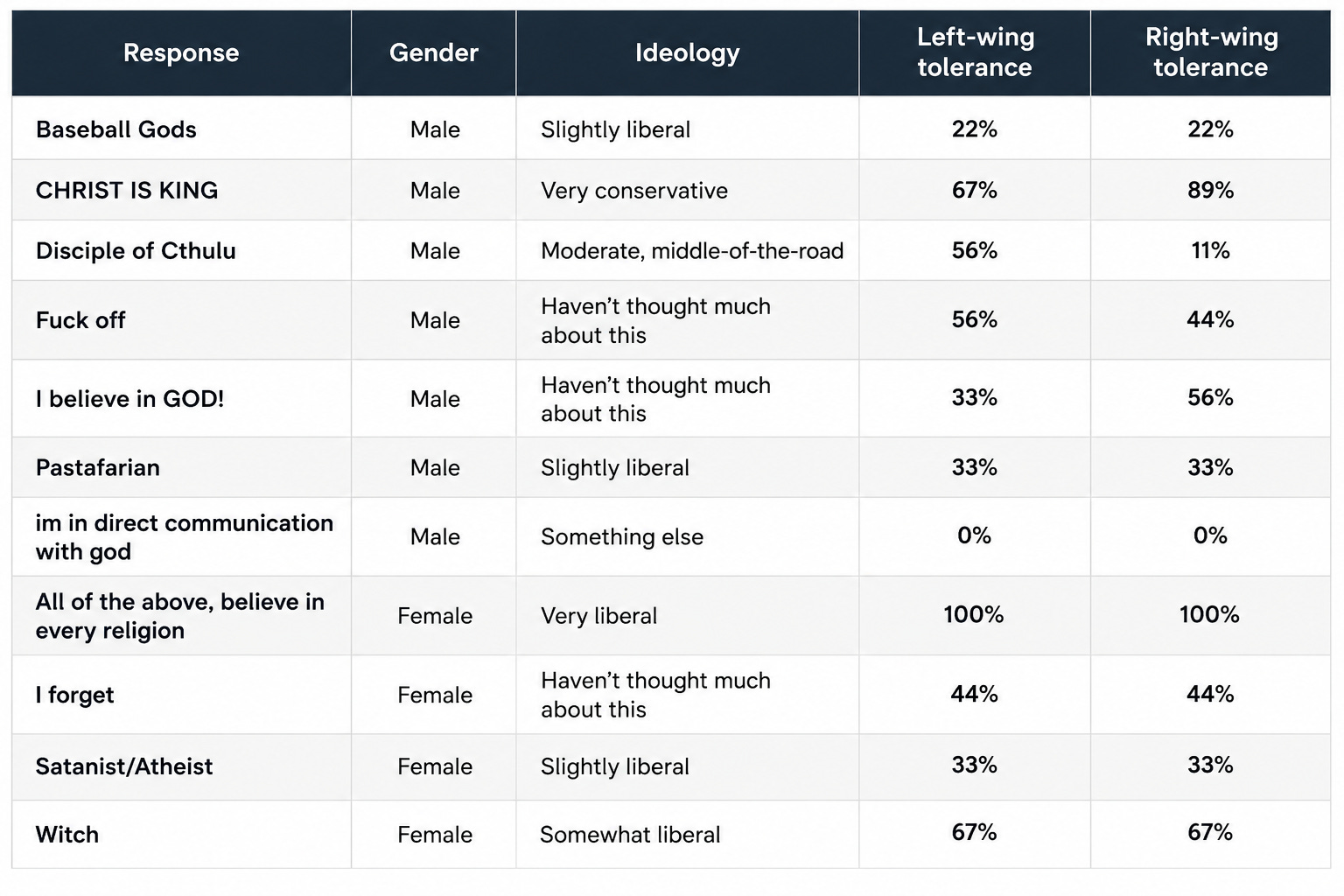
Notice the person who registers 0% tolerance for left- and right-wing speakers. So if God is whispering directly into your ear, that might be a bad sign. That one’s a big shock to me too. And Cthulhu, a primeval tentacled cosmic-horror god-monster, seems to like speakers on the left significantly better than those on the right. Probably doesn’t mean anything though.
Okay, if we’re seeking to understand why people do and don’t support free speech, seeing what kind of personality traits and behaviors are associated with that support could be really useful. And this sort of open-ended-response data gives us, albeit in a very limited and noisy way, just that: a direct measurement of (some) students’ behavior.
We have a lot more than just joke responses. Many of the responses were “normal” religions not included in the options provided, such as Sikhism. Some were conventional but uncommon religions, such as Hellenism. Some people provided explanations of various levels of detail, with the longest being 56 words. And some, of course, forgot what religion they were.
You might be wondering whether the people who give joke responses are actually taking the rest of the survey seriously. Based upon correlations between items where I expect to see correlations (such as party ID and ideology), and responses to other potential opportunities for joke responses (such as an open-ended self-censorship question and number of friends), I’m inclined to say that most, but not all, joke responses took the survey seriously, but it’s hard to be absolutely sure.
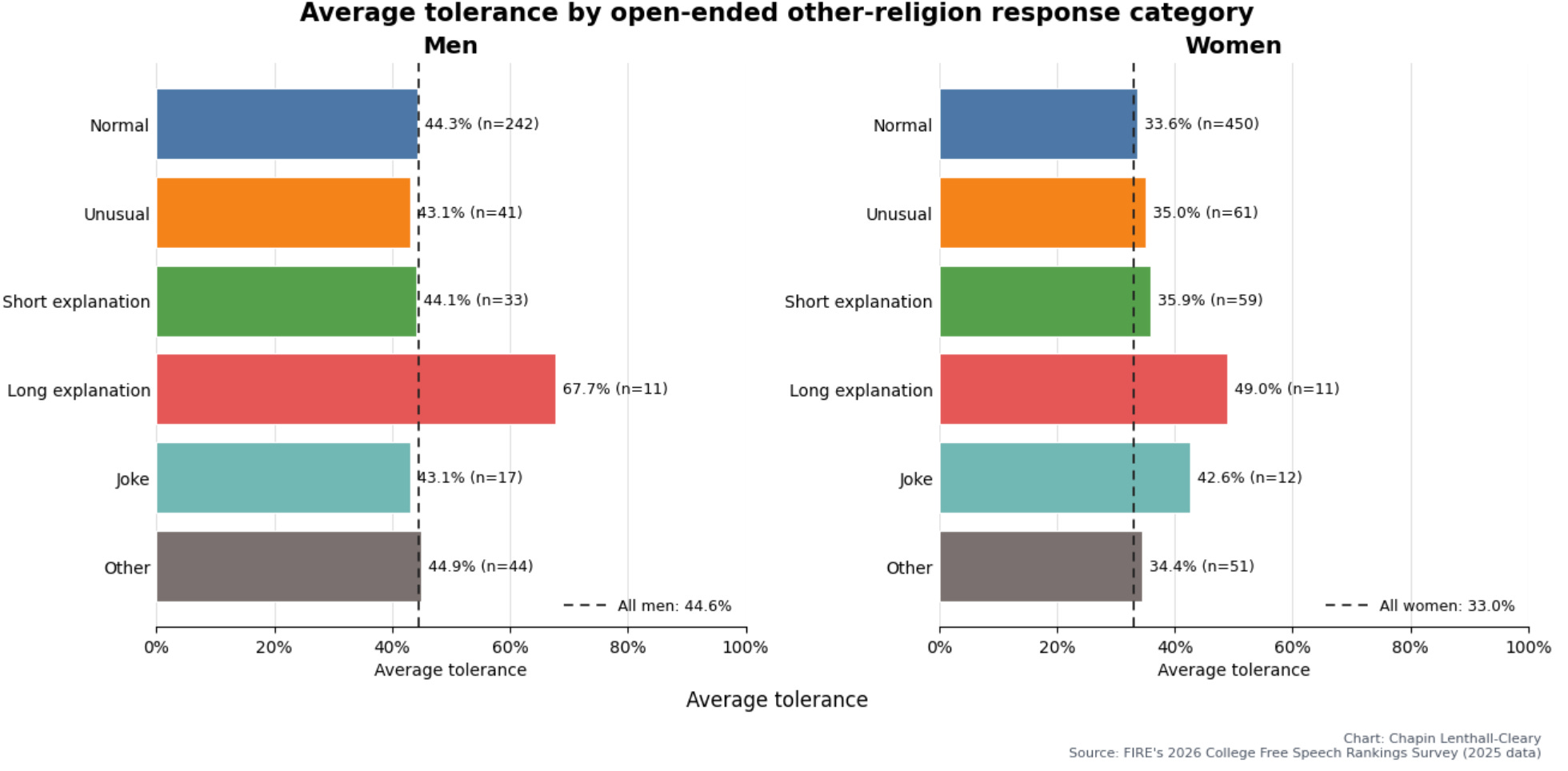
These seem like importantly and interestingly different groups of people. So how tolerant is each group?
For those of you who are wondering, the categories don’t have perfectly rigorous definitions. Perhaps you disagree with my classifications; there is, for instance, a good argument that Pastafarianism should count as a normal, serious religion. If so, I encourage you to re-classify the responses and rerun my analysis; the data is here.
Buy something nice for the pedant in your life.
Among both sexes, those who gave long explanations are unusually tolerant (the dashed lines are averages for all students of that gender, not just those with open-ended religion responses). We saw before that people who report their religion with more precise categories — Protestant instead of Christian, Atheist or Agnostic instead of “nothing in particular” — tend to be substantially more tolerant. The substantially higher tolerance scores from those who gave long answers corroborates the idea that something related to giving long or precise answers — maybe thoughtfulness, or thoroughness, or tendency towards rigor, or something else — is related to support for free speech. And while it’s a small sample, it’s quite a strong effect. In fact, the average man who gave a long explanation would be slightly more tolerant than someone who said all speakers should probably be allowed to speak on campus, with nearly half saying all speakers should definitely be allowed. That’s…remarkably good.
Notably, the above plots use the average of left- and right-wing tolerance. That’s the single cleanest and easiest number to use (and allows for better comparisons across ideologies), but it also treats someone who is tolerant of speakers on only one side the same as someone who is equally tolerant of speakers on both sides, provided their averages are identical. We can address this by looking at minimum tolerance:
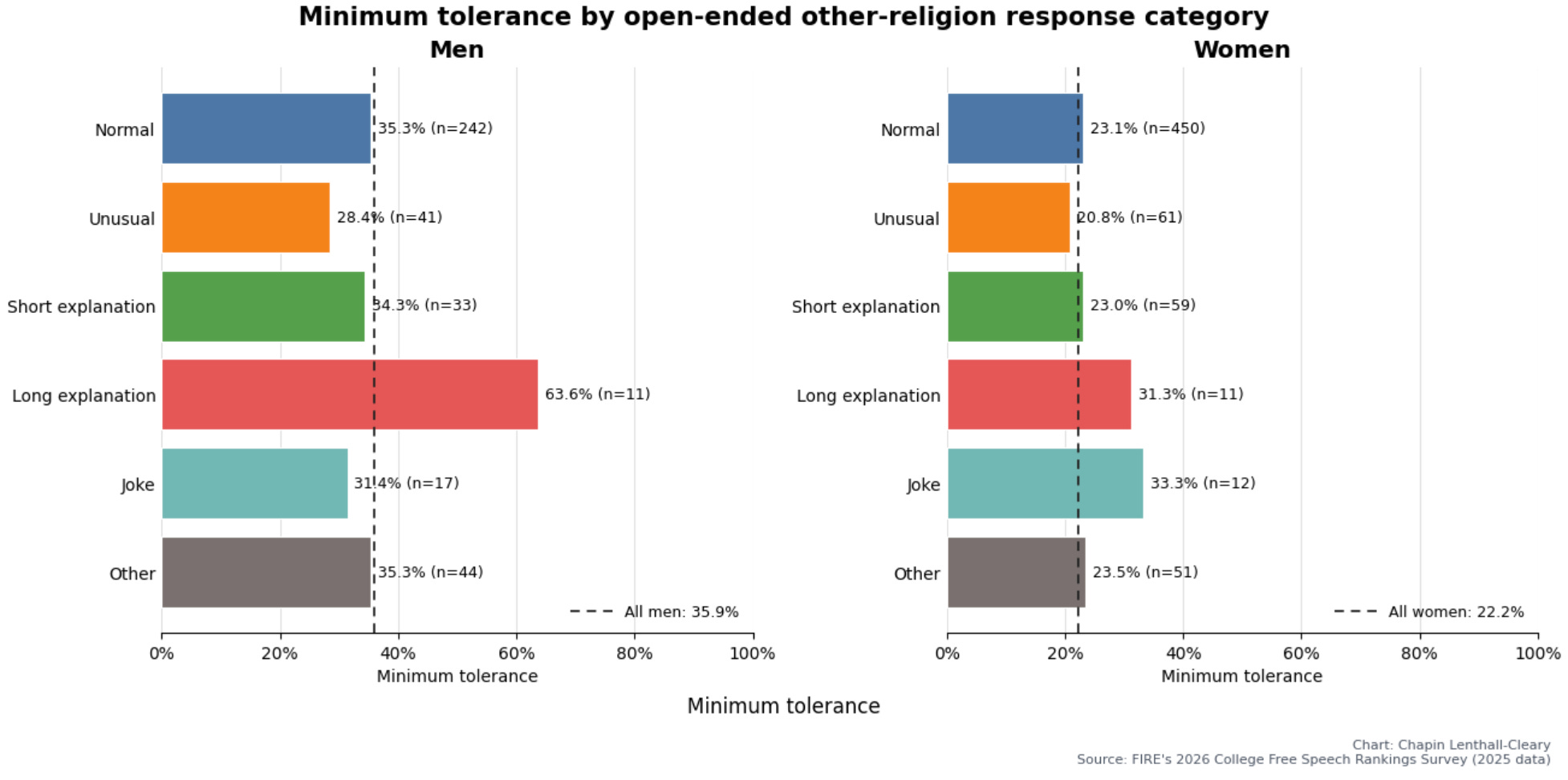
Using minimum tolerance, some of the effects are even starker. Despite men in our survey overall being vastly more tolerant than women on average, women who gave joke responses were more tolerant than men who gave joke responses.
Obvious cautions given the small ns, but still quite an effect. Worth noting that the unusually high tolerance of long answers comfortably meets the p < .05 threshold often used for statistical significance, though the “joking women beat joking men” claim doesn’t.
I’m not immediately sure why this is; if I had to hazard a guess, I’d say that among men, not taking this sort of thing seriously is lower-hanging comedic fruit, whereas joking about religious beliefs may come less naturally to women (indeed, giving joke responses at all was rarer among women, especially when considering that women outnumber men in our sample).
So what’s special about those who gave long responses that might be causing their increased tolerance? Let’s look at what they said, starting with two perfectly tolerant men argued against our classification scheme:
Anglican. Common mistake that there is an assumed binary between Catholic and Protestant (Anglican is neither)
Lutheran (LCMS) (the original Protestants, who are very different from Baptists, Methodists, Pentecostals, and especially Jehovah’s Witnesses, who are not Christian. I will not select an option that includes Jehovah’s Witnesses in the list of examples.) (By the way, JWs don’t even consider themselves to be Protestants either: https://www.jw.org/en/jehovahs-witnesses/faq/are-jehovahs-witnesses-protestants/)
Two other perfectly tolerant men:
Believe in God, don’t subscribe to a specific religion. But certainly not Athiest[sic] or Agnostic
Don’t do religion as that’s slavery to control the masses ... I have a soul and into high level spiritualism and metaphysics.
And one perfectly tolerant woman:
Wouldn’t consider myself LDS but I participate in that church.
They all seem thoughtful and independent-minded (whether by not adhering to a particular religion or by challenging the survey’s classification scheme), yet they mostly seem fairly community-oriented (three of the five attend religious services several times a week). Granted, part of those effects are maybe to be expected from the mere fact that we’re selecting for long responses (there’s more opportunity to seem thoughtful when you have a longer response). So what about the long responses from those who aren’t so tolerant? What’s different about them?
There are two such men:
I believe that interpretation (the act of bridging the gap (communicating between two entirely seperate[sic] souls)) is god. Art is religious ritual because it engages in interpretation. interpretation is the unknown that affects our lives for eternity — it is the single unknown that rules our universe and therefore is god.
Agnostic: I believe that there’s some higher power out there but there is no evidence of what it is.
Seemingly misusing the term Agnostic (which means unsure whether god exists, not unsure what form god takes). Notably, one of the perfectly tolerant students had a similar answer, but used the term correctly.
There’s some room to make arguments about whether one can believe one thing, but know another. If so, it’s plausible that the student above meant “I know there’s no evidence whether god exists, but I believe anyway,” which arguably should count as agnostic. Impossible to be sure what he meant, but I think the just-misusing-the-term reading is the most plausible here.
And three women:
raised methodist — not practicing anymore
Scholar of different religions, started Christian
Grew up catholic and no longer religious
All three used to be some sort of Christian, and aren’t anymore, and two are clearly non-religious now.
Indeed, all five responses seem to lack all the qualities I pointed out about the tolerant responses. They lack the (sometimes argumentative) tendency towards precision or rigor. None of them have the same obvious signs of community involvement, and I’d argue that they lack the independent-minded-ness too. Granted, one might respond that leaving Christianity demonstrates independent-minded-ness. Given the (alleged, I haven’t seen research on or looked into the topic) cultural pressures against Christianity in some social circles, I’m not so sure.
Obviously we should be very hesitant about drawing confident conclusions from small-n sentiment analysis, but those two groups seem to me maybe a step removed from night-and-day. On one side, we have two religious-classification-nitpickers, a freethinking Mormon-adjacent woman, a unique individual into “high-level…metaphysics,” and a guy who knows what “agnostic” means. On the other, we have two religious backsliders, a third person who’s possibly arguably also a religious backslider, a unique individual into art, and an “agnostic.” Anyone else not surprised which group is more tolerant?
There’s a final question we haven’t touched on yet, and it’s the most important of all: exactly which speakers did the Disciple of Cthulu want to allow on campus? He definitely wouldn’t allow “Transgender people have a mental disorder” or “Black Lives Matter is a hate group.” Looks like Cthulhu would fit right in at the sensitivity training. And he probably wouldn’t allow three other speakers.
But he definitely would allow the speaker who said, “The Catholic church is a pedophilic institution.” Not sure whether Cthulhu would think this is a knock on the Catholic church or some kind of selling point, but it sure wants everyone to be able to hear about it.
The code, data, and codebook used to create this article are here.

That there were no members of the Church of the SubGenius or HyperDiscordians is everything that's wrong with the youth today.
This made my day. Funny and smart is good.
I was raised in a non-observant, reform Jewish family - culturally Jewish - 2nd and 3rd generation immigrants - by atheists who were not fans of organized religion but acknowledged their roots. Skeptical of Zionism. The family mantra was Respect Individuals, Question Authority. I identify as a grateful agnostic and as libertarian, classical liberal, anarcho-capitalist, etc. Try hard not to stereotype groups by the bad actors who get all the publicity, but draw the line at puppy mill owners. And the government administrators who have stolen money and mismanaged projects for the Veterans Admin. Everyone has their demons, I guess.
My dad would lecture us on the importance of free speech and tolerance for differing opinions and civil discourse, even with perceived enemies, during the turmoil of the 60s. I think his undergraduate and graduate degrees at the University of Chicago in the 1940s had something to do with his beliefs, but maybe more that he was that way when he arrived.
Watched my mom laugh at bigots, including American Nazis in full uniform, as if they were wayward children - not hatred, just exasperation. They both would have appreciated FIRE as I do.
My bias: I tend to see Left and Right activists as different manifestations of the same philosophy - feeling as if they have the God-given right to control the property and private lives of other people, even when those people do not aggress on others. Take from A involuntarily, give to favored B. And so on. But in terms of free speech, yes, invite them all to campus. Even the bad actors. Don't boo them. Listen to them try to justify their actions, even, to quote my dad, the idiots. Even the puppy mill owners.