


This post builds on a previous one about gender and tolerance, so I recommend starting there if you haven’t already read it.
In our surveys assessing university student tolerance for hypothetical controversial speakers, most students have not wanted to allow most speakers on campus. You can almost hear someone saying, “These kids today are too soft. Send ‘em to boot camp!” The funny thing is, that might actually help.
One would hope that military duty would make people more principled defenders of free speech. But it also seems plausible that strict military hierarchies could make people more willing to use authority against dissent. So which is actually true? As usual, that’s tough to confidently answer with our data, but a related question is much easier: Are military students more tolerant?
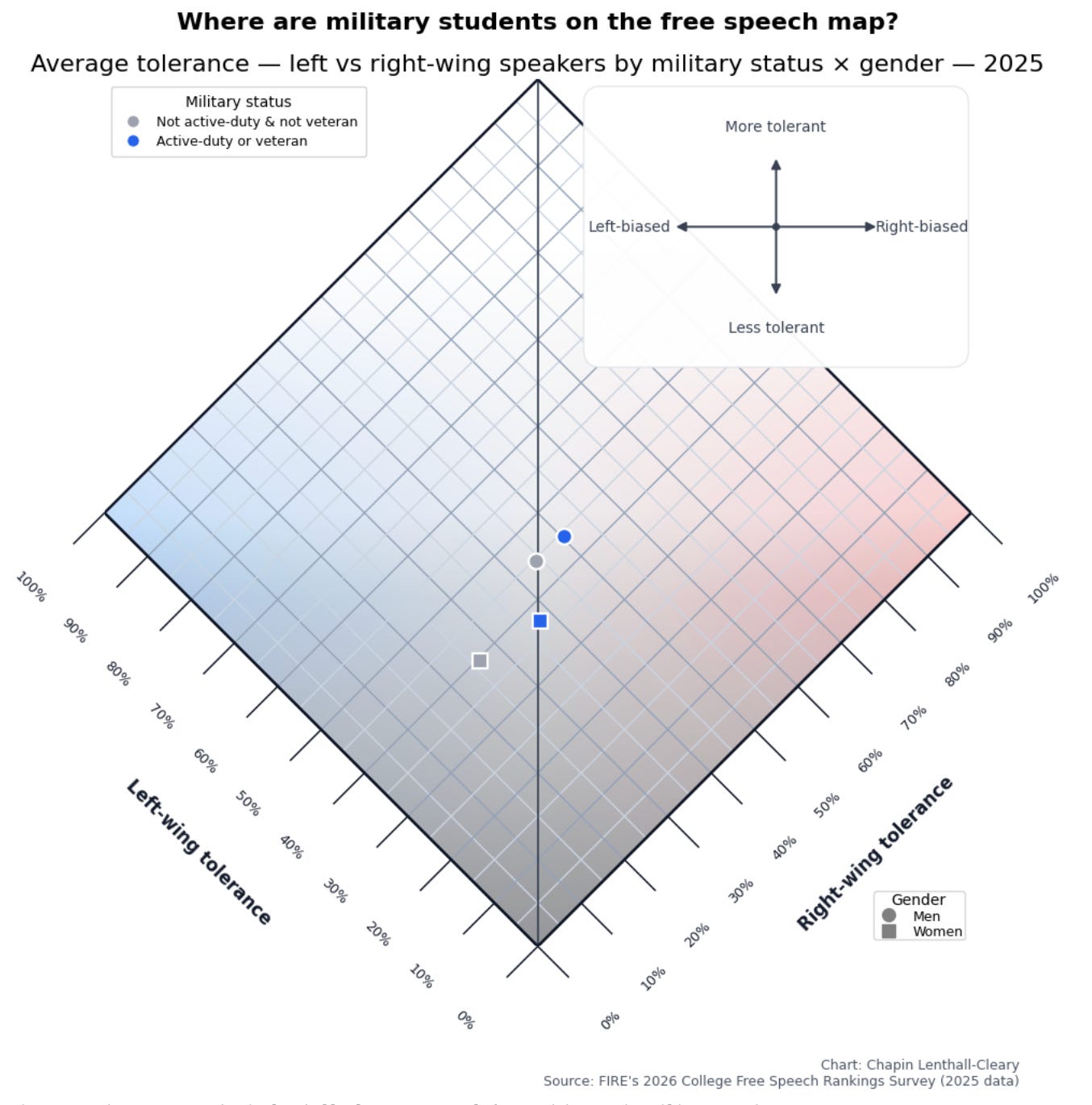
Okay, that’s hardly shocking. Military students are, on the whole, more right-biased than others, and a bit more tolerant. But what if we break down the data according to ideology?
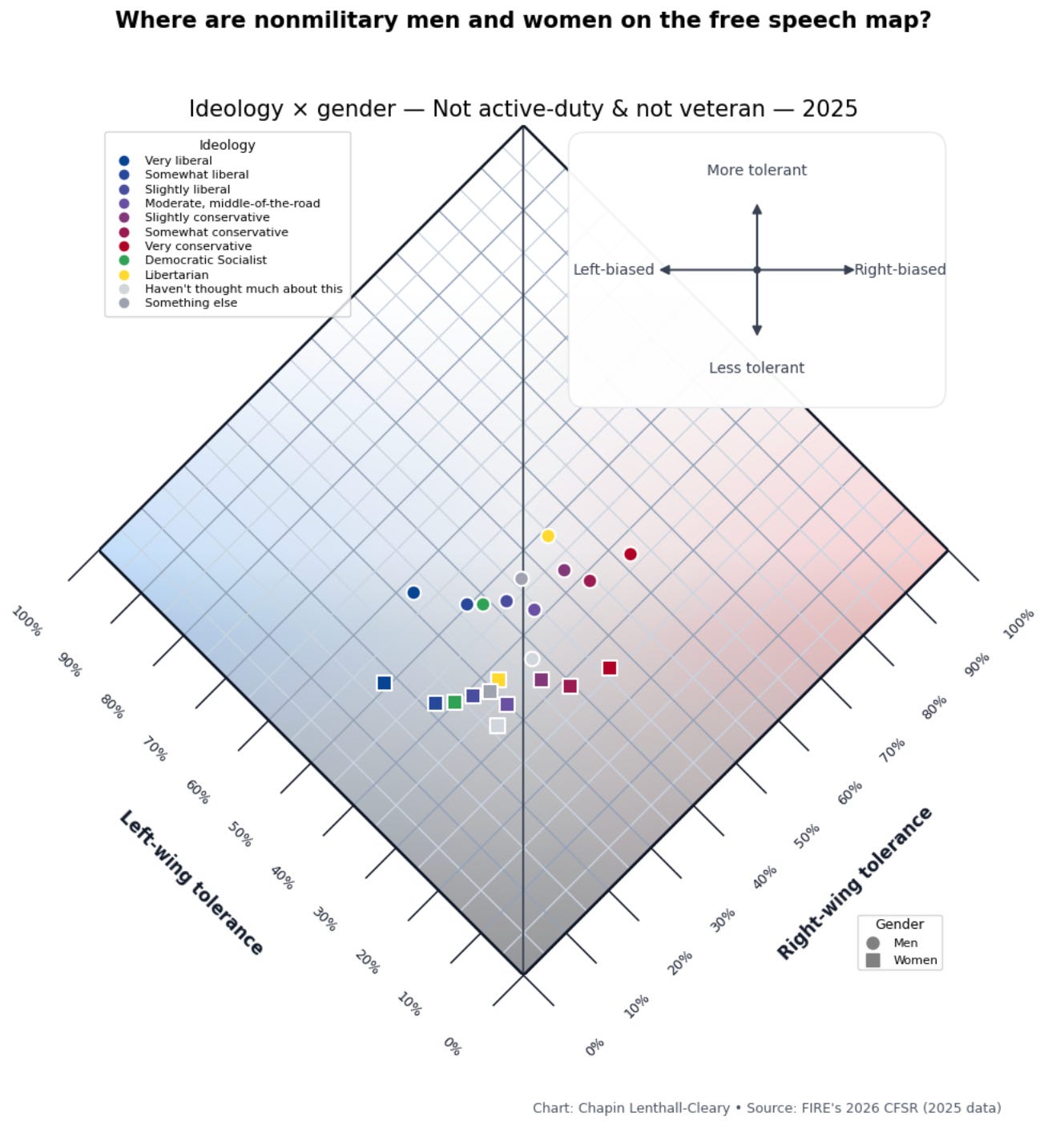
This looks very similar to the free speech map for gender and tolerance. Given that most students aren’t military (note the plot title), this is expected. So where do military students place?
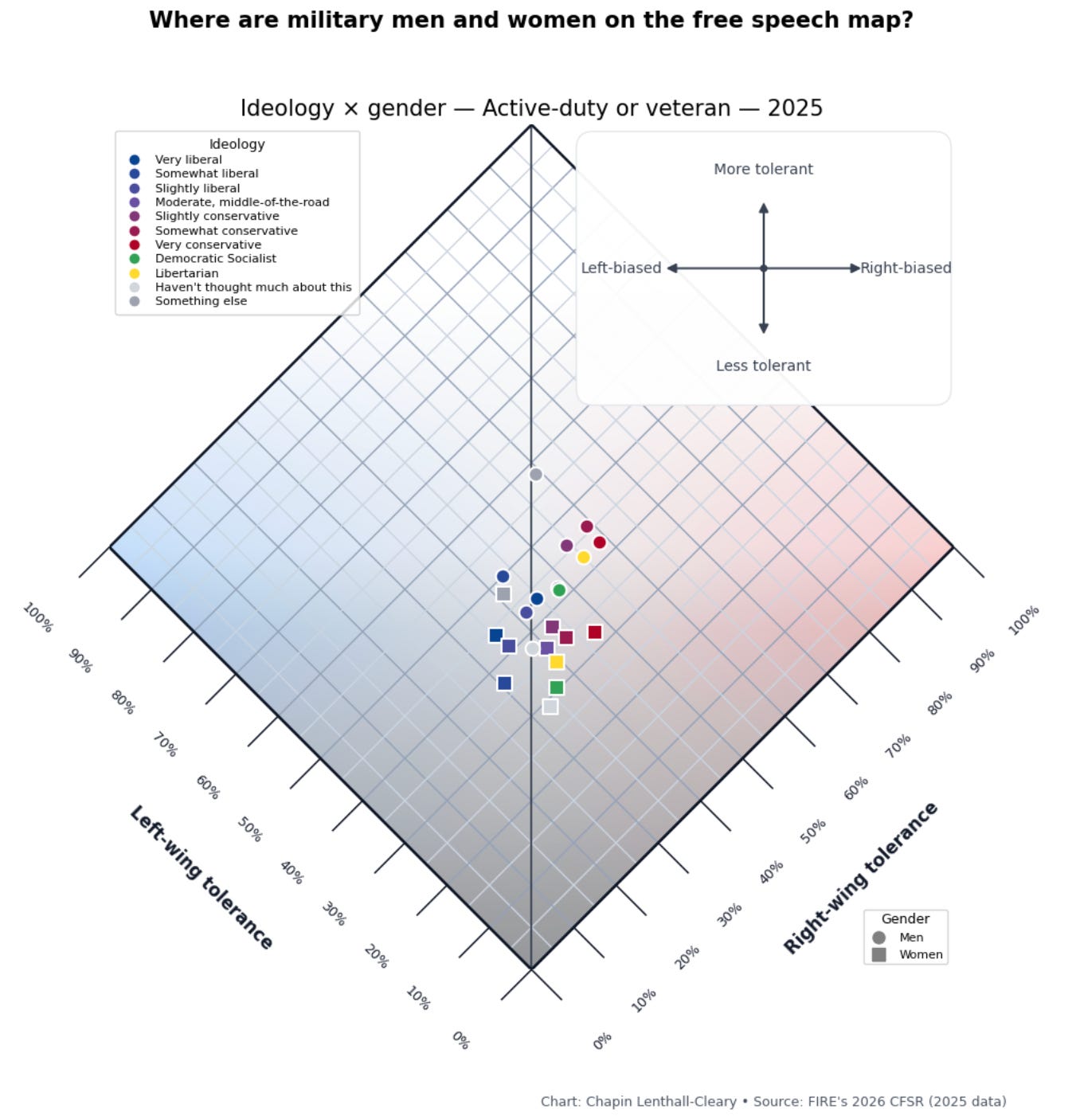
Not a silver bullet, but that’s quite a result.
Military students are only a bit more tolerant overall, but they are significantly more fair to their political opponents. Male military students have 21% less tolerance bias than their civilian counterparts. Female military students have 29% less tolerance bias. (This is controlling for ideology. If you don’t control for ideology, then military men are 16% less biased than civilians while military women are 32% less biased.)
Two things to note here. First, there are 676 men and 526 women in this dataset. That’s a small enough sample that you shouldn’t put too much trust on any particular point (particularly when split by ideology). But it is high enough that the general pattern is very probably an accurate description of reality.
And, as usual, this doesn’t prove the direction of causation. Maybe being in the military decreases bias and increases tolerance. Or maybe students who are less biased and more tolerant are disproportionately likely to join up for the military. Or both.
It’s a common refrain that everyone is biased, and people are doomed by their own perspectives to never be fair judges towards ideas they oppose. But the data here reminds us that some people are significantly fairer than others. And if military experience indeed causes a decrease in bias, perhaps a principled impartiality really is a teachable skill.
The code, data, and codebook used to generate these plots are available here.
