



The FIREwire is a weekly news roundup of the biggest stories involving free speech, as well as reports, essays, fresh data, and original analysis.
A note: starting this week, the FIREwire will only contain headline news and data. For essays, movies, podcasts, history, online debates, and reader comments, please see our new weekend edition, FIREside, arriving Saturdays.
Pentagon fires Stars and Stripes editor
The Pentagon fired Stars and Stripes editor-in-chief Erik Slavin for “insubordination” days after he told CBS he would not run a Pentagon-written story in place of an accurate one. It then fired publisher Max Lederer and reporter Lara Korte too.
As Jacob Gaba reports, the firings capped a year of quieter work. In January, the Defense Department pulled the decades-old regulation requiring the paper operate freely, and a March memo expanded departmental oversight over editorial decisions.
In Vietnam, one senior officer’s standing complaint about Stripes had been that its reporters asked questions. It seems little has changed.
Below the fold
A federal appeals court ruled that a New Hampshire district likely violated the First Amendment by punishing parents who wore pink “XX” wristbands to protest a trans player being fielded on the opposing high school soccer team.
A Nebraska student’s cartoon criticized ICE, his school district pulled it, and when FIRE objected, they put the whole newsroom under prior review.
Massachusetts has a new law requiring due process before a complaint can get a library book removed. Wicked good move, Mass.
A Michigan city won’t give FIRE the Facebook posts that had its commissioners threatening to sue residents, calling them too “emotionally offensive” to release.
The Committee to Protect Journalists (CPJ) says online ads can now be used to track journalists, map their contacts, and expose their sources.
Around the world
Britain keeps prosecuting blasphemy without having a blasphemy law. As Sarah McLaughlin reports, retired police officer Stephen Gray was fined more than £1,000 for reposting a Facebook meme mocking Muslims over child marriage, while Hamit Coskun, who burned a Quran and was attacked in the street for it, beat the resulting charge only after an arrest, a conviction, and two appeals. Britain doesn’t need blasphemy laws when the process is the punishment.
Russia fined Meduza’s exiled editor Ivan Kolpakov for “participating in the activities of an undesirable organization.” Namely, the newsroom he runs.
Bangladesh will keep three journalists jailed until trial for crimes against humanity because they asked then-Prime Minister Sheikh Hasina about student protests in 2024, and she answered by likening protesters to the traitors who sided with Pakistan against Bangladeshi independence — an insult that set off riots killing up to 1,400, drove her into exile under a death sentence, and may result in three journalists being hanged for asking the question in the first place.
Congo’s M23 rebels banned media in the east they control from debating politics or covering the national government, and suspended Bukavu FM host Claude Kashonga for 45 days after he criticized rebels for seizing private homes.
Vietnam passed a publishing law this week, effective March 2027, redefining publishing as a technology industry and requiring AI labels for digital work.
Tech
A federal judge ruled the Pentagon’s “supply chain risk” label on Anthropic — imposed after the company refused to drop its weapons and surveillance guardrails — was unlawful First Amendment retaliation.
Also this week, Meta’s roughly $17 billion child-safety settlement brings curfews to teen accounts and age checks to everyone else’s.


By the numbers
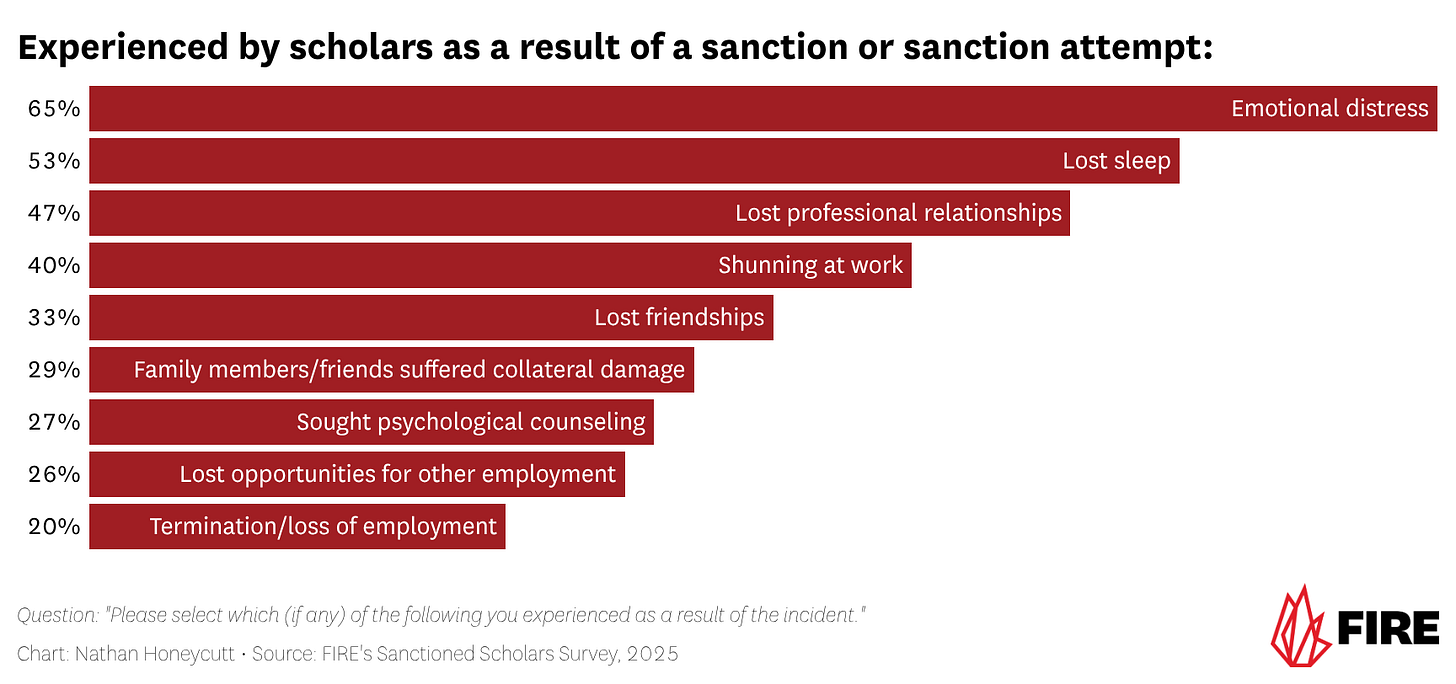
12%. That’s the share of sanctioned scholars who told FIRE their careers ultimately came out ahead — and even they described the experience as hell, including days without sleep and an inability to think about anything else. The other 88% got the version without the upside, and a new FIRE survey of over 200 faculty plus two dozen interviews finds the damage is rarely just professional.
Kudos to FIRE for highlighting the judges who highlighted the unconstitutionality of viewpoint discrimination by a New Hampshire school district. Isn't it time that FIRE also said something substantial about the flagrant and very common viewpoint discrimination by judges?
Almost a week ago, on Aug. 23 David Lat (a member of FIRE's Advisory Council) highlighted that on Aug. 18 a veritable militia of retired federal and state judges tried to have an attorney sanctioned based expressly on viewpoint discrimination.
128 retired judges sought to have an attorney "disciplined" for his speech, and with their own words they condemned themselves (and Florida's Supreme Court and the highest courts of other states). They proved clearly and convincingly they were motivated by unconstitutional viewpoint discrimination. They repeatedly focused on speech that they thought might merely "impugn" the purported "integrity" of a judge. They focused on attorneys' "making disrespectful" so-called "attacks on judges" instead of providing mere "respectful critique" of "rulings." They repeatedly focused on "statements" that "disparage the judges," "disparaging remarks against a judge;" "disparaging comments" and “ad hominem attacks on the judiciary." Some 21 times, the judges' letter used some variation of the word "attack." Viewpoint discrimination permeated their letter and condemned them, their complaint and the courts and judges who have acted on similar sentiments and words.
The truth about the Florida rule, itself, is that it is the epitome of unconstitutional viewpoint discrimination. All such so-called "rules" of every state (targeting attorney speech that merely "impugns" the "qualifications or integrity" of actual or potential public servants) clearly and irrefutably violate our Constitution. They expressly target only criticism (not false flattery) of judges.
Regarding this issue, it is very well worth thinking about what made the Sedition Act of 1798 unconstitutional. Many people like to say the Act was unconstitutional. But very few can say why. The reason is highly relevant here.
In New York Times Co. v. Sullivan, SCOTUS discussed "the Sedition Act of 1798" without ever bothering to explain how it violated our Constitution. In fact, the Act actually did (and John Adams emphasized that it was meant to) powerfully protect criticism of our public servants. It expressly permitted (and protected) criticism that would bring any national government official "into contempt or disrepute; or to excite against them" even "the hatred of the good people of the United States" unless and until the government proved--to a JURY (of the people) beyond a reasonable doubt--first and foremost, how such speech was "false" and then also proved how it was both "scandalous and malicious."
Even so, the Act violated our Constitution--for a reason that wasn't emphasized until well after Sullivan. Now, we commonly call it "viewpoint discrimination." “Viewpoint discrimination is poison to a free society;” so now we acknowledge that “it is especially important” that courts emphasize “that the First Amendment does not tolerate viewpoint discrimination” by any public servant against any people. Iancu v. Brunetti, 588 U.S. 388, 399 (2019) (Alito, J., concurring). It “is a bedrock principle underlying the First Amendment” that “government may not prohibit the expression of an idea simply because” somebody (especially a public servant) “finds the idea” merely “offensive or disagreeable.” Texas v. Johnson, 491 U.S. 397, 414 (1989).
Any “regulation of speech because of disagreement with the message it conveys” violates our Constitution. Ward v. Rock Against Racism, 491 U.S. 781, 791 (1989). Judges “target[ing]” an attorney's “particular views” commit “blatant” and “egregious” “violation[s] of the First Amendment.” Rosenberger v. Rector & Visitors of the Univ. of Va., 515 U.S. 819, 829 (1995). Courts are “limited public forum[s]” in which judges “may not” ever “discriminate against speech on the basis of its viewpoint.” Id.
FIRE should (finally) start telling the truth about unconstitutional viewpoint discrimination to which Americans have been subjected by judges in recent years. All Americans should impugn the qualification, as well as the integrity, of any judge who contends or pretends that any attorney may be punished or penalized for any expression because it merely is disrespectful to or disparaging of a judge or merely impugns the qualifications or integrity of a judge and it merely is "unfounded."
The standard stated in all such state rules of professional conduct comes directly from New York Times Co. v. Sullivan. In Sullivan, SCOTUS unanimously emphasized "the First Amendment guarantees” establish the impropriety of imposing "any test of truth" that "puts the burden of proving truth on the speaker." "The constitutional guarantees require" a "federal rule that prohibits a public official from" penalizing or punishing criticism "relating to [any] official conduct" for its content until someone "proves that the statement was" (first and foremost) a "falsehood" and then proves that it also was "made with ‘actual malice’—that is, with knowledge that it was false or with reckless disregard of whether it was false or not."
At the same time, in Sullivan SCOTUS (foreshadowing the subsequent statements in Garrison v. Louisiana) focused specifically on criticism of judges and invoked prior precedent focusing on criticism of judges:
"Injury to official reputation error affords no more warrant for repressing speech that would otherwise be free than does factual error. Where judicial officers are involved, this Court has held that concern for the dignity and reputation of the courts does not justify the punishment as criminal contempt of criticism of the judge or his decision. [citing Bridges v. California]. This is true even though the utterance contains ‘half-truths’ and ‘misinformation.’ [citing Pennekamp v. Florida]. Such repression can be justified, if at all, only by a clear and present danger of the obstruction of justice. [citing Craig v. Harney and Wood v. Georgia]."
Clearly "judges are to be treated as ‘men of fortitude, able to thrive in a hardy climate.' " (quoting Craig v. Harney). "Criticism of their official conduct does not lose its constitutional protection merely because it is effective criticism and hence diminishes their official reputations."
Months later, in Garrison v. Louisiana, SCOTUS (again unanimously) focused squarely and directly on statements by a government attorney who did something very similar to Percival. Garrison publicly implied eight judges were inexcusably lazy or maybe even criminally corrupt. Even so, SCOTUS emphasized that judges are "public servants" and the “public interest in a free flow of information to the people concerning public officials, their servants” is “paramount,” so “anything which” even “might touch on an official’s fitness for office is relevant” and protected, including judges’ “dishonesty, malfeasance, or improper motivation.”
“Truth may not be the subject of” any type of content-based “sanctions” “where discussion of public affairs is concerned,” so “only” such “statements” as have been proved to be “false” may be punished with “either civil or criminal sanctions.” Our Constitution “absolutely prohibits” any content-based “punishment of truthful criticism” of any public servant’s public service.
As emphasized in Milkovich v. Lorain Journal Co. in 1990, expression and communication by even a government-employed attorney “relating to matters of public concern” must be proved (by the government) to “contain” at least a “false factual connotation.” Until the government bears that burden such expression and communication must “receive full constitutional protection.” Punished speech must be proved to at least “imply” an “assertion of fact” that was proved “false.” Our Constitution requires “a federal rule that prohibits a public official from” punishing or penalizing criticism “relating” to “official conduct” “unless [someone] proves” material facts establishing how it was a “falsehood” and how it “was made” with “actual malice.” “This rule” necessarily precludes any purported “rule compelling the critic of official conduct to guarantee the truth of all his factual assertions.” (Milkovich quoting Gertz v. Robert Welch, Inc., 418 U.S. 323 (1974) (quoting Sullivan).