


“There’s nothing you can say, particularly anything that’s mildly interesting or contentious or your viewpoint, that someone somewhere won’t find offensive.”
— Ricky Gervais, comedian and actor, on calls to tone down his controversial comedy.
Meta report finds AI models censor some political criticism
A new report from Meta’s Oversight Board reveals that many popular AI models — including those created by Anthropic, DeepSeek, and OpenAI — are less likely to criticize repressive regimes than freer countries. In some cases, the LLMs used a desire to abide by censorship laws as justification for refusing to generate critical material.
“What a victory it represents for authoritarians to see their repression ripple far beyond their own police and prisons into technology that shapes what people say and understand about them and the world,” Sarah McLaughlin writes. “If we’re not careful to guard against the willful or unintentional influence of foreign censorship laws or practices, the intelligence these models provide may prove artificial indeed.”
FIRE supports challenge to social media warning label law
FIRE, joined by organizations such as the ACLU and EFF, filed an amicus brief supporting a challenge to a Colorado social media law. The law would require social media platforms to display a warning to minors that social media is harmful to their health.
“From dime novels and comic books to television, music, and now social media, lawmakers have repeatedly tried to shield children from the supposed menace of the moment,” writes Gill Sperlein. “But the First Amendment does not allow the government to censor or coerce speech in the name of protecting minors.”
Below the fold
NIL agreements regulate activities that qualify as a form of speech. Congressional bills like the Protect College Sports Act aim to regulate the NIL landscape, but they could potentially limit expression by providing governing bodies broad discretion in regulating conduct. As Amuda Balu argues, NIL regulators have to keep an eye out for First Amendment concerns.
Until its repeal in 1986, Act 57 made English mandatory in all Hawaiian public and private schools. The law nearly eradicated the Hawaiian language, until activists brought it back. Elyse Everest tells the story.
Parody is not a statement of fact made with actual malice and is thus protected under the First Amendment. However, FCC pressure to suspend Jimmy Kimmel’s late-night show — along with other examples — indicates satirical speech is still under fire. Athena Rem takes a closer look at why protecting such speech matters.
In 1923, the entire cast of Got fun nekome, a play portraying a Jewish family that defined gender and social status norms, was found guilty of obscenity. Some Jewish leaders worried that the film would further antisemitic stereotypes, but Max Friedman argues the mere possibility does not justify eradicating the play in the name of Jewish safety.
After Major League Baseball players altered their uniforms as a form of protest, the MLB faced significant pressure from government officials to change their rules on uniform alterations. Athena Rem’s latest piece explains how such encroachment holds concerning implications for the speech of private employees.
Major news networks NBC, ABC, and CNN chose not to broadcast President Donald Trump’s prime-time address on Thursday on their primary platforms. Now, Trump is calling for the networks that did not air his speech to have their licenses revoked, placing pressure on the media organizations.
International
The Trump administration announced it will shorten the duration of visas for foreign journalists from years to 240 days, cutting those for Chinese journalists down to only 90 days. The move prompted China to threaten retaliatory measures against the visas of U.S. journalists and raised serious concerns about press freedom.
Tech
A new bill proposed in California would require California State University and the Chancellor of the California Community Colleges to establish procurement standards for GenAI in line with state requirements. Under these requirements, GenAI tools would have to be evaluated to ensure they will not produce “harmful” or “illegal” content, vague definitions that are often based on subjective judgement. In their latest, Michael Hurley and John Coleman warn that the passage of the bill could leave those in higher education without the tools necessary for research and exploration.
In recent years, there has been a significant uptick in copyright infringement lawsuits against AI companies. Organizations like Universal Music Group and The New York Times filed massive lawsuits against companies like Anthropic and OpenAI alleging that training AI models on copyrighted lyrics and news articles constitutes theft. AI companies argued for the fair use of these materials to make a new expressive product. Both sides believe that the future of free expression is on their side. Join Tyler Tone for a deep dive into the application of copyright to AI and what exactly its implications are for the First Amendment.
Culture
Podcasts
The Blessings of Liberty explores constitutional history, Supreme Court debates, and the “American Idea,” hosted by bestselling author and constitutional scholar Jeffrey Rosen.
In this episode, leading originalism and executive power scholars Jed Shugerman and Ilan Wurman break down the historical arguments underlying two of the Court’s most consequential cases this term: Trump v. Barbara (the birthright citizenship case) and Trump v. Slaughter (the presidential removal power case).
Today in history with Sheridan Macy
The Indian government ordered the expulsion of three foreign correspondents after they refused to sign pledges committing them to abide by censorship rules the country had established as part of the state of emergency declared by Prime Minister Indira Gandhi on June 25, 1975. The reporters were from London papers The Times and The Daily Telegraph, as well as Newsweek. Earlier in the month, Washington Post journalist Lewis Simons, who had been stationed in the country for three years, was expelled after the newspaper refused to recall him for publishing statements critical of India’s president. The newspaper was then not allowed to send another journalist or continue operating in India. Many of the foreign correspondents stationed in New Delhi were asked to sign the censorship pledges or face expulsion.
Over the course of the state of emergency, more than 200 Indian journalists were arrested and jailed, power was cut to major newspaper offices, and a chief censor was appointed with strict guidelines on what could be published. Many journalists and newspapers protested by publishing blank editorial columns. The Emergency was officially declared in response to threats to national security, including a recent war with Pakistan. However, it was more likely a move to preserve the power of the prime minister in the face of increasing opposition and corruption charges.
By the numbers
Who is trying to punish scholars for their speech?
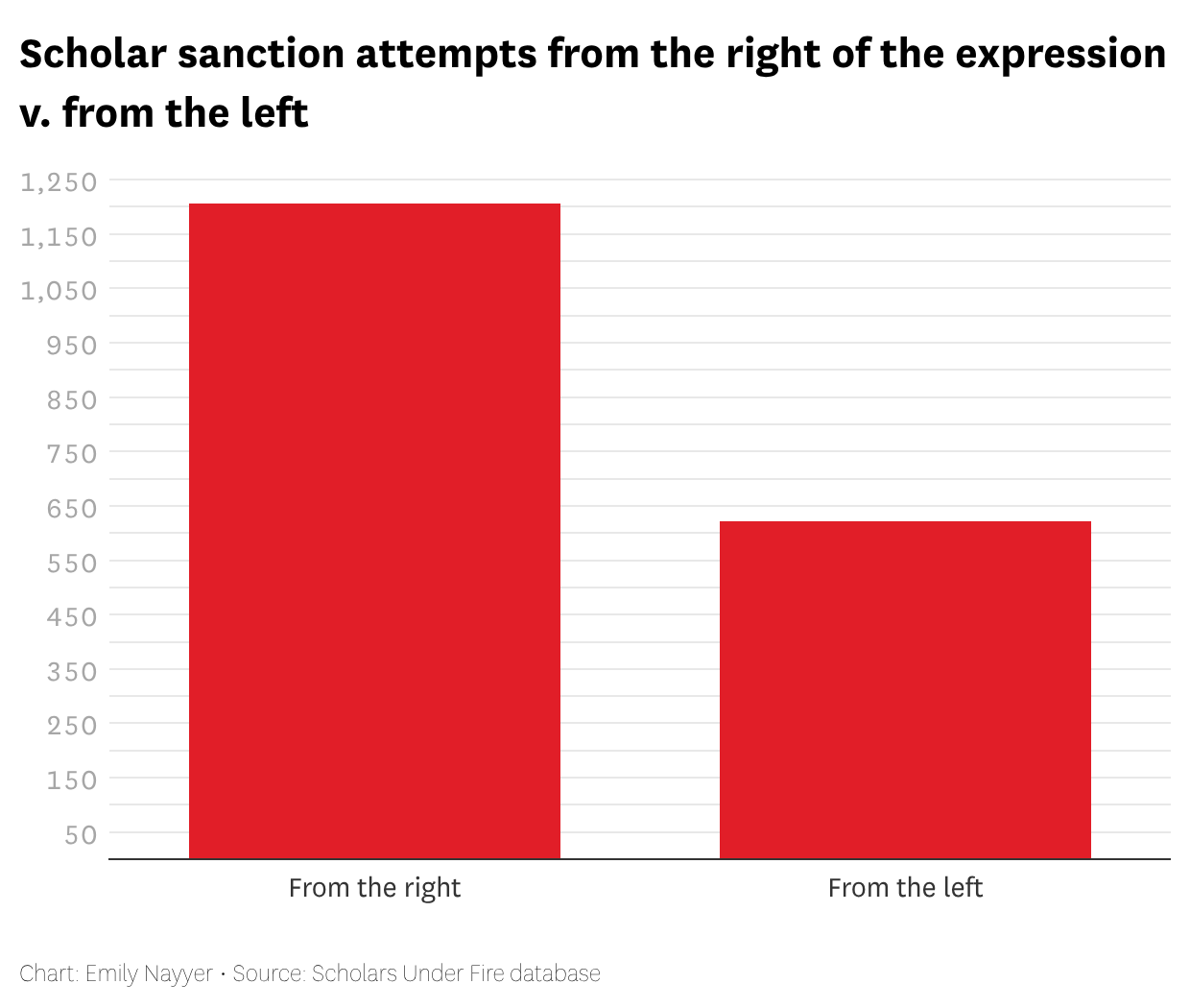
Drawing upon data from our Scholars Under Fire database, we found some notable trends. The first is that sanction attempts are more likely to come from the right of the scholar’s expression than from the left.
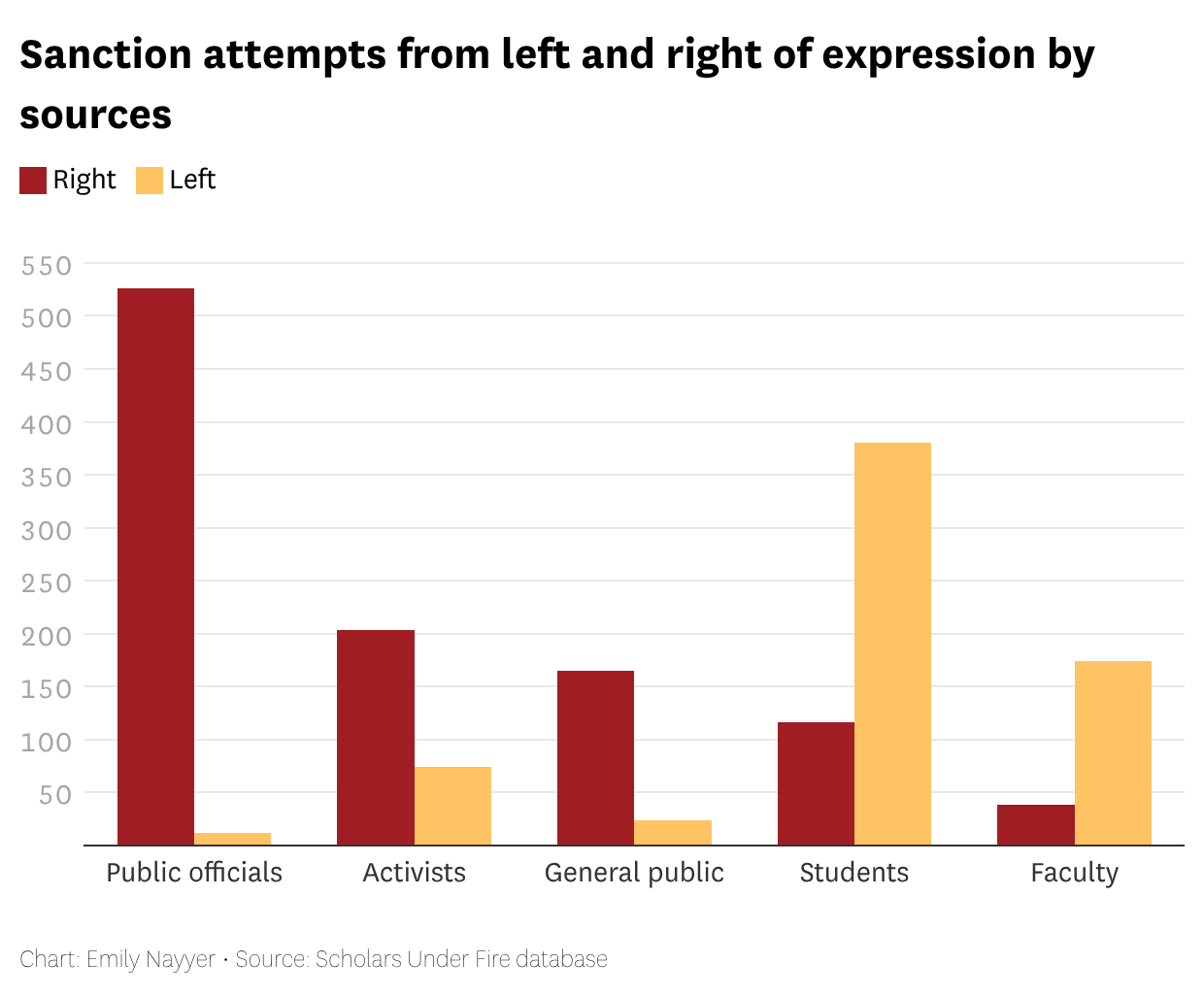
The second is that sanction attempts from the right are more likely to involve off-campus actors, while attempts from the left are more likely to involve on-campus actors.
Almost half of the sanction attempts initiated from the right of the scholar’s expression involve public officials, and about three-quarters involve public officials, activists, and/or members of the general public. On the other hand, 61% of the attempts initiated from the left of the scholar’s expression involve students, and 89% involve students and/or faculty.

Scholar sanctions "by the numbers," R >> L.....
Really, guys? Who does the left have to sanction except the right? What percentage of "scholars" are left v right? How about doing it as a per capita figure? How about looking at percentage of conservative vs. progressive "scholars" get sanctioned? Wanna put a couple bucks on that one?
As for political bias in AI, I've found that if you beat them up pretty hard, they'll stop with the bias and respond rationally. Until then, bias. For sure.
I wouldn't go so far as to say or imply that SCOTUS in Hustler Magazine v. Falwell (1988) said anything like "parody is not a statement of fact made with 'actual malice.' " SCOTUS was far more restrained: "The jury" (not SCOTUS) had concluded that the portrayal of Falwell could not "reasonably be understood as describing actual facts about [Falwell] or actual events in which [he] participated." That particular jury reached a conclusion based on the facts of that particular case. A different jury in a different case could reach the opposite result regarding a different form of parody.
In Hustler, SCOTUS emphasized that our Constitution precludes punishing or penalizing criticism of any public servant (any government employee) or any socially powerful or influential person without proof of material facts establishing how the criticism constituted a "falsehood." Falwell had failed to prove any false statement or implication of fact. But that is not at all the same thing as saying that any speech that is labeled "parody" cannot be a statement of fact. That conclusion, like beauty, is in the eye of the beholder.
Another way to put how to properly analyze such speech is to ask whether it caused actual harm (because people were deceived and believed that a falsehood was true) or whether it caused mere hurt (because people laughed). Was the speech harmful deception or mere hurtful derision? Falwell improperly focused on the latter (claiming "intentional infliction of emotional distress").