


After Charlie Kirk’s assassination last year at Utah Valley University, FIRE documented about 90 attempts to sanction scholars — mostly for their social media comments about Kirk’s life and death. As we noted, many of these attempts were initiated by public officials. They also contributed to the highest-ever recorded total of scholar sanction attempts in the history of our Scholars Under Fire database, which spans over a quarter of a century and contains almost 2,000 entries, including 322 campaigns that resulted in a termination.
Just like FIRE’s Campus Deplatforming Database, which we explored last week, there are notable trends in the Scholars Under Fire data.
The first is that sanction attempts are more likely to come from the right of the scholar’s expression than from the left.
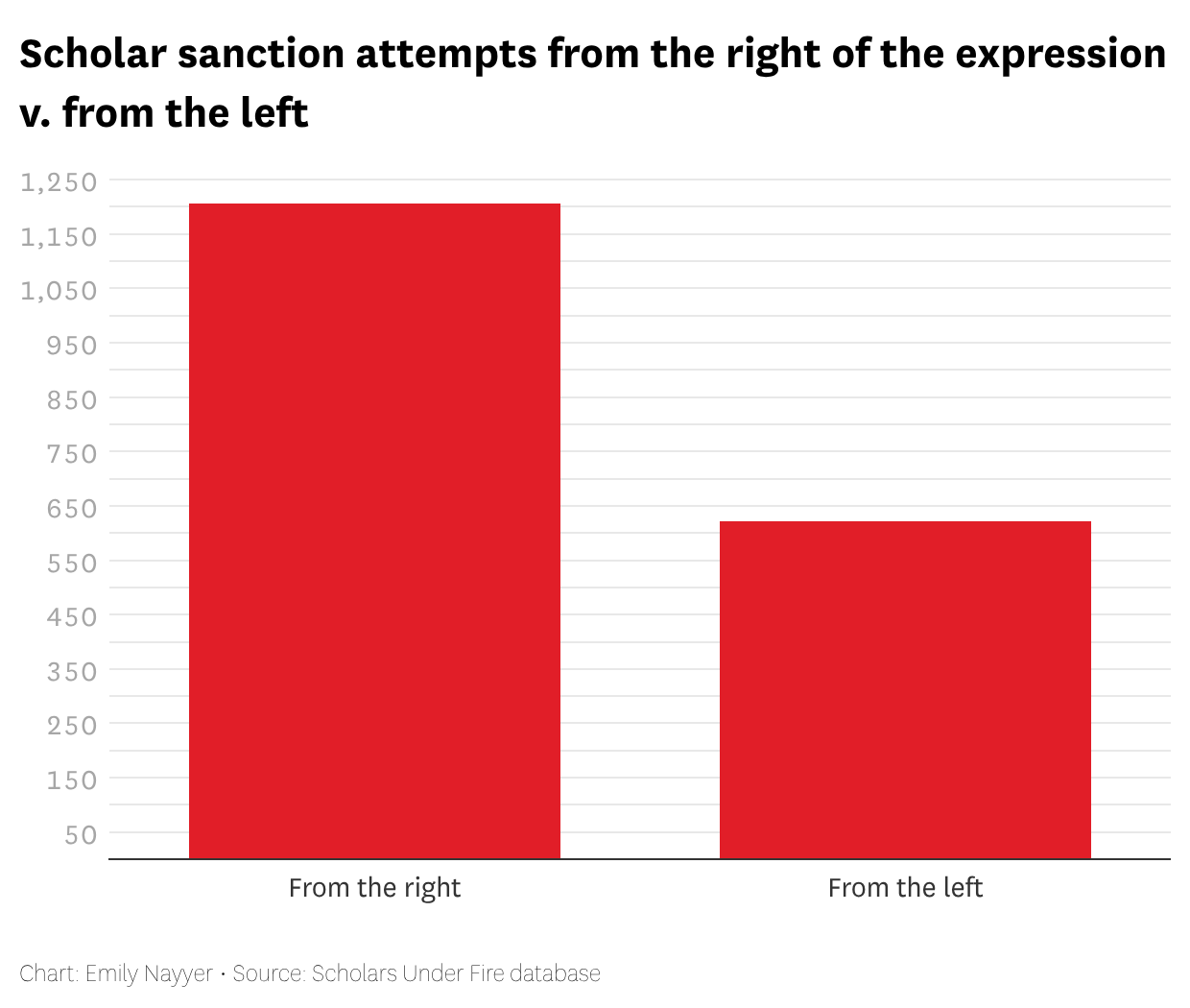
Almost half (44%) of the sanction attempts initiated from the right of the scholar’s expression involve public officials, and about three-quarters involve public officials, activists, and/or members of the general public. On the other hand, 61% of the attempts initiated from the left of the scholar’s expression involve students, and 89% involve students and/or faculty.
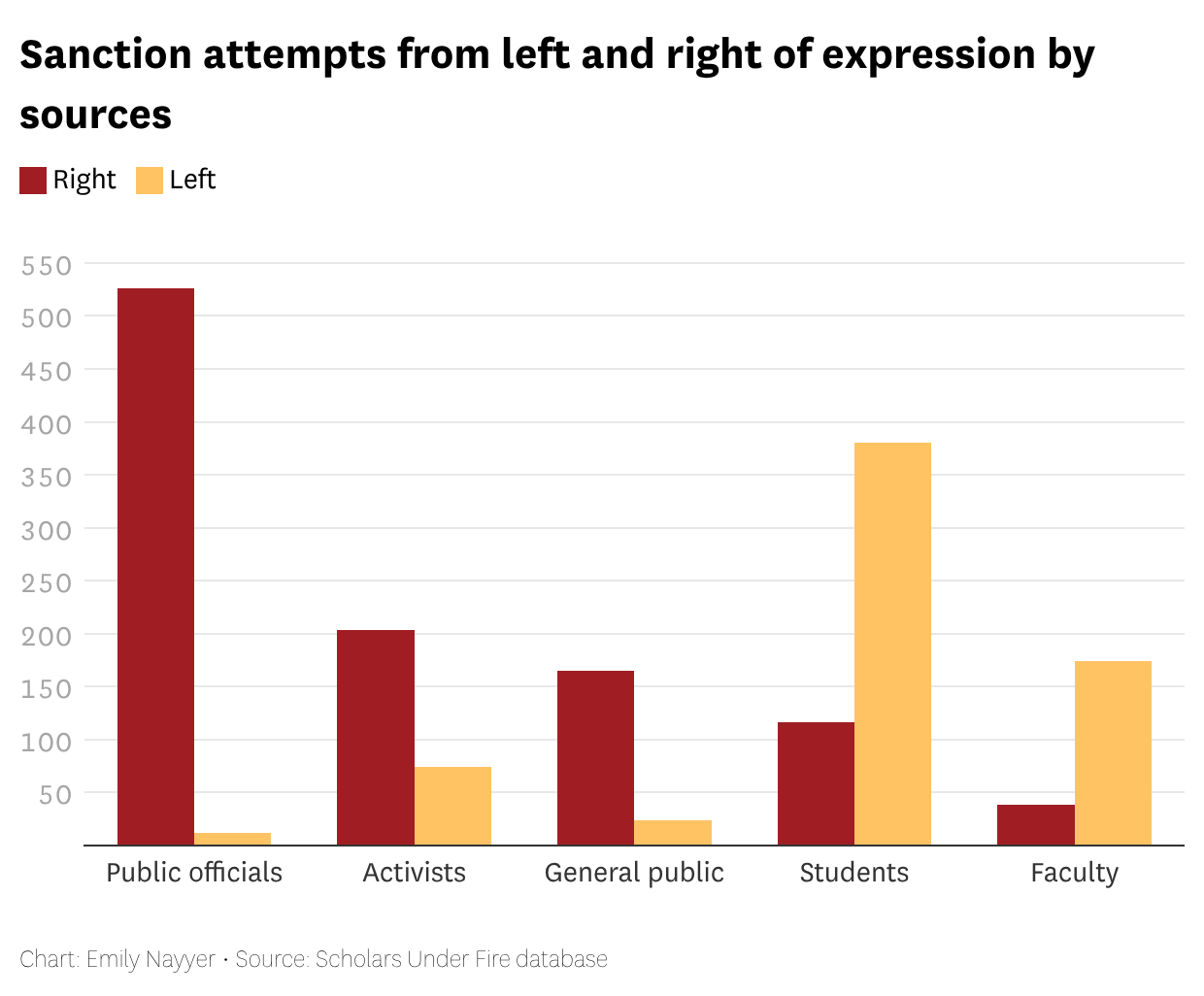
In other words, sanction attempts from the right are more likely to involve off-campus actors, while attempts from the left are more likely to involve on-campus actors.
This is similar to a pattern found in FIRE’s Campus Deplatforming Database — efforts to deplatform speakers and events that come from the left of the expression typically involve students and faculty, while efforts from the right of the expression typically come from public officials, activists, alumni and/or the general public. Scholar sanction attempts, however, are more likely to be successful than deplatforming attempts — with about three-quarters of the former (1,456 of 1,935) succeeding compared to roughly half of the latter (946 of 2,064).
It’s important to note that a handful of events are responsible for almost 600 of the scholar sanction attempts FIRE has recorded:
In the aftermath of George Floyd’s murder in 2020, over 100 scholar sanction attempts occurred due to expression regarding Floyd specifically or race more generally. Most of these attempts came from the left of the scholar’s expression.
The temporary removal of almost 400 books — most of which were authored, co-authored, edited, or co-edited by scholars — from the shelves of the Naval Academy’s Nimitz Library in early 2024 following directives from the Pentagon to comply with President Trump’s executive orders opposing diversity, equity, and inclusion efforts. These attempts came from the right of the scholar’s expression.
The aforementioned assassination of Kirk at Utah Valley University and the subsequent targeting of scholars for their social media comments about Kirk’s life and death. All of these attempts came from the right of the scholar’s expression.
At the same time, it is alarming that four of these five mass incidents have occurred over the past year and a half and that each one of these involved public officials.
This points to a troubling conclusion. Disputes over scholars’ speech are no longer confined to campus protests, faculty complaints, or calls for administrators to act. Increasingly, public officials are intervening directly — investigating faculty bodies, removing scholarly works, pressuring institutions, and seeking punishment for expression they disfavor.
The political direction of these campaigns matters, and the data should make us skeptical of claims that censorship is the exclusive province of either the left or the right. But the source of the pressure matters, too. When government officials use the power of the state to target scholars or institutions because of their expression, the threat extends beyond any individual controversy. It places academic freedom itself at the mercy of political power.
Universities should not punish scholars simply because their speech provokes outrage, attracts outside pressure, or becomes politically inconvenient. And defenders of free expression should apply that principle consistently — especially when the speaker’s views are unpopular, offensive, or opposed to their own. The Scholars Under Fire data show how often institutions fail that test. The recent surge in government-driven campaigns shows why passing it has become more urgent than ever.

Will FIRE and Greg Lukianoff defend Shiloh Hendrix? She has been convicted of Disorderly Conduct for saying mean things to a Somali sex offender who was filming her and her child, a month after his charges were dropped by the same Minnesota justice system that prosecuted her. Shiloh’s sentence is 90 days in prison (suspended), $1,000 fine, 200 hours community service, and probation - this is a test for all people and organizations who claim they defend free speech.
It may (may) be the case that outside influence is being exerted simply because there is no influence *within* the university structure. So efforts to institute change cannot happen internally. This does not excuse heavy handed interference. But the topic has more nuance than black and white statistics.