


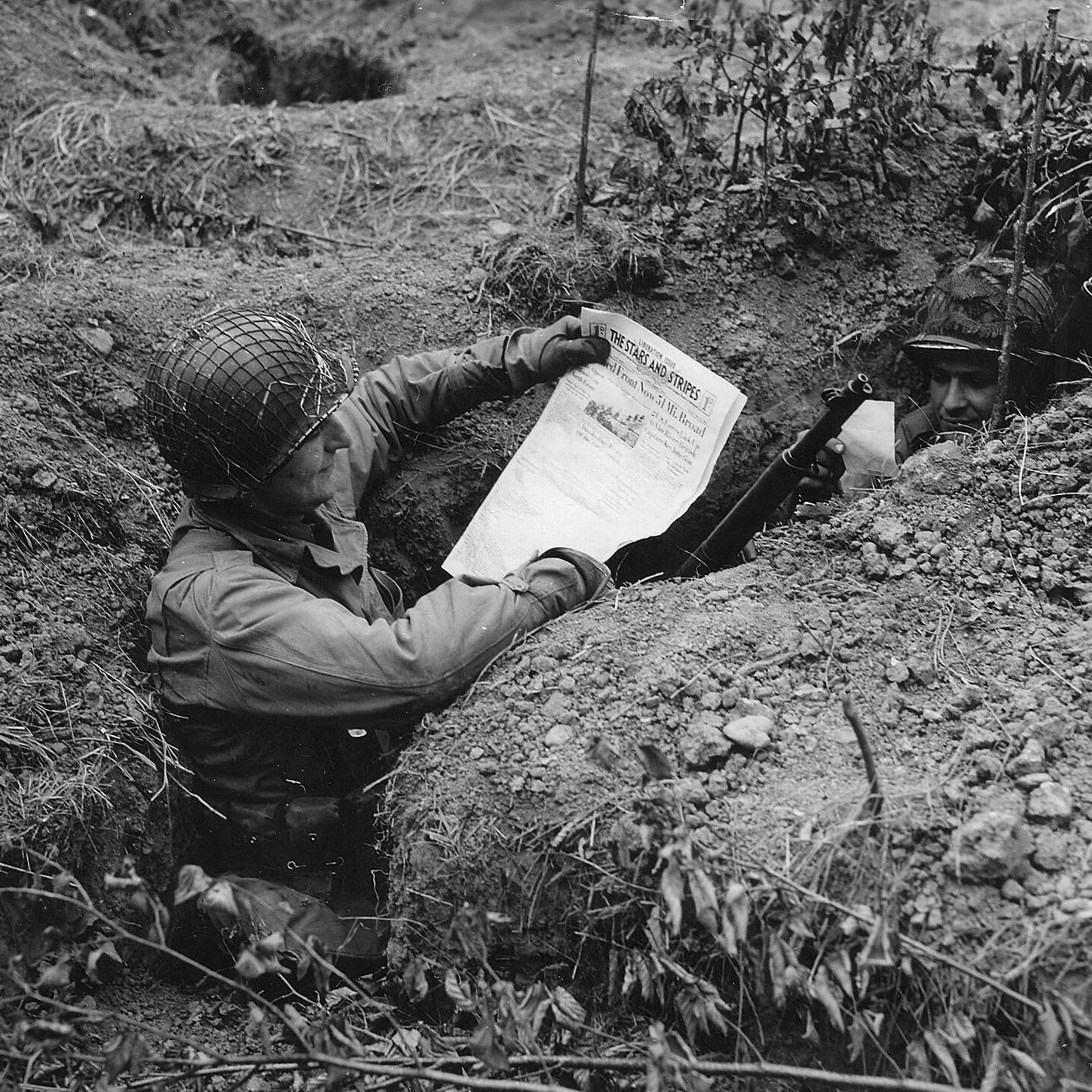
At the height of World War II, Gen. Dwight D. Eisenhower didn’t want the military’s independent newspaper to become a propaganda tool. He expected his subordinates to keep their “hands off” Stars and Stripes. More than 80 years later, the Pentagon has fired the newspaper’s leaders after they publicly defended that very principle.
Last week, the Pentagon fired Erik Slavin, editor-in-chief of Stars and Stripes, for “insubordination.” Slavin says he was fired for telling CBS in a recent interview that it would be a “red line” if the government told him, “Don’t run a perfectly accurate story. Run this instead. Here it is, written by the Pentagon.” The Pentagon also fired Middle East reporter Lara Korte and publisher Max Lederer. In announcing his retirement just days before, Lederer had said the paper’s “value and mission” differed “in fundamental ways” from the direction of the Pentagon’s leadership.

Eisenhower protected the paper because he understood that soldiers who cannot read the truth cannot be trusted to fight for it. Servicemembers now have reason to wonder whether what they are reading is independent news, or something the chain of command has approved before it reaches the press.
Stripes is funded and operated by the military, but the Department of Defense itself imposed rules for decades requiring the paper to operate independently of military command, with “a free flow of news and information.” The rules also explicitly gave Stripes reporters the same right as commercial journalists to ask questions and gain access.
Stripes wasn’t always fully independent. Though the original was founded to provide news to servicemembers on World War I’s Western Front, it was mired in censorship. The paper’s Board of Control battled the editorial leadership over content, with its founding officer Guy T. Viskniskki removing stories that might hurt morale on the front. However, other sources — including the paper’s final issue during this initial run — claim it maintained editorial independence. The paper was shut down at the end of the war, but the idea that the military could offer an independent newspaper survived.
In 1942, when Eisenhower helped revive the paper, Gen. George C. Marshall called it “a symbol of the things we are fighting to preserve and spread in this threatened world. It represents the free thought and free expression of a free people.”
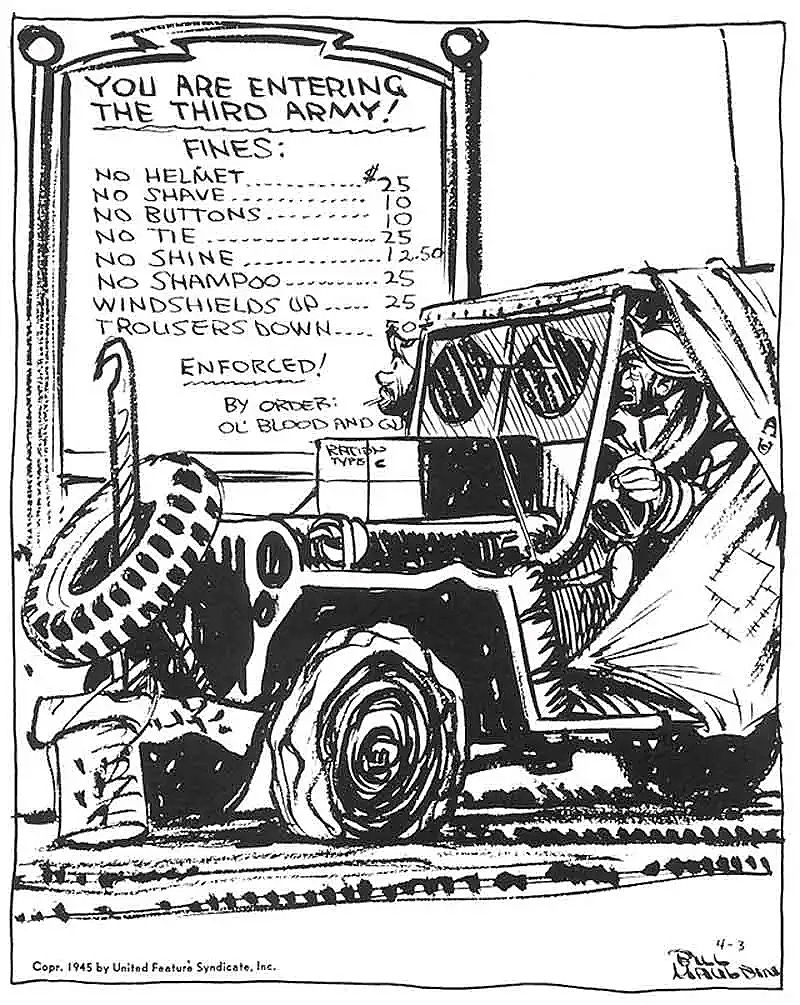
Eisenhower enforced that principle. In 1945, Gen. George S. Patton threatened Stripes cartoonist Bill Mauldin over his “Willie and Joe” comic strip, in which Mauldin mocked Patton’s strict rules requiring frontline soldiers to remain clean-shaven at all times. Patton called the cartoon characters “goddam bums,” berated Mauldin in his office for 45 minutes, and threatened to throw him in jail. But Gen. Eisenhower, then the supreme allied commander in Europe, told Patton to back off.
The tension didn’t disappear after World War II, and it became especially vivid in Vietnam. In a 1970 article filed from Saigon, Stripes reporter Bob Hodierne wrote how a soldier whose company had been mauled at Hamburger Hill probably knew less about the battle than his mother back in Des Moines. That is, unless he was lucky enough to get his hands on a copy of the Pacific Stars and Stripes. “Stripes was the one place,” he explained, “that G.I.’s could sometimes read about the shooting, bleeding, bombing, gassing, dying, and killing.”
Hodierne added, “Daily calls to the paper’s Saigon bureau about stories that just didn’t do the military any good were so common that if a day went by when one didn’t come in, the civilian bureau chief, Pat Luminello, would fret.”
One senior officer objected to the paper calling Hamburger Hill “Hamburger Hill,” rather than using the military designation “Hill 971.” Another senior officer was more up front about the basic problem, repeatedly complaining that “Stripes reporters asked questions.”
But that was, of course, the whole point. The military didn’t need another publication that simply repeated what commanders wanted troops to hear. Servicemembers already had official channels for that. What they needed was a newspaper that would tell them what was happening, including what was going wrong.
By the late 1980s, recurring allegations of censorship and command influence became serious enough for Congress to investigate. It instructed the Department of Defense to “manage” the “inherent conflict” between censorship and military objectives. Shortly thereafter, the DoD codified regulations requiring Stripes to operate free from “news management or censorship,” complete with a civilian editor.
The Pentagon has now dismantled much of that framework. On Jan. 15, it removed the old regulation from the federal rulebook, saying the same rules would now be covered by a separate Defense Department directive. But a March 9 memo imposed new restrictions on what Stripes could publish, banning wire-service and syndicated content (even cartoons), restricting FOIA requests, imposing a “good order and discipline” standard, and expanding Defense Department oversight of editorial decisions.
Then when Slavin and Lederer raised concerns about this, the Pentagon fired them. The Pentagon also fired Korte for covering topics the administration disfavors — including, of all things, Bad Bunny concerts. And when ombudsman Jacqueline Smith, the person tasked with defending the paper’s independence, criticized the rule change, the Pentagon fired her too. All because the Pentagon wants to eliminate purported “woke distractions” at the paper.
Announcing the rule change, the Pentagon’s top public affairs official Sean Parnell posted on X:
We will modernize its operations, refocus its content away from woke distractions that siphon morale, and adapt it to serve a new generation of service members. Stars & Stripes will be custom tailored to our warfighters. It will focus on warfighting, weapons systems, fitness, lethality, survivability, and ALL THINGS MILITARY.
Stripes has always focused on “warfighting.” That’s not what’s at issue. What is in dispute is whether those boys at Hamburger Hill had the right to know what they had survived just as well as their mothers back home. It’s a dispute about whether the paper will continue to represent a beacon of press freedom within the world’s most powerful military.
Where World War I officers censored content to improve morale, their World War II counterparts declined to censor for the same reason. Eisenhower and his compatriots realized that morale depends on credibility, because you can’t inspire someone to push on if they don’t believe what you’re saying. True morale derives from the spirit of freedom: the enduring feeling of control over what you say, read, and think. At its best, Stars and Stripes harnessed that feeling for servicemembers. It exemplified that true freedom of speech and freedom of the press lies in the ability to speak critically about your country — even (and especially) during wartime.

Two of the biggest blind spots in most Americans' conception of the freedom of expression and communication pertain to soldiers and lawyers.
Far too many judges routinely presume or pretend that something gave them the power to punish lawyers for criticism that judges find merely offensive. Taking that absurd thinking to an even more absurd new level, in 2024, thirteen federal judges (led by the Fifth Circuit's Judge Ho and the Eleventh Circuit's Judge Branch) very publicly pretended that something in our Constitution somehow gave judges the power to impose extrajudicial punishment on even law students and even law schools for merely exercising their freedom of association to attend universities that also happened to be attended by other students whose expression the judges found merely offensive for personal religious reasons. See, e.g., https://davidlat.substack.com/p/columbia-law-clerk-clerkship-hiring-boycott?r=30ufvh&utm_campaign=post&utm_medium=email&triedRedirect=true
Following the example of those judges, Trump has attacked lawyers and law firms by pretending that something in our Constitution somehow gave him the power to retaliate against them for their prior exercises of the freedom of expression and communication or their current exercises of the freedom of association.
Now, Trump and his supporters are pretending that something in our Constitution somehow gave them the power to retaliate against federal employees at a government-operated newspaper for merely exercising our freedom of expression and communication (including by expressing the intention to continue exercising such freedom). But SCOTUS precedent has long emphasized the opposite, and such precedent necessarily protects even lawyers and even soldiers.
In Connick v. Myers in 1983, for example, SCOTUS re-emphasized that even "a public employee does not relinquish First Amendment rights to comment on matters of public interest by virtue of government employment." No government entity has any power to "condition public employment on a basis that infringes the employee's constitutionally protected interest in freedom of expression."
"The First Amendment 'was fashioned to assure unfettered interchange of ideas for the bringing about of political and social changes desired by the people." It is crucial to our Constitution that the People and our public servants understand the fundamental principle that "[Speech] concerning public affairs is more than self-expression; it is the essence of self-government," which is the point of the entire U.S. Constitution. So SCOTUS repeatedly has emphasized that "speech on public issues occupies the 'highest rung of the heirarchy [hierarchy] of First Amendment values," and it "is entitled to special protection." Consistent with our Constitution, "free and open debate is vital to informed decisionmaking by the electorate."
In 2006, SCOTUS based Garcetti v. Ceballos on Connick v. Myers and emphasized the following. Any "citizen who works for the government is nonetheless a citizen. The First Amendment limits the ability of a public employer to leverage the employment relationship to restrict, incidentally or intentionally, the liberties employees enjoy in their capacities as private citizens." "So long as employees are speaking as citizens about matters of public concern, they must face only those speech restrictions that" the government proves "are necessary for their employers to operate efficiently and effectively." It's not possible for Trump and Hegseth to prove that censoring or retaliating against employees of any newspaper for their expression is "necessary" for the U.S. Armed Forces "to operate efficiently and effectively."
Now seems like an especially appropriate time for Americans to also bear in mind the wit and wisdom of Justice Jackson writing for SCOTUS in 1943 in West Virginia State Board of Education v. Barnette (https://supreme.justia.com/cases/federal/us/319/624/).
The First and Fourteenth Amendments make it a “fixed star in our constitutional constellation” that “no official” (no public servant) “can prescribe what shall be orthodox in politics” or “religion” or “other matters of opinion or force citizens to confess by word or act their faith therein.”
The “freedom to differ is not limited to things that do not matter much. That would be a mere shadow of freedom. The test of its substance is the right to differ as to things that touch the heart of the existing order.”
“There are village tyrants as well as village Hampdens, but none who acts under color of law is beyond reach of the Constitution.”
"The very purpose of a Bill of Rights was to withdraw certain subjects from the vicissitudes of political controversy, to place them beyond the reach of [all] officials [and even of all "majorities," i.e., any faction of the people, themselves] and to establish them as legal principles to be applied by the courts. One’s right to life, liberty, and property, to free speech, a free press, freedom of worship and assembly, and other fundamental rights may not be submitted to vote; they depend on the outcome of no elections."
The “freedoms of speech and of press” are “susceptible of restriction only to prevent grave and immediate danger to interests which the state may lawfully protect.”
"Those who begin coercive elimination of dissent soon find themselves exterminating dissenters. Compulsory unification of opinion achieves only the unanimity of the graveyard."
Every American should understand that "the First Amendment to our Constitution was designed to avoid these ends by avoiding these beginnings. There is no mysticism in the American concept of the State or of the nature or origin of its authority. We set up government by consent of the governed, and the Bill of Rights denies those in power any legal opportunity to coerce that consent. Authority here is to be controlled by public opinion, not public opinion by authority."